
The Social Shield: Hardening Reputation Systems with Social Graphs
Security challenges for reputation mechanisms using online social networks
This paper explores the integration of Online Social Networks (OSNs) into reputation mechanisms for e-commerce to combat fraud. It highlights how network topology and social trust links can be leveraged via algorithms like PageRank or filtering techniques to identify reliable participants and mitigate sybil attacks.
TL;DR
Trust is the lubricant of digital trade, yet traditional 5-star rating systems are easily gamed by cliques and bots. This paper argues that by mapping participants into an Online Social Network (OSN), we can use the "structural cost" of friendship to make reputation manipulation prohibitively difficult. By analyzing network topology, we can filter out biased "buddy" ratings and identify "sybil" identities that lack genuine social roots.
Background: The Trust Deficit in Anonymity
In peer-to-peer e-commerce, the seller often holds an information advantage. We rely on reputation to bridge this gap. However, the online world suffers from two major vulnerabilities:
- Sybil Attacks: Creating 1,000 bots to upvote a mediocre service is nearly free.
- Collusion: Friends rating friends highly, regardless of actual performance.
The author posits that social networks offer a unique solution because social ties are hard to fake at scale and carry intrinsic value to the user—one is unlikely to burn a real professional or social identity just to boost a temporary eBay score.
Methodology: Two Paths to Integrity
The paper outlines two primary ways to weaponize social graphs for trust:
1. Structural Reputation (Implicit Trust)
Instead of asking for a rating, we look at where a user stands in the network. If "trustworthy" people link to you, your reputation rises.
- The PageRank Logic: Just like Google ranks pages based on who links to them, we can rank people. A link from a high-reputation user is worth more than a link from a bot. This makes "spoofing" via local property changes (like adding 10 fake friends) ineffective against global structural analysis.
2. Social Filtering (Explicit Trust)
When a user looks at a vendor's rating, the system filters the results based on the viewer's social distance.
- The "Anti-Bias" Filter: The system can automatically discard ratings from people who are too close (e.g., distance < 3) to the seller. This forces would-be colluders to find "strangers" to lie for them, which is significantly harder than asking a friend.
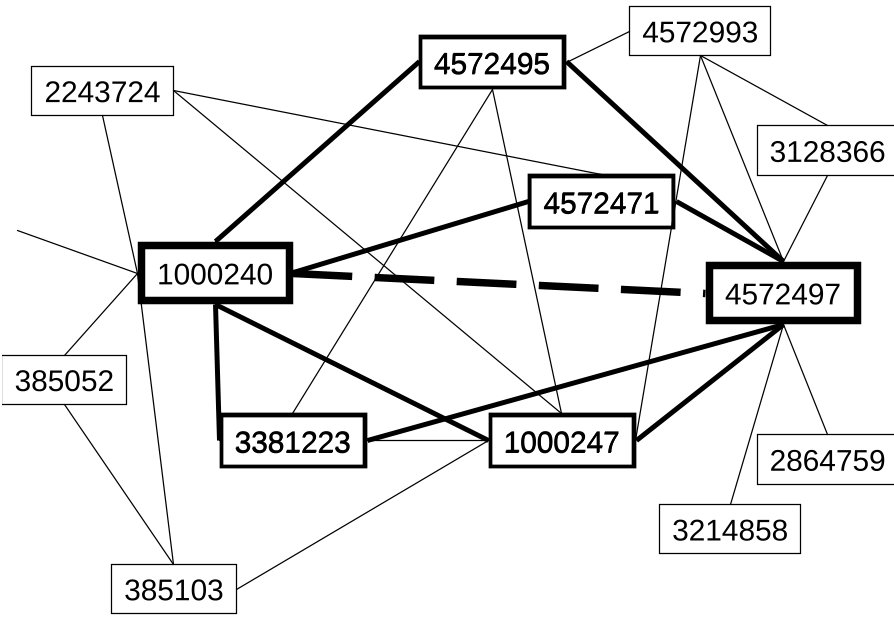 Figure 1: Even if two colluders try to hide their link (dashed line), the "high clustering" of social networks usually reveals their connection through mutual friends (thick solid lines).
Experimental Insight: The Cost of Disconnecting
The author analyzed the BuddyZoo and Essembly datasets to see if users could "cheat" the system by simply not declaring their friends.
- Findings: Most people are so tightly knit that removing a single link doesn't hide the relationship. In BuddyZoo, friends shared an average of 4 mutual acquaintances. To hide a relationship from a "friend-of-friend" filter, you’d have to convince those 4 people to also delete their links—a high social cost for a minor reputation gain.
Critical Analysis: The Privacy Paradox
While social-network-based reputation is robust, it faces a massive Privacy Challenge. If a system needs to know all your friends to calculate your reliability, it becomes a surveillance tool.
The author suggests two paths forward:
- Trusted Third Parties: Centralized hubs (like Facebook/LinkedIn) act as the arbiter.
- Decentralized Computation: Using cryptographic methods (like Secure Multi-Party Computation) to calculate a "trust score" without ever revealing the underlying raw social graph to any single participant.
Conclusion: A Networked Future for Trust
Tad Hogg’s work serves as a foundational reminder that reputation is not just a number—it is a reflection of social context. By moving away from "global averages" toward "personalized social trust," platforms can create environments where honesty is the most profitable strategy.
The future of this field lies in decentralized identities (DID) where users own their social graphs and carry their "honesty scores" across different marketplaces without sacrificing total privacy.