
Safebook: Reclaiming Privacy via Decentralized "Matryoshka" Networks
On the Security and Feasibility of Safebook: A Distributed Privacy-Preserving Online Social Network
The paper proposes Safebook, a decentralized Online Social Network (OSN) architecture designed to protect user privacy from centralized service providers and malicious intruders. By leveraging real-life trust relationships and a novel "Matryoshka" multi-hop routing mechanism, it provides a functional SNS without a central omniscient server.
TL;DR
Safebook is a decentralized social network architecture that eliminates the "Big Brother" service provider. By organizing your trusted friends into concentric protective shells—resembling a Russian Matryoshka doll—it hides your identity and social graph from the underlying network, achieving privacy through cooperative P2P decentralization.
The "Big Brother" Problem in Modern OSNs
In current Online Social Networks (OSNs) like Facebook or LinkedIn, the service provider is an omniscient entity. Even if you use the strictest privacy settings, the provider still owns your data, knows your friends, and tracks your interactions. This centralized architecture creates a single point of failure:
- Single Point of Breach: A provider-side hack exposes everyone.
- Data Exploitation: Providers can (and do) monetize private social graphs.
- Social Engineering: Attackers can easily clone profiles because trust is anchored in the central database, not real-world verification.
Safebook challenges this by asking: Can we build a social network that reflects the decentralized nature of real-life friendships?
Methodology: The Matryoshka Architecture
The core innovation of Safebook is the Matryoshka. Instead of connecting directly to a central server, your social presence is protected by layers of peers.
1. The Core and Shells
- The Core: The user node itself.
- Inner Shell (Mirrors): Your direct, trusted friends. They store your encrypted data and serve it when you are offline.
- Outer Shells (Prisms & Entrypoints): Friends of friends who act as relays. They route requests into the core without knowing whose profile they are actually serving.
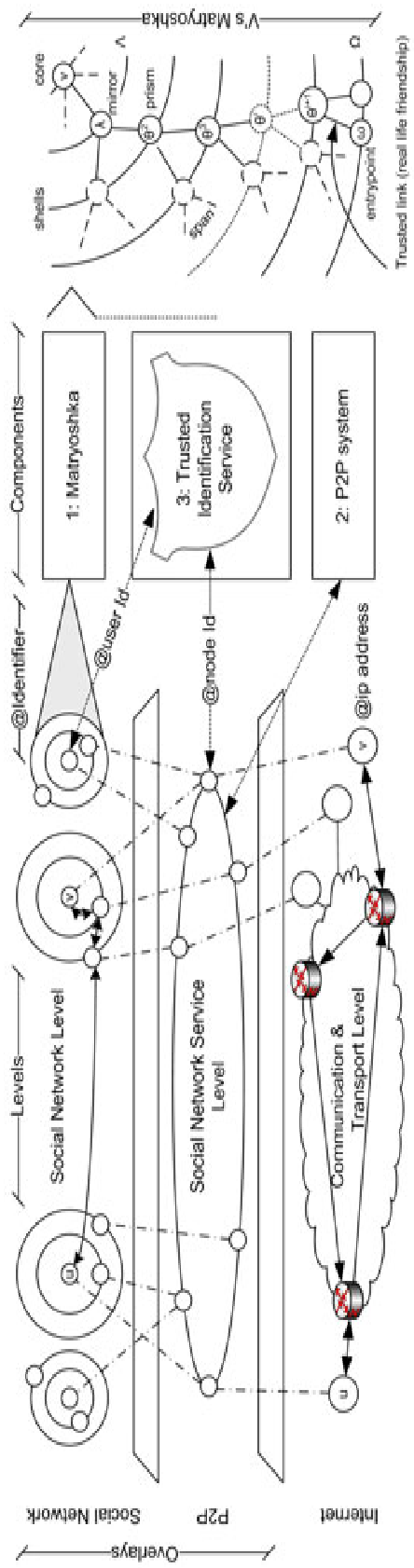 Figure: The layered model of OSNs and the Matryoshka shell structure.
2. Separation of Identifiers
Safebook splits a user's identity into two:
- Node ID: Used for routing in the Kademlia-based P2P substrate.
- User ID: Used for social interaction and end-to-end encryption. Only your trusted contacts can link these two, ensuring that a random node on the internet cannot trace your physical IP to your social profile.
Feasibility: Does it Actually Work?
A major critique of decentralized systems is performance and availability. If your friends go offline, does your profile disappear?
Data Availability
The authors used a geometric probability model to calculate availability. They found that a "Spanning Factor" (the number of outgoing connections per node in the shell) is critical. With a span of 2, even if nodes have low uptime (30%, similar to Skype users), a user only needs about 13-23 mirrors to maintain 90% data availability.
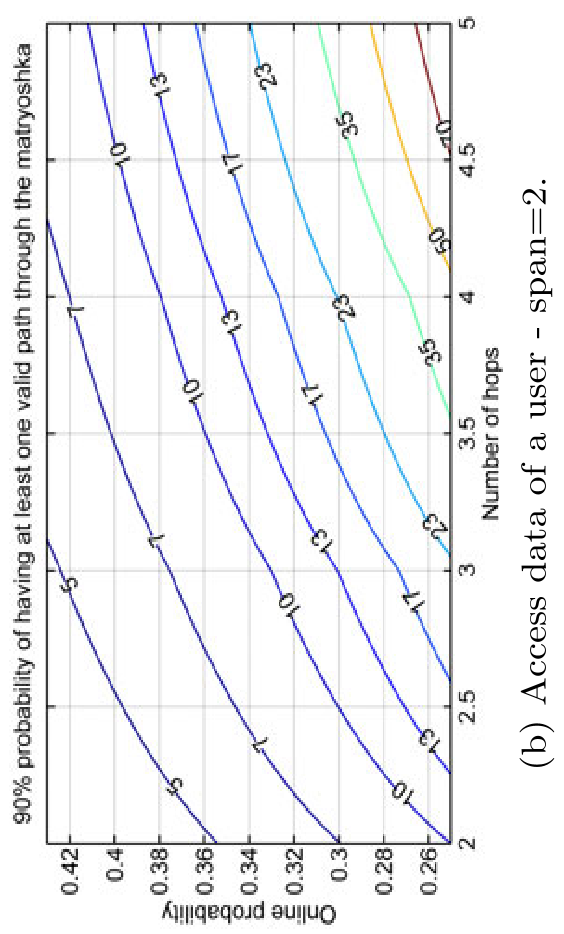 Figure: Reachability and data availability metrics based on Shell count and Spanning factors.
Latency
By simulating a 9-hop journey (4 hops in the DHT lookup + 4 hops through the Matryoshka + 1 delegation hop), the results show that 90% of requests succeed in roughly 6 to 10 seconds. While slower than a centralized server, this is acceptable for non-real-time social browsing.
Security & Privacy Insights
Safebook offers several levels of protection:
- Unlinkability: Because requests are routed recursively through shells, an entry point has no idea if it is serving a request for its direct neighbor or someone 3 hops away.
- Cooperation Incentives: Unlike anonymous TOR-like systems where "altruism" is required, Safebook relies on real-life trust. You forward messages for your friends because they are your friends.
- TIS (Trusted Identification Service): A lightweight service that issues certificates to prevent Sybil attacks (where one attacker creates thousands of fake nodes).
Conclusion & Future Outlook
Safebook is a pioneering step toward "un-siloing" social data. Its primary strength lies in its Inductive Bias: the assumption that trust in a digital network should mirror trust in the physical world.
Limitations:
- The dependency on a TIS (even if decentralized) remains a slight bottleneck.
- 6-10 seconds latency might struggle with the "infinite scroll" expectations of modern users.
However, as concerns over data sovereignty grow, the Matryoshka design provides a robust blueprint for the next generation of privacy-centric, peer-to-peer social ecosystems.