
PSACO: Breakthrough in Portfolio Optimization via Hybrid Swarm Intelligence
Study of Security Investment Optimizing Combination Based on PSACO
This paper introduces PSACO (Particle Swarm Ant Colony Optimization), a hybrid swarm intelligence meta-heuristic designed for optimizing security portfolios. By integrating a pheromone-guided mechanism from ACO into the PSO framework, the method effectively solves a multi-factor portfolio model that incorporates real-world friction factors like transaction costs and taxation within the Chinese security market.
TL;DR
Modern financial markets are messy, filled with taxes, transaction costs, and regulatory constraints that the classic Markowitz model ignores. This paper introduces PSACO, a hybrid algorithm that marries the global exploration power of Particle Swarm Optimization (PSO) with the surgical precision of Ant Colony Optimization (ACO). Tested on the Chinese stock market, it provides a scientific framework for balancing risk and return under real-world "friction."
Background: Beyond the Ideal Market
In a "spherical cow" version of finance, investors only care about mean and variance. However, in reality, every trade costs money (transaction fees), the government takes a cut (taxes), and you can't always sell what you don't own (short-sale bans).
These constraints turn a simple math problem into a nightmare for traditional solvers. The authors argue that existing heuristics like Simulated Annealing or Genetic Algorithms often get stuck in local optima. Their insight? Use a "social" hybrid approach where particles find the general area of profit, and ants refine the path to the peak.
Methodology: The PSACO Engine
The core innovation is a two-stage search process that mimics both bird flocking and ant foraging.
1. PSO for Global Scouting
The algorithm starts with PSO, where particles fly through the multidimensional solution space. They update their velocity based on their personal best () and the global best ().
2. ACO for Local Refinement
Once PSO identifies a promising region, the ACO mechanism takes over as a local search probe. Ants generate new solutions using a Gaussian distribution centered around the global best position found by the particles:
As the generations pass, the standard deviation shrinks. This "pheromone-guided" focus allows the algorithm to hone in on the exact optimal weights for each stock, a level of precision PSO often lacks on its own.
Experiments & Real-World Application
The authors tested PSACO using four major stocks from the Shanghai and Shenzhen markets (including HP Group and Eastern Airlines). They factored in:
- Transaction Costs: 0.7%
- Taxes: Capital gains and basic income tax.
- No Short-Sells: Weights must be non-negative and sum to 1.
Key Results:
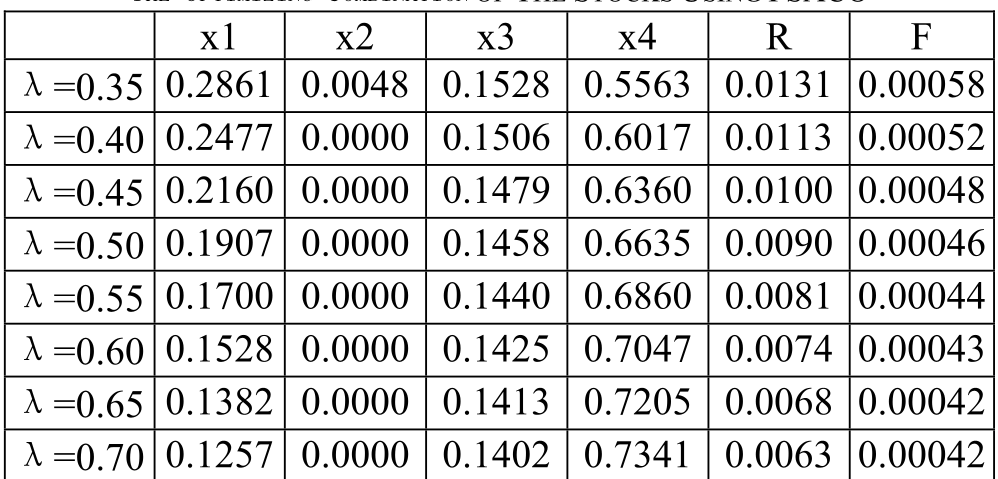
The model successfully traced the Efficient Frontier. As the risk aversion parameter () changed, the algorithm automatically reallocated assets:
- Low (Risk-Tolerant): Concentrated heavily on high-yield assets like 600664.
- High (Risk-Averse): Shifted weights toward 000880, which, despite lower yields, offered significantly lower variance.
| Parameter () | Expected Return (R) | Portfolio Risk (F) |
|---|---|---|
| 0.35 | 0.0131 | 0.00058 |
| 0.50 | 0.0090 | 0.00046 |
| 0.70 | 0.0063 | 0.00042 |
Critical Insight & Conclusion
The true value of this work lies in the hybridization philosophy. While PSO is excellent at avoiding local minima in high-dimensional spaces, it often "oscillates" near the optimum without settling. By introducing the pheromone-guided Gaussian search, the authors provide the "friction" necessary for the algorithm to stop and settle on a high-precision solution.
Limitations: The study uses a relatively small set of 4 stocks for the demonstration. In a modern portfolio consisting of hundreds of assets, the computational overhead of the ACO refinement stage might require further optimization or parallelization.
Future Work: This framework could easily be extended to include Cardinality Constraints (limiting the total number of stocks in a portfolio) or Sector Constraints, making it even more applicable for institutional fund managers.