
Bridging the Gap: A Security Model for Telco-Social Integration
A Security Model Proposal for a Social Communications Broker
This paper proposes a four-pillar security model for a "Social Communications Broker" that integrates Telco services with Online Social Networks (OSN). The model ensures privacy by bridging mobile identities (MSISDN) with social identities, validated through the "Movistar Contacta" Facebook pilot involving 1,000 users.
TL;DR
Mobile operators have a unique opportunity to "socialize" their services (calls, SMS) by integrating them with platforms like Facebook. However, the sensitivity of phone numbers creates a massive security hurdle. This paper proposes a Social Communications Broker—a gateway that bridges Telco networks and social networks using a four-factor security model to ensure privacy, prevent identity theft, and manage social permissions without leaking the user's MSISDN.
Problem & Motivation: The Identity Collision
We live in two parallel worlds:
- The Telco World: Built on MSISDNs (phone numbers) and SIM cards. It is highly secure but "siloed."
- The Social World: Built on URIs, friend graphs, and web identities. It is ubiquitous but historically privacy-starved.
The "Social Communications" concept attempts to merge these. Imagine calling a Facebook friend directly from their profile without ever seeing their phone number. The challenge is Trust. How do you verify that the person linking a phone number to a Facebook account actually owns that SIM? And how do you prevent the social network—or malicious actors—from harvesting those numbers?
Methodology: The Social Broker Architecture
The authors propose a Social Broker acting as the middleman. It consists of adaptors for Social Networks (SNA) and Operator Services (OSA).
1. Authenticating the "Link"
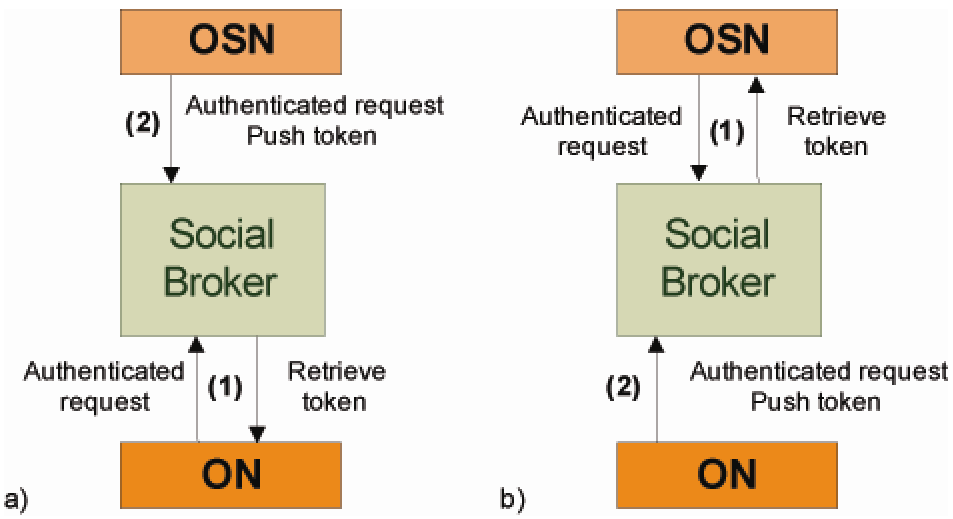
To securely bind a social ID to a phone number, the authors reject simple web forms. Instead, they propose a Token Interchange Mechanism.
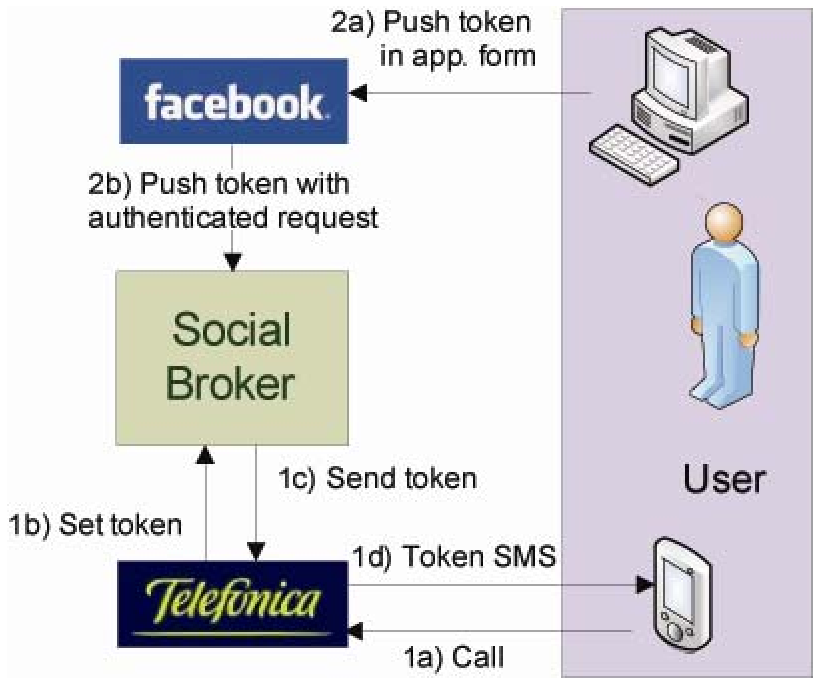
- The Logic: A user must perform two authenticated actions. One via the Telco network (e.g., receiving an SMS/Call) to get a token, and one via the OSN (e.g., entering that token into a signed web request).
- Why it works: It proves the user has physical possession of the SIM and authorized access to the social account simultaneously.
2. Physical Implementation & Privacy
To keep data safe, the Broker is deployed in a DMZ (Demilitarized Zone).
- Identity Hiding: The paper suggests using a "Social Communications Identifier" or a generic short-code (e.g.,
3225). When John Doe calls a friend via the app, the recipient sees "3225" and the name "John Doe," but never the actual phone number. This preserves the Anonymity of the MSISDN.
Experiments: The Movistar Contacta Pilot
The model was tested via Movistar Contacta, a Facebook app that allowed 1,000 users to send SMS and make calls from their browser.
Key Findings:
- Privacy is Paramount: 52% of users explicitly wanted to contact people without sharing their digits.
- Friction is the Enemy: The registration process (Call -> Get SMS -> Enter Code) was perceived as difficult. Users are often unwilling to read instructions in a fast-paced social environment.
- UX Evolution: To solve friction, the authors proposed QR Code scanning or OSN-side key generation to streamline the "Link Authentication."
Critical Analysis & Conclusion
The paper successfully identifies the "Identity Link" as the most vulnerable point in Telco-Social convergence. The security model is robust, particularly the use of timestamped signatures to prevent replay attacks on social requests.
Takeaways for the Future
- The Paradox of Security vs. Usability: High security often leads to low adoption in social contexts. The proposed move toward QR codes and one-click authentication is a necessary evolution.
- Telco as a Trust Provider: The operator's greatest asset isn't just the network; it's the Verified Identity. By acting as an identity broker, Telcos can remain relevant in an OTT-dominated world.
Limitations: While the model works for Facebook, differnet OSNs (like LinkedIn or X) have different API constraints. A universal "Social Broker" requires high adaptability across changing web standards.