
Securing the Social Graph: Closing the Gaps in OpenSocial Frameworks
Security in OpenSocial-Instrumented Social Networking Services
This paper presents a critical security analysis of the OpenSocial framework used by Social Networking Services (SNS) like LinkedIn and XING. It identifies significant vulnerabilities in data exchange and proposes a series of architectural extensions and best practices to protect user data from third-party application exploits.
TL;DR
As social networks transformed from closed silos into extensible ecosystems, the OpenSocial standard emerged to allow third-party developers to plug into the "Social Graph." However, this paper reveals that the specification is a "security sieve." The authors dissect how current protocols fall short in protecting user identity and data, proposing a roadmap for hardening these platforms via code signing, identity pseudonymization, and structural shifts in application architecture.
Background Positioning
In the landscape of web security, this work acts as a critical audit and expansion of the OpenSocial v0.9 specification. While the industry was rushing toward interoperability (the "write-once-run-anywhere" dream), this paper provides a sobering reality check on the privacy trade-offs inherent in third-party API access.
1. The Anatomy of an OpenSocial Ecosystem
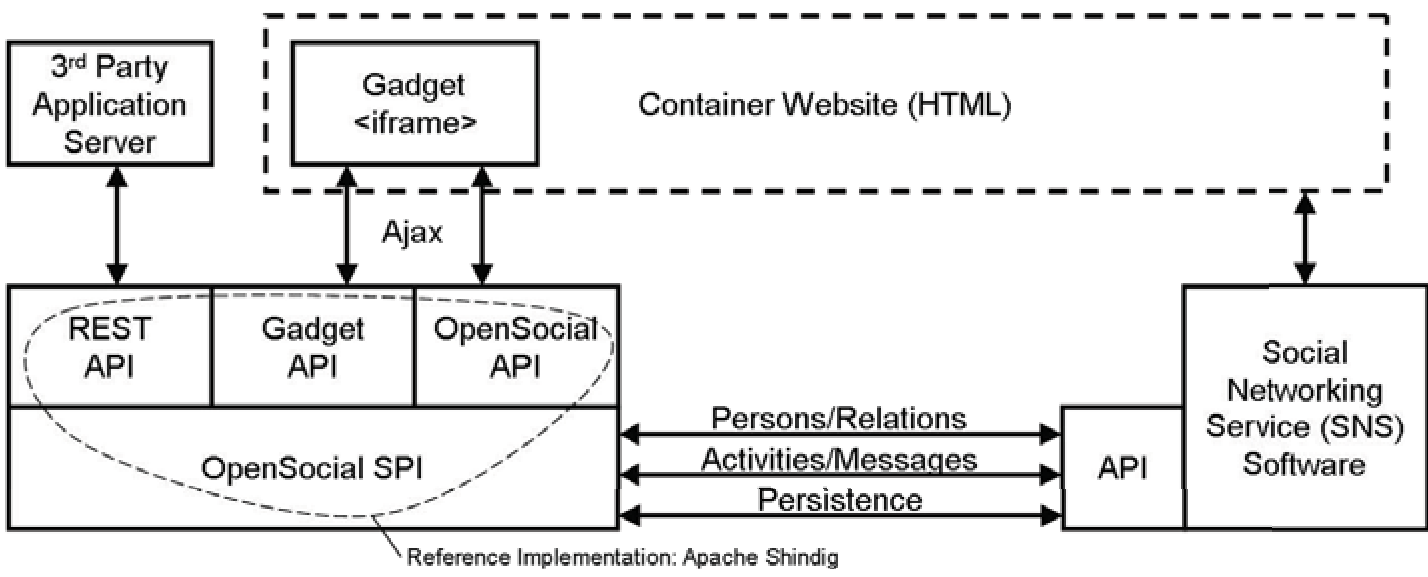
The paper defines three distinct application types that interact with a Social Networking Service (SNS), each with a different risk profile:
- Social Mashups: Lightweight, client-side only (HTML/JS). Risk: Low (Data stays in the browser/container).
- Social Applications: Rely on external third-party servers. Risk: Medium/High (Data leaves the SNS protection sphere).
- External Applications: Standalone apps (mobile/web) consuming RESTful APIs. Risk: High (Highest potential for unauthorized bulk data access).
2. Critical Pain Points: Why OpenSocial is Vulnerable
The authors identify a massive discrepancy between what is signed and what is processed.
The "Inconsistency" Attack (Signature Wrapping)
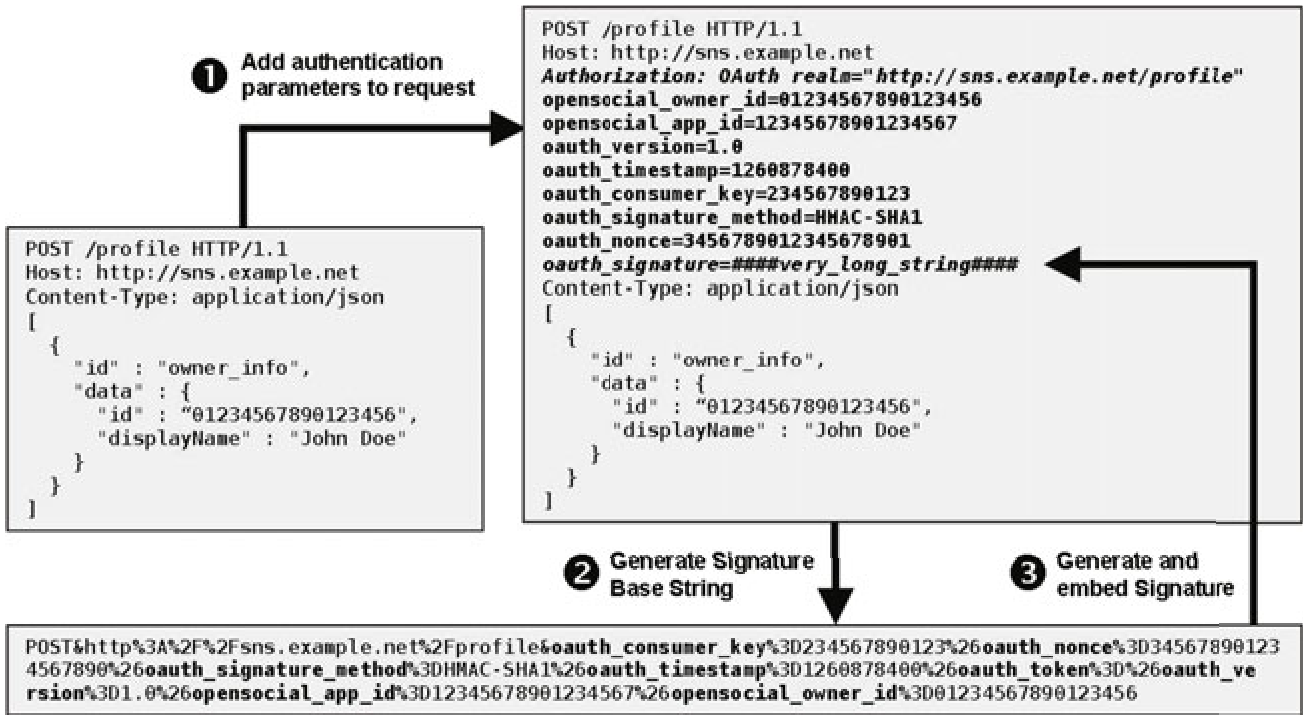
The most striking vulnerability discussed is the reliance on OAuth for parameter signing. While a container might sign the owner_id in the HTTP header to prove it’s legitimate, a malicious user could alter the owner_id within the unsigned JSON body of the request.
If the application server verifies the signature but executes logic based on the body payload, it can be tricked into leaking data from a different user's profile. This is a classic logic flaw where the security mechanism and the business logic are "decoupled."
The Identity Correlation Problem
Most containers pass internal User IDs directly to third parties. This allows a single developer owning multiple apps to correlate user behavior across the web, effectively unmasking users and building "shadow profiles" without consent.
3. Methodology: Proposed Hardening Mechanisms
The paper doesn't just critique; it offers a blueprint for a more secure social web:
Identity Pseudonymization
Instead of passing User_12345, the container should generate an application-specific pseudonym. App A sees the user as Alpha, and App B sees the same user as Beta. This kills the possibility of cross-app data correlation at the source.
Code Signing & Gadget Integrity
Currently, many gadgets load JavaScript dynamicially from external URLs. An attacker (or the developer) could change the code after the SNS has reviewed it. The authors propose mandatory Code Signing, ensuring that the code running in the user's browser is exactly what was audited.
The Access Lifecycle
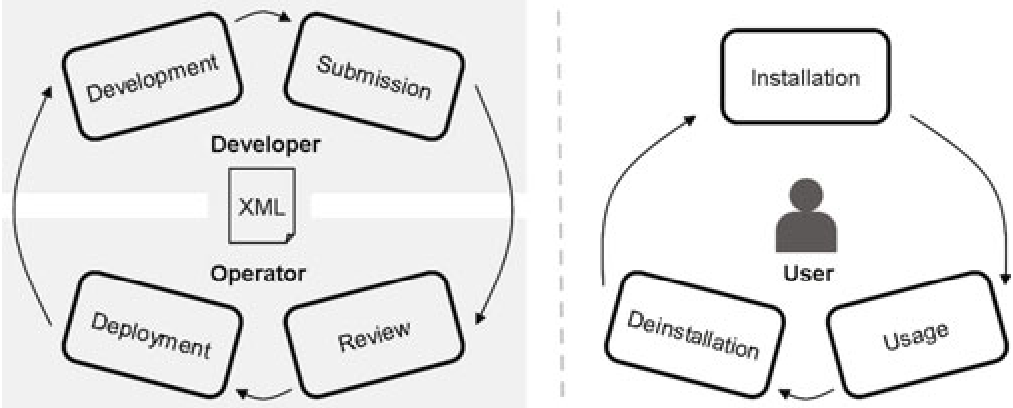
The authors detail how security must be maintained throughout the Deployment -> Installation -> Usage lifecycle.
4. Key Results and Security Recommendations
The authors validate their concerns by showing that the current specification fails to protect Response Integrity. While the request to the app server is signed, the response coming back to the user is not. This allows for Man-in-the-Middle (MitM) attacks where the app's output is poisoned.
Crucial Technical Checklist for SNS Operators:
- Enforce HTTPS for all API endpoints and gadget rendering.
- Mandatory Consistency Checks: Compare IDs in signed headers against application payloads.
- Data Minimization: Only release the specific fields (e.g., just "First Name" instead of "Full Profile") requested by the app.
5. Critical Analysis & Conclusion
The paper succeeds in shifting the conversation from "How do we make gadgets work?" to "How do we make gadgets safe?".
Takeaway: The "write-once-run-anywhere" philosophy often clashes with security, as different containers have different risk tolerances. By standardizing pseudonyms and code signing, OpenSocial could have achieved both interoperability and privacy.
Limitations: While the paper proposes "Configurable ID Cards," it acknowledges that this increases user friction. In the modern era of "one-click" convenience, users often choose speed over security—a psychological hurdle the paper recognizes but cannot solve technically.
Future Outlook: The insights here regarding third-party data access are highly relevant to modern Data Sovereignty discussions and the decentralization of social media (e.g., the Fediverse). The struggle for "Fine-grained Access Control" remains the frontline of privacy research today.