
Securing the Social Cloud: Bridging Big Data and Privacy through Advanced Frameworks
Security and privacy of big data for social networking services in cloud
This paper proposes a novel system framework that integrates Big Data (BD), Social Networking (SNg), and Cloud Computing (CC) to address data exchange security. It introduces an intermediate communication node in the Cloud that utilizes modified encryption algorithms (Blowfish and AES) to enhance privacy for large-scale social media data.
TL;DR
As Social Networking (SNg) and Big Data (BD) converge, the resulting "Big Data SNg" ecosystem faces unprecedented security vulnerabilities. This paper introduces a Cloud-based system framework that acts as a secure intermediary for social data exchange. By optimizing encryption algorithms like Blowfish and AES for high-throughput environments, the researchers achieve massive gains in data processing speed while maintaining robust privacy boundaries.
The Collision of Scale and Secrecy
The modern social landscape is "self-organizing and complex," generating massive data volumes (The 3 Vs: Volume, Velocity, Variety). However, traditional databases struggle with the complex JOIN operations required for Big Data, and current security protocols are often too slow for real-time social interactions.
The authors identify a critical paradox: users have high trust in social circles but low control over the sensitivity of their data. Prior work shows that even the most efficient encryption often stalls at rates insufficient for petabyte-scale transfers. The bottleneck isn't just the algorithm; it's the architecture.
Methodology: The Safe Cloud Node
The core innovation lies in a system-framework-network established in a secure Cloud environment. Instead of relying on the native, often vulnerable security of social platforms, users connect via a special authentication node.
1. Algorithm Modification
The researchers focused on two high-performance symmetric algorithms: Blowfish and AES. They modified the number of iterations (NIter) to make them compatible with specific bio-inspired algorithms used in the transmission chain.
2. Architectural Design
The framework adopts an IoT-inspired topology to handle high-quality video and multimedia (Big Data). It utilizes the NAMRTP (Network Adaptive Multimedia Real-time Transport Protocol) to ensure that heavy data packets don't cause network congestion.

Experimental Performance
The superiority of the chosen algorithms is evident when compared to legacy standards like DES or RSA.
| Algorithm | MB per Second | Key Length |
|---|---|---|
| Blowfish | 64,386 | 32-448 bits |
| AES | 61,010 | 128-256 bits |
| RSA | 10,900 | 1024-4096 bits |
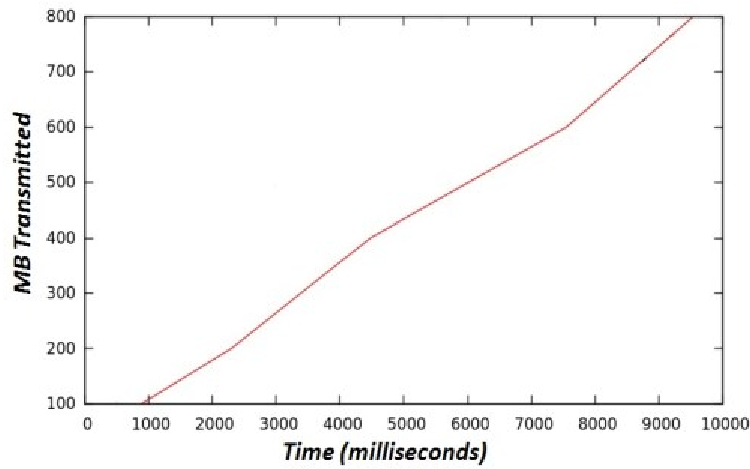
Beyond raw speed, the paper evaluates the Encryption Rate () over time. The results indicate that as the transmission progresses, the implementation becomes more accurate and efficient, showing a distinct upward trend.
Packet Loss and Reliability
Even at the most distant nodes (Node 9 in simulation), the system maintained high integrity. The authors provided a mathematical model for Packet Loss (), demonstrating that the framework successfully avoids "stuck overflow" during the transmission of large files.
Critical Insight & Future Outlook
This work highlights that Cloud Computing is the essential glue that permits Big Data to serve Social Networking without sacrificing security. By treating the Cloud as an "intermediate communication node" rather than just a storage bucket, we can apply heavy-duty encryption without the user-side performance hit.
Limitations: While the encryption throughput is impressive, the study focuses primarily on symmetric encryption. Future iterations will likely need to address the key management overhead when scaling to billions of social nodes.
Final Takeaway: For AI and data engineers, this paper validates the shift toward decentralized social nodes within centralized cloud infrastructures as the future of private, large-scale data exchange.