
Security and Privacy in Mobile Social Networks: Beyond the Centralized Horizon
16852_Security and privacy in mobile social networks challenges and solutions.
This paper provides a comprehensive taxonomic overview of Mobile Social Networks (MSN), categorizing them into online-mobile hybrids, location-based, and autonomous applications. It introduces the Trustworthy Service Evaluation (TSE) system and gesture-based authentication to address critical security gaps in distributed mobile environments.
TL;DR
As social networking shifts from desktops to the palms of our hands, the traditional "trusted server" model is crumbling. This paper by Xiaodong Lin explores the wild west of Mobile Social Networks (MSN), where smartphones act as autonomous nodes. The study introduces gesture-based authentication and aggregate signatures to solve the paradox of sharing information with strangers while maintaining ironclad privacy.
The Evolution of Social Proximity
Social networking is no longer just about who you know online; it’s about who is standing 10 meters away from you. The author classifies MSN into three distinct architectural tiers:
- Mobile OSAs: Mobile versions of Facebook/Twitter (ISP-dependent).
- Location-Based Apps: Foursquare-style check-ins (Privacy-sensitive).
- Autonomous Applications: Pure peer-to-peer (P2P) interactions via Bluetooth/NFC (The Frontier).
The real challenge lies in the Autonomous tier. Without a central ISP to verify identities, how can you trust a restaurant review sent by a passerby, or safely swap a digital business card in a crowded subway?
Methodology: Bridging the Physical and Digital
The core innovation of this work is moving security from the "Cloud" to the "Context."
1. Gesture-Based "Handshakes"
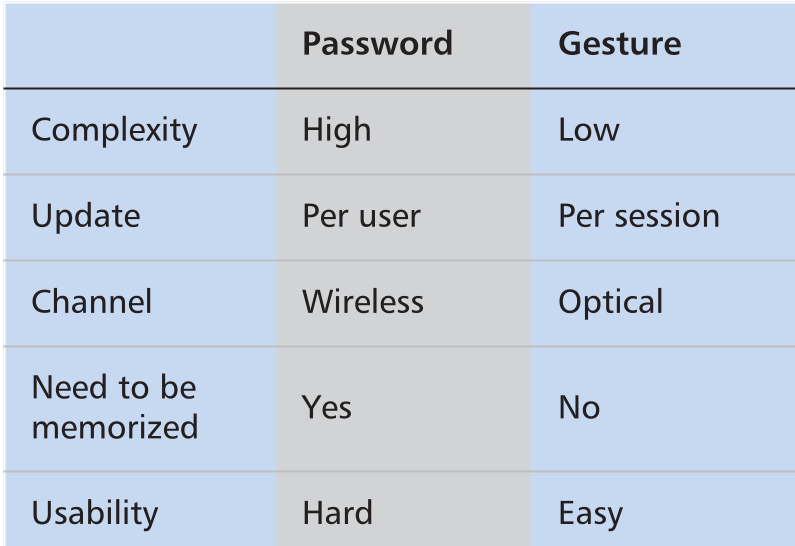
Traditional password exchange is clunky. The author proposes a Gesture-Authentication Scheme. By performing a specific physical movement (e.g., a unique shake of the phone), two SUs (Smartphone Users) create an out-of-band "optical" channel.
- Why it works: Malicious eavesdroppers can see the radio waves, but they can't "see" or replicate the physical gesture fast enough to intercept the session key.
2. The TSE System: Preventing Review Manipulation
In a distributed service review app, a restaurant (LSP) might try to delete negative reviews before broadcasting them to other users. To prevent this, the paper utilizes Aggregate Signatures.
- The Logic: Multiple user reviews are bundled into a single cryptographic signature. If the LSP deletes even one negative review, the aggregate signature becomes invalid, and other users' phones will instantly flag the data as tampered with.
Experimental Insights: Resilience Under Fire
The paper evaluates the bTSE (basic Trustworthy Service Evaluation) system against "Review Rejection Attacks."
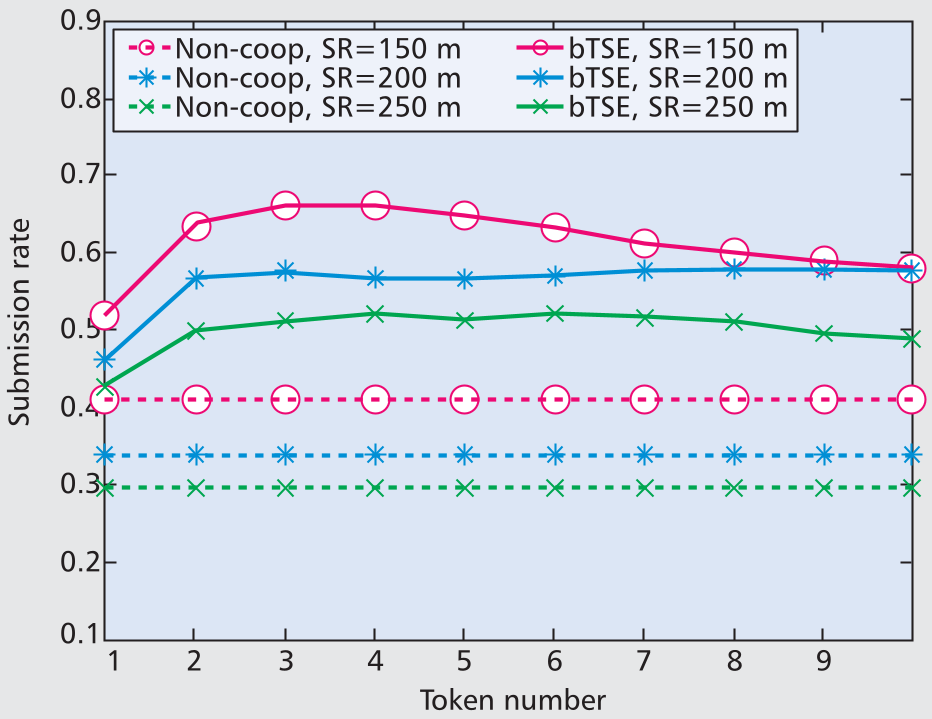
The results are stark: In a non-cooperative system, an attacker can effectively silence negative feedback, dropping the valid information flow significantly. However, the bTSE system maintains a 100% submission rate, ensuring that the "wisdom of the crowd" remains untainted by the service provider's bias.
Critical Insight: The Social Context Gap
As a Senior Editor, I find the section on Social-Context-Based Management most prophetic. Most privacy protocols treat all environments the same. Lin argues that your privacy needs in a "Shopping Mall" (high anonymity) are fundamentally different from a "Research Conference" (high disclosure). Future MSN protocols must be context-aware, automatically adjusting the degree of profile blurring based on the GPS tag and nearby device density.
Future Outlook and Limitations
While the paper provides a robust framework for 2014, today's MSN landscape faces new threats like Deepfake Social Engineering and sophisticated Sybil attacks using AI-generated identities. The "boundary" between a good user and a Sybil attacker remains fuzzy, and as the author notes, integrating location history into identity verification is the next logical step.
Takeaway: Security in the mobile age is not just about better encryption; it’s about leveraging our physical presence and social ties to create "Human-Centric" trust.