
Beyond Anonymity: Safeguarding the Hidden Web of Relations in Social Networks
Security & Privacy in Social Networks
This paper provides a systematic taxonomy of privacy-preserving techniques for Online Social Networks (OSNs), focusing on "Relation Privacy." It evaluates methods across a continuum of identity exposure—ranging from complete anonymization to full disclosure—and introduces the ℓ-diversity model to mitigate sensitive relationship leakage.
TL;DR
Simply removing names from a social network dataset isn't enough to protect users. This paper explores "Relation Privacy"—the art of hiding who knows whom even when identity seems hidden. By analyzing a spectrum of privacy techniques from k-anonymity to -diversity, the authors reveal how structural patterns (the "shape" of your friend circle) can be as revealing as a Social Security number.
The "Anonymity" Illusion: Why Structure is Identity
The fundamental motivation for this research is the failure of naive anonymization. In an Online Social Network (OSN), a user is just a vertex in a graph. Even if you replace "Alice" with "User_123," she remains vulnerable to Topology-based Attacks.
If an attacker knows Alice has exactly 157 friends (a vertex degree), they can scan the "anonymized" graph for a node with that exact degree. If only one exists, Alice is compromised. More sophisticated attackers use Active Attacks, injecting "dummy users" into the network to create unique structural fingerprints that act as homing beacons for re-identification.
Methodology: The Privacy Continuum
The authors organize privacy techniques into a continuum based on how much identity is exposed:
1. Topology-Preserving Techniques
When identities are completely hidden, we modify the graph structure to make nodes indistinguishable.
- k-Anonymity: Ensuring at least nodes share the same degree.
- k-Neighborhood Anonymity: A deeper layer where the 1-hop structure around a node must be identical for at least users.
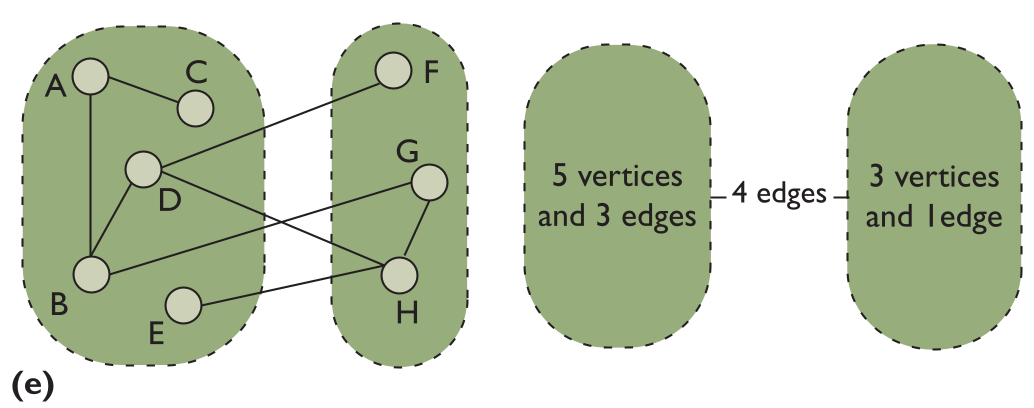
- k-Automorphism: The gold standard for structural symmetry, ensuring the graph has isomorphic matches for any subgraph.
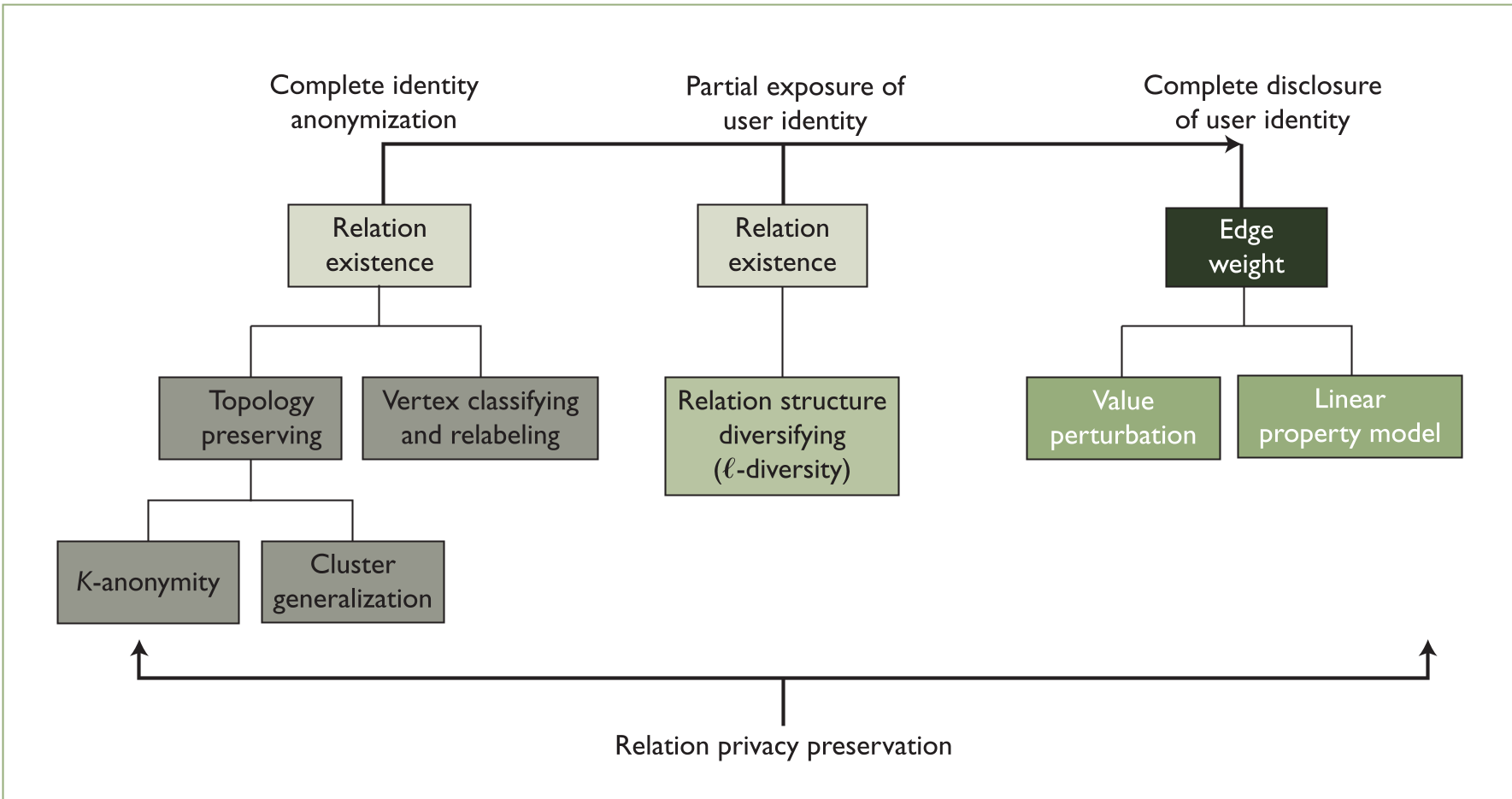
2. The -Diversity Model for Partial Exposure
The most "real-world" scenario involves partially known identities (e.g., via a public blog). The authors propose -diversity.
- Intuition: Don't let two groups of users share too many common neighbors.
- Mechanism: By adding fake edges or noise, the system ensures that even if an attacker identifies "User A," they can only guess a link to "User B" with a probability of .
The Cost of Privacy: The Utility Trade-off
Every time you add a "fake" edge or merge nodes into a cluster to protect privacy, the data becomes less useful for researchers (e.g., sociologists or marketers). The paper evaluates this through two lens:
- Topology-based Metrics: Measuring changes in the average shortest path or clustering coefficients.
- Workload-based Metrics: Running actual queries (like "find the most influential user") on both the original and the noisy graph to see how much the results diverge.
Critical Insight & Future Outlook
The paper’s most profound takeaway is that relation privacy is a collective problem. Unlike a password you can change, your "relations" involve other people. If your friends are careless with their privacy, they inadvertently expose yours.
While the paper provides a robust framework, it notes a significant gap: Time-series snapshots. As OSNs evolve daily, protecting privacy across multiple published versions of the same graph remains a "frontier" challenge. For practitioners, the message is clear: when publishing graph data, focus on the edges and the local topology, as that is where the most sensitive "leaks" reside.
Conclusion
This work serves as a foundational roadmap for OSN owners. By moving from simple vertex-labeling to complex structural obfuscation like k-isomorphism, we can share data that is scientifically valuable yet resilient against increasingly clever topological forensics.