
Software-Reconfigurable VSNs: Bridging the Gap Between Vehicles and Marketers via OOFDM
SPECIAL SECTION ON SECURITY AND PRIVACY FOR VEHICULAR NETWORKS
This paper proposes a software-reconfigurable OOFDM system based on SDN for data backhauling and fronthauling between Vehicle Social Networks (VSNs) and Central Offices (COs). It introduces and compares DHT-ACO-OFDM and DFT-ACO-OFDM architectures, achieving dynamic switching to optimize either spectral efficiency or Bit Error Rate (BER).
TL;DR
This research introduces a novel, software-reconfigurable communication platform designed for Vehicle Social Networks (VSNs). By utilizing SDN (Software-Defined Networking) to switch between DHT and DFT based optical OFDM modulations, the system can dynamically prioritize either spectral efficiency or signal reliability. Experimental results show reconfiguration latencies in the microsecond range, making it a robust solution for real-time vehicular data transmission.
Problem & Motivation: The Rigid Link Bottleneck
In modern smart cities, vehicles act as mobile sensors and recommenders. Marketers at a Central Office (CO) need to transmit massive amounts of trajectory and advertising data to and from these vehicles.
Current systems face two major hurdles:
- Spectral Inefficiency: Standard Optical OFDM (OOFDM) requires complex-to-real signal conversion. Using the Discrete Fourier Transform (DFT) with Hermitian symmetry effectively halves the usable bandwidth.
- Architecture Rigidity: Different marketing tasks have different needs. A system sending simple text ads needs high reliability (low BER), while one streaming high-def multimedia maps needs high throughput (spectral efficiency). Rigid, hardware-fixed systems cannot swap between these priorities on the fly.
Methodology: The Core Architecture
The authors solve this by introducing a dual-path physical layer powered by an SDN controller.
1. Discrete Hartley Transform (DHT) for Real Signals
Unlike DFT, the DHT results in real values directly when using one-dimensional mapping (like PAM). This eliminates the need for Hermitian symmetry, potentially doubling the spectral efficiency compared to traditional DFT methods.
2. ACO-OFDM vs. DCO-OFDM
To make the signal unipolar for optical transmission, the paper utilizes Asymmetrically Clipped Optical OFDM (ACO-OFDM). By modulating only the odd subcarriers, the clipping noise is contained within the even subcarriers, allowing for a higher Signal-to-Noise Ratio (SNR) compared to DC-biased (DCO) methods.
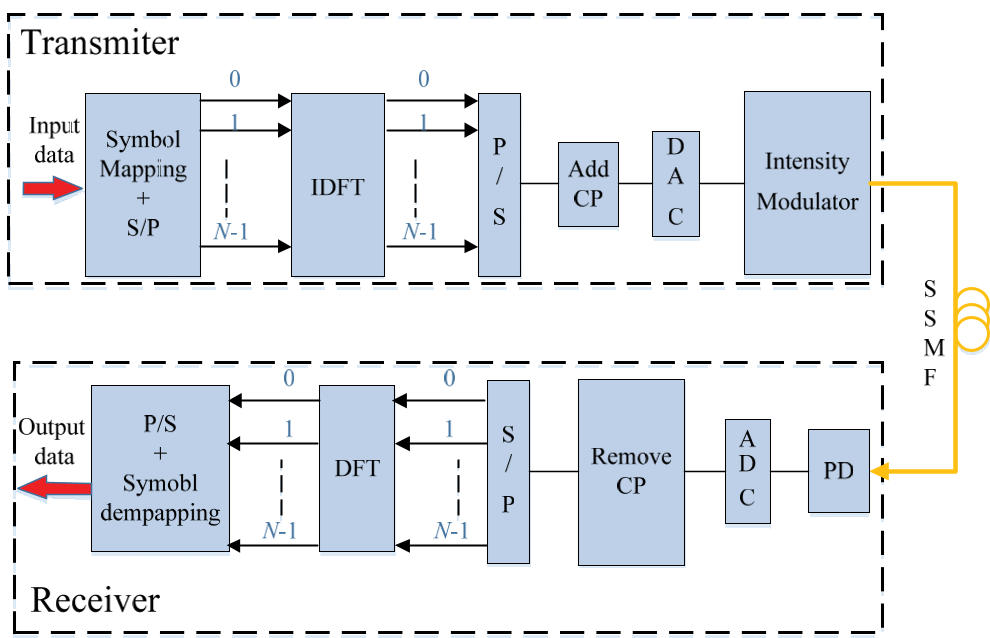 Figure 1: The standard IM/DD OOFDM structure used as the baseline for the proposed system.
3. SDN-Driven Reconfiguration
The "brains" of the system reside in an SDN controller. Using extended Flow Mod messages (0x0101 for DFT/QAM and 0x0202 for DHT/PAM), the controller instructs the transceivers to swap modules based on the application's priority at the northbound interface.
Experiments & Results
The study conducted rigorous simulations and hardware-in-the-loop tests.
- DHT-ACO vs. DHT-DCO: At a BER of , ACO-BPSK was significantly more power-efficient than DCO-BPSK, proving the superior sensitivity of the asymmetrically clipped approach.
- DHT vs. DFT Trade-off:
- DHT-ACO-OFDM achieved 2x the spectral efficiency.
- DFT-ACO-OFDM maintained a lower BER in high-order modulation scenarios (e.g., 64-QAM).
- Control Latency: The average time to reconfigure the entire link was measured at approximately 643 s, demonstrating the feasibility of real-time application switching.
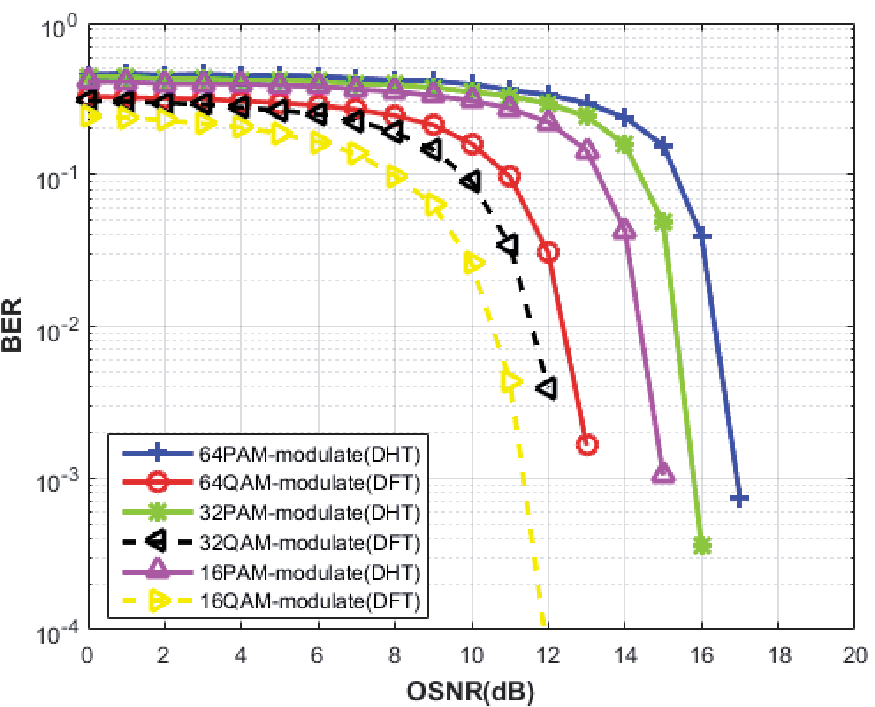 Figure 2: BER comparison showing the efficiency gains of ACO over DCO in the DHT framework.
Critical Analysis & Conclusion
Takeaway
This paper successfully bridges the gap between high-level network management (SDN) and low-level signal processing (OOFDM/DHT). By treating modulation as a reconfigurable software module rather than a hardware constant, the researchers have created a blueprint for truly "elastic" vehicular networks.
Limitations & Future Work
While the point-to-point results are impressive, the current iteration is limited to a single vehicle-to-CO link. The authors acknowledge that moving toward point-to-multipoint scenarios and exploring more advanced "elastic" techniques beyond DHT/DFT will be critical for scaling this to a city-wide VSN.
Final Thought
The shift toward software-defined physical layers is inevitable as 6G and V2X demand more flexibility. This work provides the necessary mathematical and experimental groundwork to make that shift a reality for vehicular social networking.