
Security Relationship: Quantifying the Vulnerability of Social Networks
Research of Security Relationship Based on Social Networks
This paper introduces a security assessment framework for social networks by defining the core concept of "Security Relationship." Using a Bayesian Network model, it quantifies risks associated with core nodes and community structures to predict and perceive security threats like fraud and rumor dissemination.
TL;DR
Social networks are essentially "sub-secure" structures where a single influential node can trigger a viral security crisis. This paper shifts the focus from simple connectivity to Security Relationships, proposing a Bayesian model that integrates node influence, community structure, and information dissemination scales to quantify network risk levels from "Safe" to "Danger."
The "Sub-Security State" of Modern Networks
As platforms like Facebook, Twitter, and Weibo reached billions of users, a structural paradox emerged. We perceive our social graphs as utility tools, but the authors argue they are in a permanent "Sub-Security State."
The root of the problem lies in the Core Nodes—opinion leaders with massive follower counts. When these nodes are compromised or unintentionally spread misinformation, the "cascading effect" leads to geometric explosions of rumors or fraud. Current security research often treats nodes in isolation; this paper argues that we must instead treat the relationship as the primary unit of risk.
Methodology: From Qualitative Grades to Quantitative Bayesian Inference
The authors construct a hierarchical framework to bridge the gap between abstract risk and measurable data.
1. Defining the Actors
The model identifies two critical types of high-influence nodes:
- Hidden Danger Nodes: Nodes with high authority/influence but no prior malicious history. They are "sleeping giants" whose compromise would be catastrophic.
- Dangerous Nodes: Nodes already associated with security events (fraud, phishing).
2. The Bayesian Assessment Model
To handle the logical dependencies between node influence and community stability, the authors utilize a Bayesian Network. This allows for the fusion of "polymorphic data"—combining structural parameters (clustering coefficients, path lengths) with behavioral data (keywords, retransmission rates).
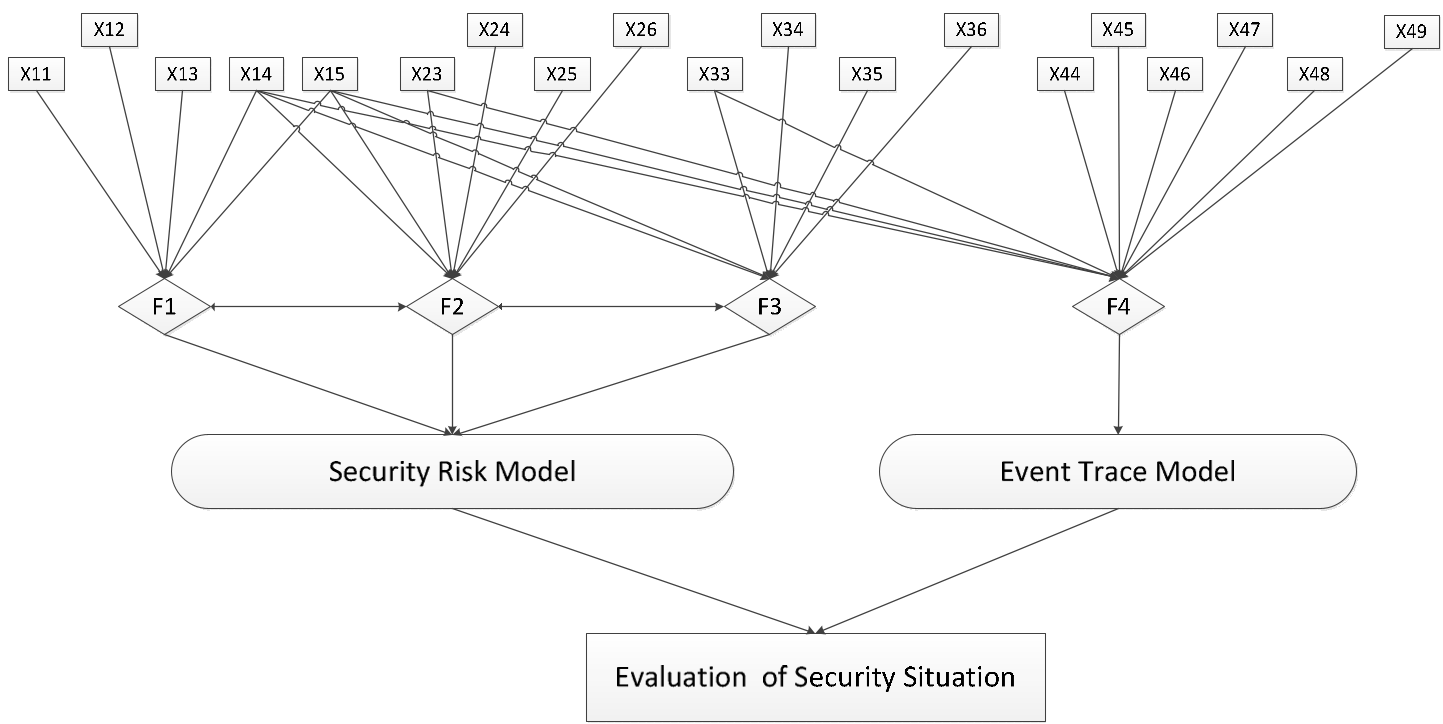 Figure 1: The proposed Bayesian structure linking factors like community structure and dissemination scale to the final security grade.
3. Factor Analysis
The model breaks down risk into four primary object sets ( to ):
- Key Nodes (): Degree, security grade, and neighbor associations.
- Community Structure (): Cluster coefficients and average path lengths.
- Dissemination Scale (): Using Independent Cascade (IC) and Linear Threshold (LT) models to predict how far a threat will spread.
- Keywords/Tracing (): Real-time sentiment and retransmission counts.
Experimental Framework & Results
The assessment is mapped to a Five-Level Security scale, providing a clear dashboard for network administrators:
| Grade | Assessment | Measure Score |
|---|---|---|
| Green | Security | 2 |
| Blue | Inferior Security | 1 |
| Yellow | Critical Value | 0 |
| Orange | Inferior Danger | -1 |
| Red | Danger | -2 |
By applying the Analytic Hierarchy Process (AHP), the authors assign weights to different network factors. This allows the system to identify "Top-k" critical nodes via greedy algorithms, effectively pinpointing the source of a security breach or a rumor-mongering campaign.
Critical Insights
The true value of this work lies in its probabilistic approach to social safety. Unlike binary firewalls, the "Security Relationship" model acknowledges that a node's danger level changes based on its position in the network and the current "information climate" (keywords/trends).
Limitations & Future Work
While the theoretical framework is robust, the paper relies heavily on static parameters. In the era of AI-generated content (Deepfakes), the velocity of these relationships is much higher than in 2012. Future iterations would benefit from:
- Dynamic Temporal Analysis: Moving from static graphs to real-time streaming data.
- Adversarial Modeling: Accounting for botnets specifically designed to "game" core node influence.
Conclusion
This paper provides a vital theoretical foundation for Situation Awareness in social networks. By moving beyond traditional node-based security and adopting a relational, Bayesian perspective, it offers a path to predicting systemic failures before they go viral.