
Defeating the Ghost: A Geometric Defense Against Sybil Attacks in Mobile Social Networks
A Security Routing Mechanism against Sybil Attacks in Mobile Social Networks
The paper introduces a cross-layer security routing mechanism designed to combat Sybil attacks in Mobile Social Networks (MSNs). By integrating RSSI-based distance measurement on the client side with a geometric consistency verification algorithm on the server side, it achieves the reliable identification and elimination of forged identities.
TL;DR
Mobile Social Networks (MSNs) are vulnerable to "Sybil attacks," where one malicious device assumes multiple identities to hijack routing. This paper proposes a dual-layer defense: clients measure physical proximity via RSSI, while servers use Trilateration to verify if those nodes actually "fit" into a 2D physical space. If a node's geometry doesn't add up, it's kicked out of the routing table.
Background & Positioning
As a subset of Delay Tolerant Networks (DTNs), MSNs rely on the "Store-Carry-and-Forward" (SCF) mechanism. Efficiency depends on social properties (friendship, encounter frequency). However, this social-awareness is a double-edged sword. The paper sits at the intersection of Social-Aware Routing and Network Security, specifically addressing the gaps left by traditional identity management systems in highly dynamic environments.
The Problem: The "Reasonable Forge" Dilemma
In MSNs, nodes report their locations to a server to facilitate routing. A malicious node can easily create "Sybil nodes" (virtual identities) with fake locations. If the attacker knows where its neighbors are, it can forge a virtual location that looks perfectly plausible to the routing algorithm.
The Core Insight: Even if an attacker can lie about a coordinate, it is mathematically difficult to lie consistently about relative distances to multiple neighbors simultaneously.
Methodology: Geometry as a Truth Machine
The proposed solution splits the workload between the Mobile Client and the Location Server.
1. Client-Side: Distance Measurement
Instead of just trusting GPS, nodes use Received Signal Strength Indicator (RSSI).
- Node sends a signal.
- Neighbors report the received power .
- Node calculates the distance using free-space wave propagation.
2. Server-Side: The Consistency Check
When the server receives these distances, it runs Algorithm 1: Eliminate_Sybil_Node.
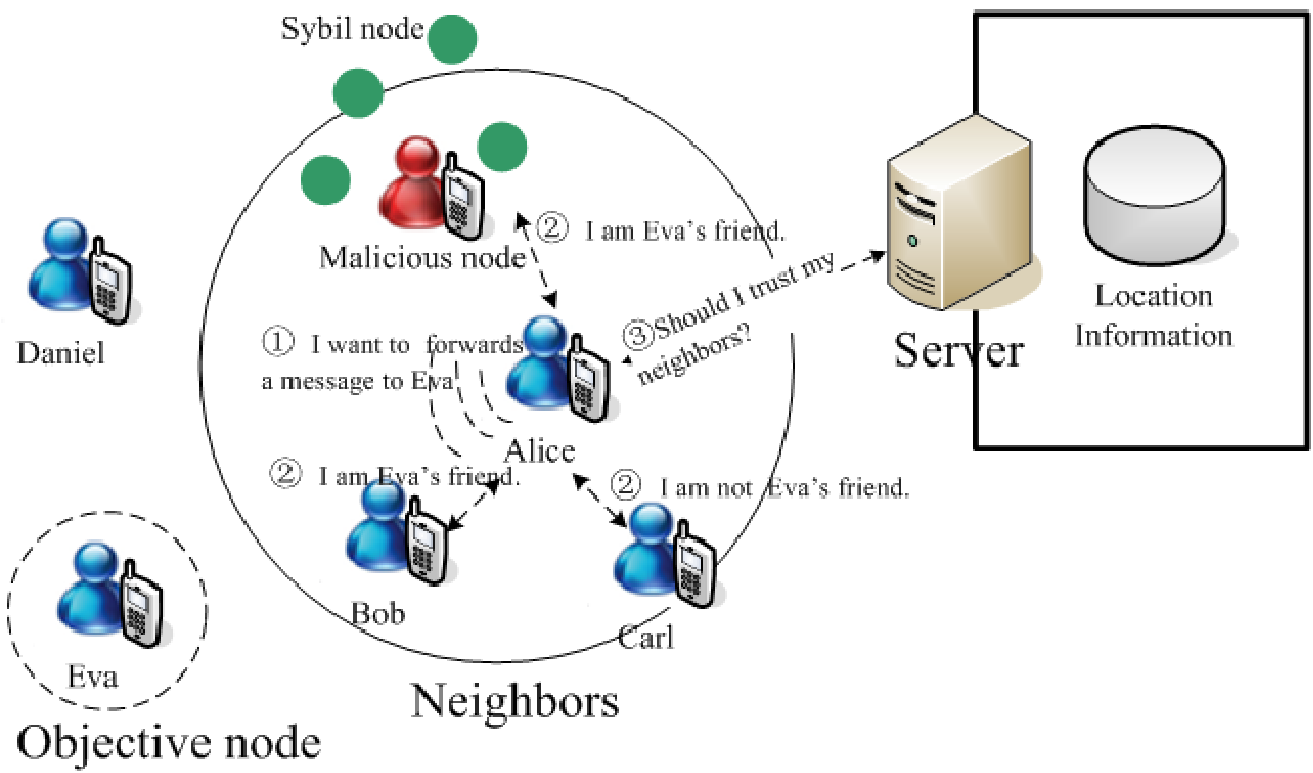
- Trilateration: The server picks three nodes to define a local coordinate system.
- Physical Mapping: It calculates the expected position of a fourth node based on its reported distances.
- The "Truth" Test: If the calculated distance between two nodes significantly differs from the measured distance beyond a threshold , the system identifies a conflict. Since real physical objects cannot exist in two places at once (or fail Euclidean geometry), the "impossible" nodes are flagged as Sybil identities.
Experiments & Analysis
The authors provide a theoretical proof of the algorithm's effectiveness:
- Theorem 2: If the reference nodes are real, no Sybil node can pass the consistency check.
- Theorem 3: If a Sybil node is accidentally used as a reference, the set of "valid" nodes will shrink, but the Sybil node will still likely be isolated because it cannot maintain consistency with the wider network of honest nodes.
Cost Considerations
- Energy: For a neighborhood of nodes, the process requires packet switches. This is the primary trade-off—security comes at the cost of communication overhead.
- Computational: The server handles the heavy lifting of Trilateration, which is efficient for modern location servers.
Critical Insight & Conclusion
Takeaway
The genius of this approach is moving away from cryptographic trust (which can be stolen) to physical trust (which is bounded by the laws of geometry). By forcing nodes to prove their "physicality" through distance consistency, the bar for a successful Sybil attack is raised from simple software spoofing to complex signal manipulation.
Limitations
The paper assumes a "Free-Space" propagation model for RSSI. In real-world urban environments, multipath fading and obstacles (buildings, moving vehicles) can cause RSSI values to fluctuate wildly, potentially leading to "False Positives" where honest nodes are flagged as Sybil nodes.
Future Outlook
To make this production-ready, Integrating Machine Learning to filter RSSI noise or using Time-of-Flight (ToF) for more accurate distance measuring would be the logical next step for securing the next generation of 6G/IoT social networks.