
Securing the Cloud Social Network: A Proxy Re-Encryption Approach
Towards security in sharing data on cloud-based social networks
This paper proposes a security framework for data sharing in cloud-based social networks using ElGamal-based Proxy Re-Encryption (PRE). The core method enables group members to share encrypted data without distributing private keys, effectively managing user revocation through a semi-trusted proxy.
TL;DR
As social networks migrate to the cloud, protecting data against both hackers and the cloud providers themselves is critical. This paper introduces a framework where data visibility is managed by a Proxy Re-Encryption (PRE) scheme. By splitting keys between users and a proxy, the system allows for secure sharing and instant member revocation without the "nightmare" of re-encrypting the entire database.
Background: The Cloud Dilemma
In the era of ubiquitous sensing (iPhones, GPS, Laptops), data is no longer stored locally. While services like Amazon S3 and Dropbox offer reliability, they pose a massive Privacy Risk. If you encrypt your data to keep it safe from the provider, how do you share it with a friend without giving them your master password?
Current solutions often require:
- Re-downloading and decrypting everything (Not scalable).
- Redistributing keys whenever a group member leaves (Insecure and complex).
The Proposed Framework: Split-Key Architecture
The authors move away from "all-or-nothing" encryption. Instead of a single key, they utilize a mathematical split based on the ElGamal Cryptosystem.
1. The Core Mechanism: Key Splitting
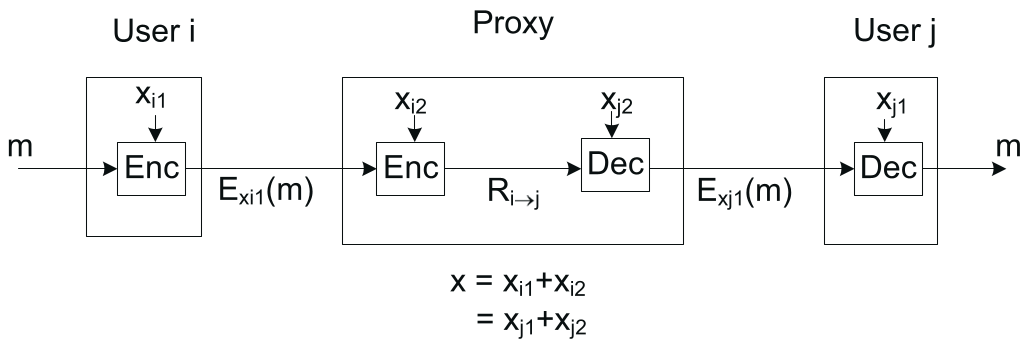
The Key Manager (a trusted third party) generates a master secret . Instead of giving it to users directly, it splits it:
- User gets:
- Proxy gets: (specifically paired to User )
- The Math:
When you upload data, you encrypt it with . The proxy then uses to complete the encryption to a "group standard." When another user wants to read it, the proxy uses to partially decrypt it, leaving it in a state that only user 's specific key can unlock.
2. Model Architecture
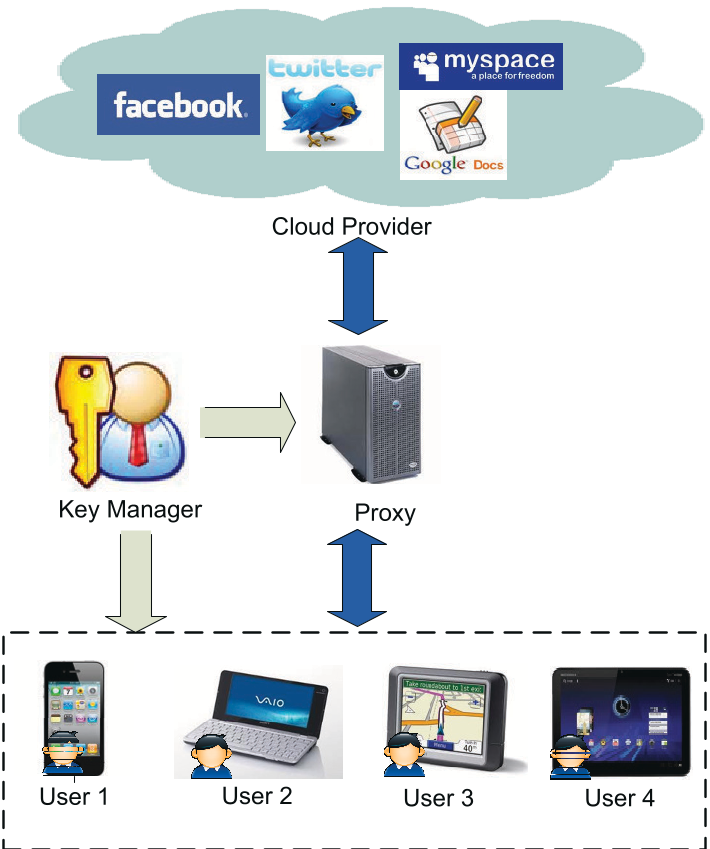
The framework consists of four distinct entities interacting to ensure data flows securely from the producer to the consumer.
Key Features: Beyond Just Storage
Instant User Revocation
This is the "killer feature" of the paper. If a member is fired or leaves the social group, the Key Manager simply tells the proxy to delete that user's pair. Even if the user still has their key and has downloaded the encrypted data, they cannot decrypt it because the "pre-decryption" step by the proxy is missing.
Keyword Search on Encrypted Data
Storing data is useless if you can't find it. The authors include a Keyword Encryption scheme based on hash functions () and random functions (). Users can generate tokens for specific keywords, allowing the proxy to perform a match against encrypted indices without ever knowing the actual words being searched.
Critical Analysis & Results
The paper summarizes various PRE schemes, and the authors' choice focuses on balancing security and simplicity.
The Achilles' Heel: Collusion
The authors honestly identify a major limitation: Collusion Attacks. If a revoked user and the proxy server decide to cooperate, they can combine their fragments ( and ) to reconstruct the master key . This would allow them to uncover the keys of every other user in the group.
Conclusion
This framework provides an elegant solution for dynamic social groups where members join and leave frequently. By offloading the "heavy lifting" of re-encryption to a proxy that only sees fragments of a key, it maintains a high level of privacy (provided the proxy doesn't turn malicious).
Future Outlook: The next generation of this research will likely involve Collusion-Resistant PRE and optimizing the performance of the proxy to handle thousands of simultaneous "pre-decryption" requests for real-time social feeds.