
Seed and Grow: Systematic Privacy Breaches in Anonymized Social Networks
Seed and Grow: An attack against anonymized social networks
The paper introduces "Seed and Grow," a novel two-stage de-anonymization attack framework designed to identify users in anonymized social graphs. It leverages a planted "fingerprint" subgraph (the seed) and a self-reinforcing greedy matching algorithm (the grow) to achieve state-of-the-art identification accuracy on real-world datasets like LiveJournal.
TL;DR
"Seed and Grow" is a sophisticated two-stage attack targeting anonymized social networking data. By planting a small, cleverly designed "seed" subgraph and then using a self-correcting greedy algorithm to "grow" this seed through the rest of the network, the researchers demonstrate that removing names (naive anonymization) is insufficient to protect privacy. Their method outperforms previous SOTA de-anonymization techniques by eliminating arbitrary parameters and incorporating a "revisiting" mechanism to fix matching errors.
The Illusion of Naive Anonymization
Data curators often assume that by stripping unique identifiers (names, emails, SSNs) and only releasing the graph topology (who follows whom), user privacy is preserved. However, the structural identity of a node—its unique position within the web of connections—is often just as identifying as a name.
The core motivation of this paper is the observation of overlapping user bases. A user on Facebook often has a similar circle of friends on Twitter. If an attacker knows a small portion of a user's "true" graph (background knowledge), they can map it onto an anonymized "target" graph released by a service provider.
Methodology: The Two-Stage Attack
1. The Seed Stage: Planting the Fingerprint
The attacker starts by creating a specific subgraph, nicknamed the "Flag." Unlike prior work that required the attacker to control all edges of these nodes, "Seed and Grow" uses a Star-Structure centered around a "head node."
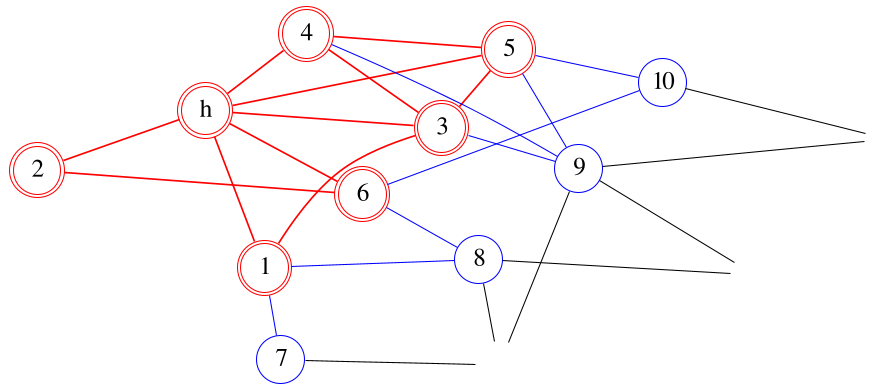
The secret weapon here is the internal degree sequence. By ensuring the randomly generated internal connections of the flag graph are unique, the attacker can recover the seed from the anonymized data with complexity—avoiding the expensive backtracking searches required by older attacks.
2. The Grow Stage: The Self-Reinforcing Match
Once the initial seed is identified, the algorithm expands like a virus. It uses two asymmetric dissimilarity metrics to compare unmapped nodes in the target graph () with nodes in the attacker's background knowledge ():
To ensure high accuracy, the authors introduced Eccentricity. If multiple nodes look like a good match, the algorithm calculates how much the "best" match stands out from the "second-best." If the difference isn't significant, it refrains from matching to prevent "poisoning" the results. Furthermore, a Revisiting mechanism allows the algorithm to re-evaluate and correct previous matches as more of the graph is revealed.
Experimental Evidence
The researchers tested the attack on the LiveJournal dataset (5.2 million vertices) and an emailWeek dataset.
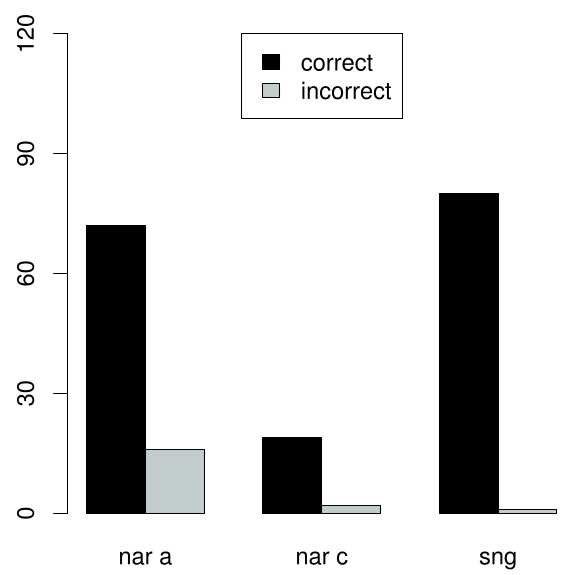
Key Findings:
- Balance of Power: Previous algorithms (like Narayanan & Shmatikov) were either too "aggressive" (high recall but 50%+ error rates) or too "conservative" (high precision but identified very few nodes).
- Superior Efficiency: Seed and Grow automatically finds the "sweet spot." In the LiveJournal tests, even with significant edge perturbation (data noise), it maintained high accuracy while identifying hundreds of users.
- Small Budget: The attack is feasible even for an attacker with a very small budget (only a 5-node initial seed).
Critical Analysis & Conclusion
The genius of "Seed and Grow" lies in its robustness to noise. Real-world social networks are dynamic; friendship links change daily. By using a "revisiting" strategy, this algorithm treats de-anonymization as an iterative optimization problem rather than a one-shot matching task.
Limitations: The attack still requires some "Active" capability (planting accounts) or "Collusion" (a small group of users sharing their data). However, as social APIs become more open, the cost of acquiring this initial "seed" is dropping.
Future Outlook: This research serves as a stark warning to organizations releasing "anonymized" datasets. As our digital identities become increasingly intertwined across platforms, the only real protection may lie in more advanced techniques like Differential Privacy or k-Anonymity, rather than simple graph scrubbing.