
Beyond Clicks: Maximizing Behavioral Intentions in Mobile Social Networks
The Algorithm of Seed Selection for Maximizing the Behavioral Intentions in Mobile Social Networks
This paper introduces the Budgeted Seed Selection (BSS) problem, a novel variant of influence maximization in mobile social networks that incorporates social psychology via the Extended Fishbein Model (EFM). The authors propose a partial enumeration-based approximation algorithm that achieves a (1 - 1/e) approximation ratio with high probability, effectively maximizing behavioral intentions rather than just the number of influenced nodes.
TL;DR
Classic Influence Maximization (IM) treats users like binary switches—either they receive information or they don't. This paper argues that intent matters more than reach. By integrating the Extended Fishbein Model (EFM) from social psychology, the authors propose an algorithm that selects "seeds" (initial influencers) to maximize the total behavioral intention of a network under a strict budget, achieving a near-optimal approximation.
Problem & Motivation: The Psychology Gap in IM
Most viral marketing research focuses on the "Infection" metaphor: if I talk to you, you are "influenced." However, in the real world, receiving a message is not the same as intending to buy a product.
The authors identify two major flaws in prior SOTA:
- Neglect of Interpersonal Beliefs: People are social animals; our intention to act is heavily modified by what our peers believe.
- Uniformity Fallacy: Existing models often treat all "influenced" nodes as equal, failing to distinguish between a lukewarm lead and an enthusiastic adopter.
The research intuition here is grounded in Positive Psychology: to maximize marketing ROI, one must identify seeds that trigger a "belief chain reaction," where the collective positive reinforcement of neighbors maximizes the intention to perform a behavior.
Methodology: Quantifying Intent with EFM
The core contribution is the formulation of the Budgeted Seed Selection (BSS) problem. Unlike standard IM, the objective function is the sum of Expected Behavioral Intentions.
The Behavioral Intention Formula
For any consumer , their intention is calculated as:
- : The internal positive belief of the user.
- : The degree of change influenced by neighbor .
- : Weights determining if the user is self-driven or peer-influenced.
The Algorithm
Since the problem is NP-hard, the authors use a Partial Enumeration Technique. The algorithm iterates through small subsets of seeds and greedily expands them based on the ratio of incremental intention to cost.
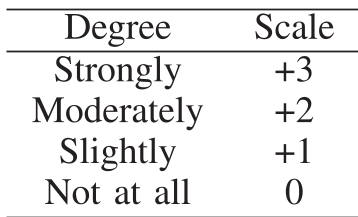 Table 1: The scales used to quantify "Degree of Change" in beliefs.
Experiments & Results
The authors tested their approach against various baselines:
- GCA (Greedy on Cost): Picking the cheapest seeds.
- GBA (Greedy on Behavioral Intention): Picking seeds with high individual intent.
- GDA (Greedy on Degree): Picking the most connected "popular" nodes.
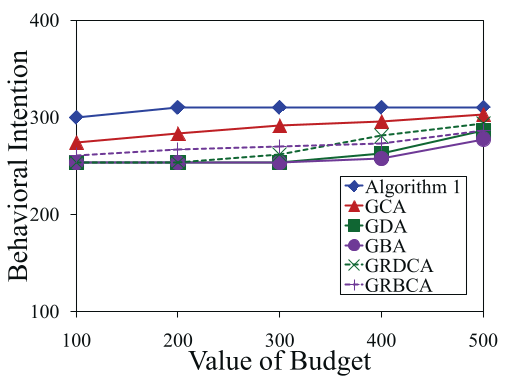 Figure: The proposed algorithm consistently yields higher total intention across different network traces (MIT, INFOCOM, SIGCOMM, Nodobo) compared to standard greedy heuristics.
Key Insights from Data:
- Budget Scalability: As the budget increases, the gap between the proposed algorithm and simple greedy methods widens, proving that "smart" seed selection is more critical when resources are abundant.
- Submodularity: The authors proved that the intention function is submodular, which is the "mathematical engine" that allows greedy approaches to provide a guaranteed performance bound.
Critical Analysis & Conclusion
Takeaway
This paper successfully bridges the gap between Social Computing and Consumer Psychology. It moves the needle from "information spread" to "behavioral conversion," which is the ultimate goal of any industrial marketing campaign.
Limitations
- Parameter Sensitivity: The model relies on weights () and belief scales () which are notoriously difficult to estimate accurately in real-time without intrusive data collection.
- Static Beliefs: The model assumes beliefs are fixed during the propagation process, whereas in reality, social influence is a dynamic, evolving dialogue.
Future Work
The logical next step is to apply this "Intention-Aware" framework to Negative Influence (e.g., rumor blocking) or Multi-Product Competition, where influencers' beliefs might conflict.