
CISM: Strategizing for Competitive Viral Marketing in Social Networks
Selecting Seeds for Competitive Influence Spread Maximization in Social Networks
This paper introduces the Competitive Influence Spread Model (CISM) to address seed selection for maximizing a product's reach in a social network where a competitor's seeds are already active. By utilizing a "possible graphs" approach and the CELF (Cost-Effective Lazy Forward) algorithm, the authors attain an approximation ratio of (1 - 1/e) for this NP-hard optimization problem.
TL;DR
In a world where Apple and Samsung compete for the same users, how does a "follower" company select seeds to maximize influence? This paper proposes CISM (Competitive Influence Spread Model), leveraging the concept of "possible graphs" to bypass #P-hard complexity and the CELF algorithm to achieve high-efficiency seed selection with a guaranteed (1 - 1/e) approximation of the optimal spread.
Background & Motivation: The Reality of Competition
Traditional research into Influence Maximization (IM) focuses on the "First Mover" advantage—identifying nodes to trigger the largest possible cascade. However, in reality, markets are rarely empty. When you launch a campaign, a competitor’s "Product B" might already be spreading.
The authors identify two critical gaps in prior work:
- Computational Hardness: Calculating expected influence in the Independent Cascade Model (ICM) is #P-hard due to the nature of probability paths.
- Competitive Dynamics: Most models don't account for the "collision" of two different information cascades in a discrete-time environment.
Methodology: Possible Graphs and The CISM Framework
1. From Probabilities to Possible Graphs
To solve the #P-hard challenge, the authors utilize the Possible Graph approach. In a social network , every edge exists as a "live-edge" with probability . By generating a set of representative deterministic "possible graphs," we can use simple Breadth-First Search (BFS) to calculate influence, which is significantly faster.
2. The Competitive Influence Spread Model (CISM)
CISM introduces a set of rules for "node capture" when two products compete:
- A-activated and B-activated seeds start the process.
- At each time step , an inactive neighbor is checked.
- The Tie-Breaking Rule: If both Product A and Product B attempt to activate in the same step, the model grants activation to Product A (the user-controlled product). This specific design ensures that the objective function remains submodular, allowing for greedy optimization.
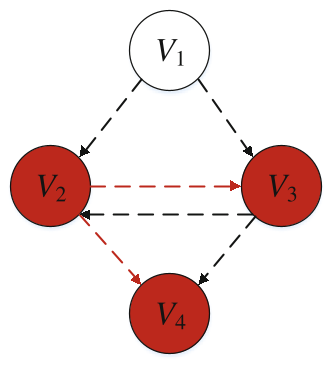 Figure: The activation logic of the CISM framework.
3. Acceleration via CELF
While the Greedy algorithm is effective, its complexity is too slow for large networks. The authors employ the CELF (Cost-Effective Lazy Forward) algorithm. CELF exploits the submodularity property (diminishing marginal returns) to skip redundant evaluations of nodes that couldn't possibly be the "best" in a current iteration.
Experimental Validation
The authors tested CISM on four datasets: NetHEPT, Ca-GrQc, p2p-Gnutella08, and Wiki-Vote.
Efficiency and Spread
The results confirm that the CELF-based CISM consistently outperforms:
- Max-Degree: Which often fails because high-degree nodes tend to cluster together, leading to "wasted" overlapping influence.
- Random: A baseline that lacks any strategic targeting.
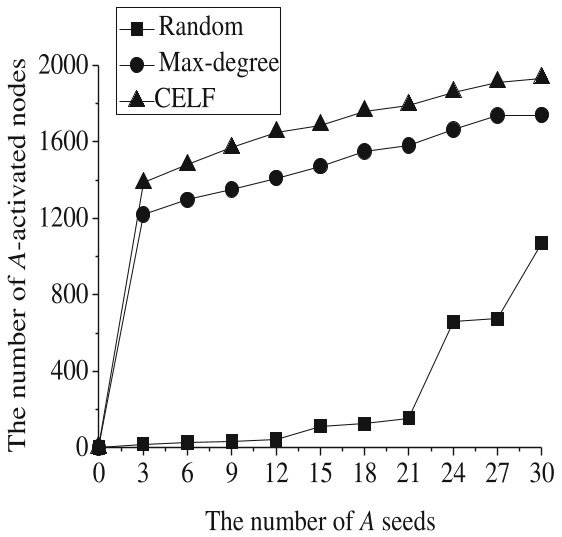 Figure: Comparison of seed selection heuristics across multiple datasets.
Another key finding is the Influence/Ratio relationship. As the competitor's seed set () increases relative to your own (), the marginal utility of your seeds drops, highlighting the "crowded market" effect.
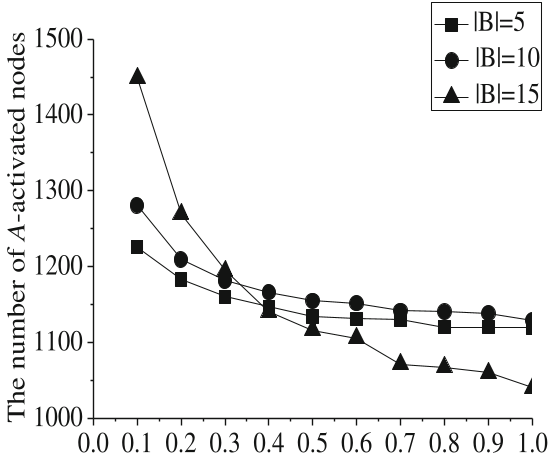 Figure: The impact of ratio on the final activated node count.
Critical Insight & Conclusion
This paper provides a robust bridge between theoretical submodularity and the practical need for competitive marketing tools. By simplifying the stochastic nature of networks into a finite set of "possible worlds," the authors make competitive targeting computationally feasible.
Limitations: While CELF is fast, it still struggles with truly massive graphs (millions of edges). Future work must look toward asynchronous spread—where Product B might have a massive head start in time—and influence quality, where not all "activations" result in equal value.
For the practitioner, the takeaway is clear: when competing in social networks, don't just look for high-degree nodes. Use submodular optimization to find seeds that provide the maximum unique coverage in the presence of existing competition.