
Seedance 2.0: ByteDance’s Giant Leap Toward Simulating Real-World Complexity
Seedance 2.0: Advancing Video Generation for World Complexity
Seedance 2.0 is a unified native multi-modal audio-video generation model developed by ByteDance, supporting text, image, audio, and video inputs to generate high-fidelity content (4-15s). It achieves SOTA performance on the SeedVideoBench 2.0 and Arena.AI leaderboards, specifically excelling in physical plausibility, complex motion modeling, and synchronized binaural audio generation.
TL;DR
The ByteDance Seed team has officially released Seedance 2.0, a powerhouse multi-modal foundation model that redefines high-fidelity video generation. By moving beyond isolated video clips to a unified audio-visual joint generation framework, Seedance 2.0 captures complex human motions, maintains rigorous physical laws, and generates synchronized binaural audio. It currently dominates both the Arena.AI (LMArena) leaderboards and the rigorous SeedVideoBench 2.0, setting a new industry standard for controllability and realism.
The Problem: The "Uncanny Valley" of Physics and Audio
Despite the hype surrounding Sora and early Kling versions, "hallucinated physics" remained a stubborn bottleneck. Models frequently failed at:
- Physical Plausibility: Skaters' legs morphing during rotations or objects defying gravity.
- Audio-Visual Dissociation: Background noise that doesn't match the scene's rhythm or "muddy" mono-track dialogue.
- Control Scarcity: Difficulty in maintaining character identity across multiple reference images or complex storyboards.
Seedance 2.0 addresses these by treating video generation not just as a pixel-prediction task, but as a world-modeling exercise.
Methodology: The Power of Unified Multi-Modality
The core innovation of Seedance 2.0 lies in its Unified Multi-modal Logic. Unlike pipeline-based approaches (where audio is dubbed later), Seedance 2.0 generates both tracks simultaneously.
1. Robust Control Signals
The model supports four input modalities—text, image, audio, and video. It handles:
- Subject Preservation: 9 reference images can be used to lock in character identity.
- Motion Transfer: Using a reference video to dictate the "rhythm" of a new generated clip.
- Cinematographic Reasoning: The model understands shot sequencing, push/pull transitions, and the "180-degree rule" of professional editing.
2. High-Fidelity Binaural Audio
By integrating an upgraded audio module, the model produces multi-track outputs (ambient, narration, BGM) with precise temporal alignment. The binaural technology ensures that sound moves spatially with the objects on screen.
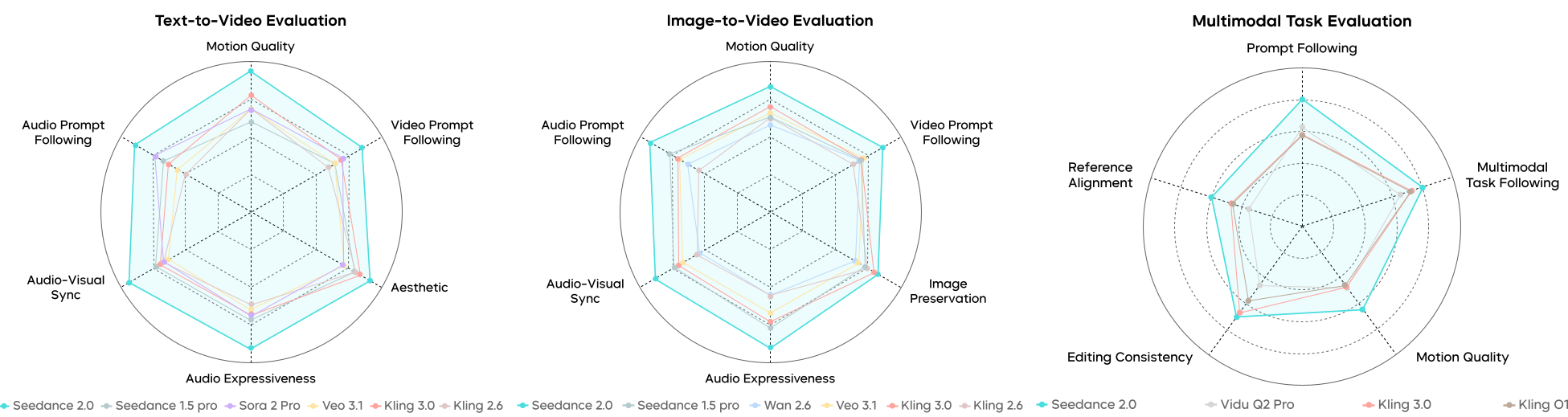 Figure 1: Comparison across T2V, I2V, and R2V tasks. Seedance 2.0 holds a commanding lead.
Experiments & Results: Dominating the Leaderboards
Seedance 2.0 was put to the test against industry titans like OpenAI Sora 2 Pro, Google Veo 3.1, and Kling 3.0.
Arena.AI Performance
On the community-powered Arena.AI (formerly LMArena), Seedance 2.0 720p secured the #1 spot in both Text-to-Video and Image-to-Video categories. Perceptually, its motion dynamics were rated higher than competitors even when those competitors outputted in 1080p.
Quantitative Breakdown (SeedVideoBench 2.0)
- Motion Quality: Reached a score of 3.75 (vs. Kling 3.0's 3.10 and Sora 2 Pro's 2.69).
- Usability Rate: A staggering 97.55% of outputs were rated "usable" for motion stability.
- Audio Sophistication: Seedance 2.0 is the only model to provide "delight-level" audio quality (score of 5), while most competitors struggled with noise and distortion.
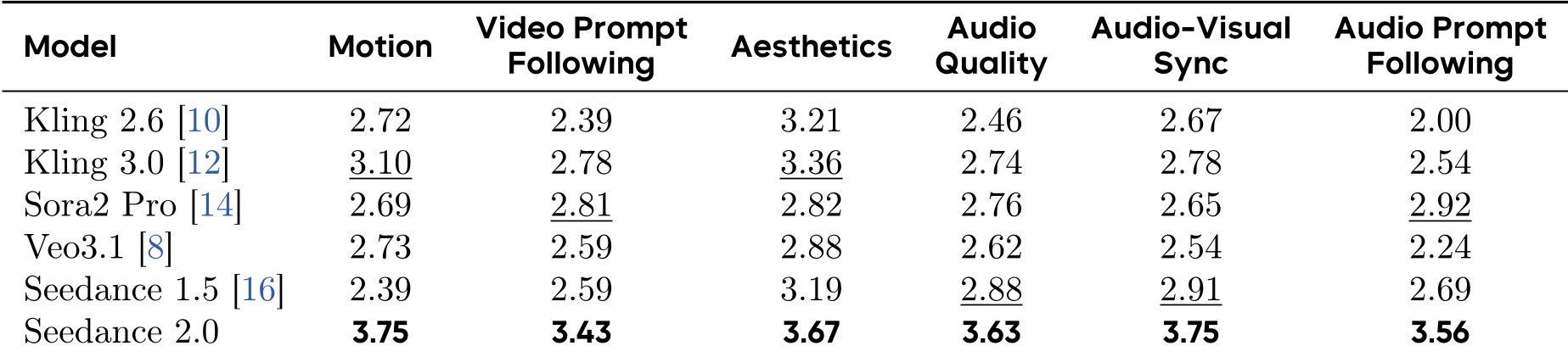 Table 1: T2V results across Motion, Prompt Following, and Audio dimensions.
Visual Evidence: Motion Mechanics
The model's ability to simulate complex interactive scenes is a differentiator. In scenes involving skating maneuvers or combat, Seedance 2.0 maintains "momentum" and "skeletal integrity."
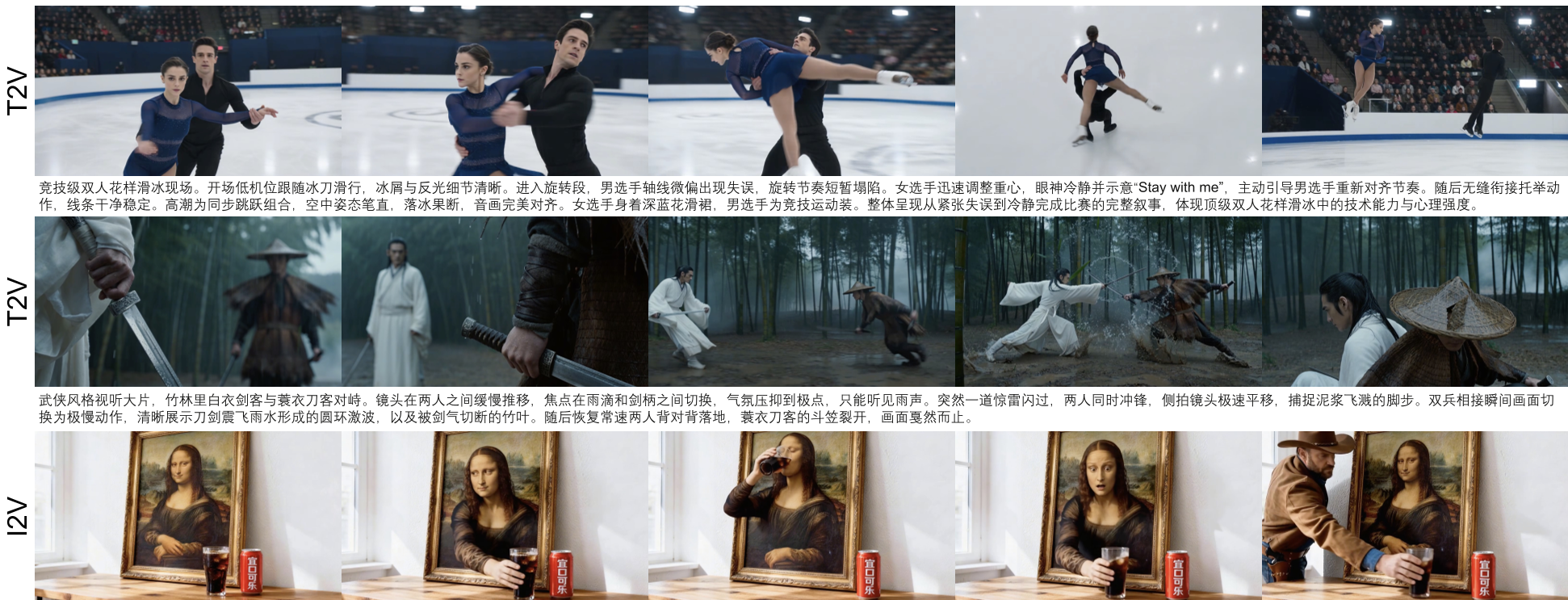 Figure 2: Example of complex narrative generation with high visual fidelity and textual overlay capability.
Future Outlook and Limitations
While Seedance 2.0 is a massive leap forward, the ByteDance team acknowledges areas for growth:
- Motion Plausibility: Occasional deformation artifacts still occur in extreme edge cases.
- Multi-Speaker Logic: Lip-sync errors can happen in crowded, high-speed dialogue scenes.
- Physical Reasoning: Future iterations will likely focus on deeper alignment between generative priors and "hard physics" simulation.
Conclusion
Seedance 2.0 is more than just a creative tool; it's a "Creative Engine." By solving the synchronization debt between audio and video and providing professional-grade cinematographic control, it paves the way for AI to handle entire production pipelines—from storyboard to final edit.
For creators, the message is clear: the barrier to producing cinema-grade content has just been lowered significantly.