
CLAS: Leveraging Cellular Learning Automata for High-Efficiency Viral Marketing
7758_A Seeding Cellular Learning Automata Approach for Viral Marketing In Social Network.
This paper introduces CLAS (Cellular Learning Automata for Seeding), a novel approach for selecting optimal seed sets in Viral Marketing. By combining Cellular Automata with Learning Automata, the method identifies influential "opinion leaders" in social networks to maximize message diffusion within polynomial time.
TL;DR
In the digital age, "going viral" isn't just luck—it's a mathematical optimization problem. This paper presents CLAS, an intelligent seeding strategy that uses Cellular Learning Automata to pinpoint the most influential nodes in a social network. By replacing exhaustive searches with a local reward-penalty learning mechanism, the authors achieve rapid identification of "opinion leaders," maximizing information spread across millions of users in polynomial time.
Problem & Motivation: The Combinatorial Nightmare
Viral marketing relies on a simple premise: target a small set of "seeds" (initial users) and let their social influence propagate the message. However, the Seed Selection Problem is notoriously difficult.
If a company wants to pick seeds out of a network of size , the number of combinations grows exponentially. Previous SOTA methods, like the greedy J-MIN-Seed algorithm, improved efficiency but still struggled with the scale of modern networks like Twitter. The authors observed that traditional Cellular Automata (CA) are great for modeling diffusion but suck at solving graph-based optimization problems. Their insight? Add "Learning" to the "Cells."
Methodology: The Core - How CLAS Works
The proposed Cellular Learning Automata for Seeding (CLAS) transforms every node in a social graph into an intelligent agent.
1. The CLA Architecture
Instead of a static state machine, each cell (node) contains a Learning Automaton (LA). These LAs make decisions (to be a seed or not) and adapt based on feedback from the "environment" (the network's diffusion potential).
2. The Reward-Penalty Mechanism
The algorithm operates through a strategic workflow:
- Direct Diffusion Selection: The system calculates the diffusion potential for node pairs with direct relationships.
- Reinforcement: The pair with the maximum diffusion receives a Reward, reinforcing their inclusion in the seed set. Other combinations receive a Penalty.
- Recursive Expansion: Using the rewarded seeds as a base, the algorithm recursively explores indirect influences (friends of friends) until the budget is met.
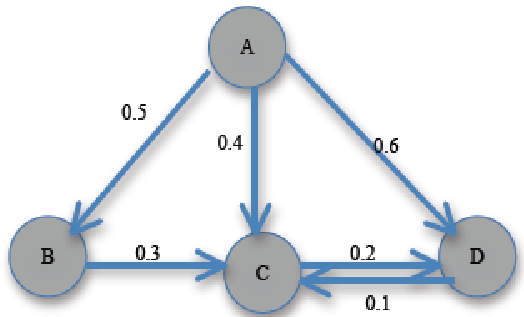 Figure: The CLAS recursive reward mechanism identifying the optimal seed set.
Experiments & Results: Real-World Scale
The authors didn't just test this on "toy" graphs; they used a massive Twitter Dataset (SNAP library) featuring:
- Nodes: 81,306
- Edges: 1,768,149
SOTA Comparison
The traditional "Seeding" approach (exhaustive/brute-force) quickly becomes unusable as the network size increases because it tries to calculate all combinations. In contrast, CLAS operates in Polynomial Time.
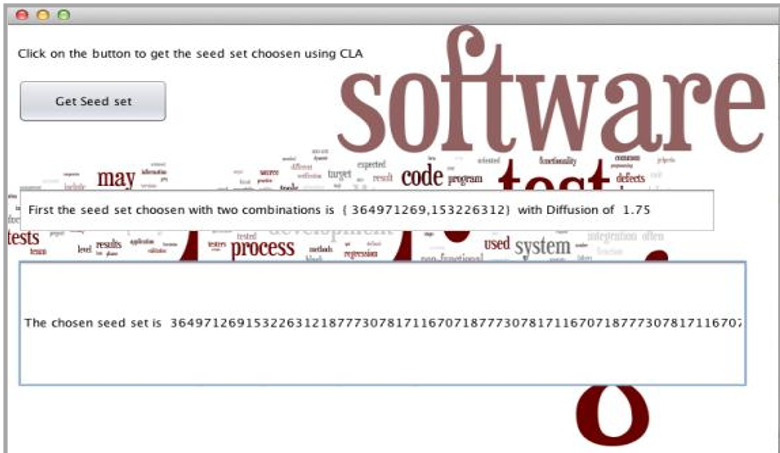 Figure: CLAS identifying a high-influence seed set in the Twitter graph efficiently.
The results showed that CLAS could identify seed sets that reached the "Expected Spread" threshold significantly faster than iterative greedy methods, without the overhead of massive submodular function evaluations.
Critical Analysis & Conclusion
Takeaway
CLAS represents a shift from Global Optimization to Distributed Learning. By treating the social network as a live environment where nodes "learn" their influence value, we can bypass the computational bottlenecks of traditional graph theory.
Limitations
While highly efficient, the paper's current weight generation for social edges is somewhat simplified. In real-world scenarios, the "weight" (probability of influence) is highly dynamic and depends on the specific product or content being shared.
Future Outlook
The next step for this technology is integrating Active Diffusion. Rather than just selecting seeds, the CLA could dynamically adjust the marketing message as it spreads, creating a truly "intelligent" viral campaign that reacts to user feedback in real-time.