
Seemo: A Computational Leap from Discrete Labels to Emotional Continua
Seemo: A Computational Approach to See Emotions
The paper introduces Seemo, a neural embedding framework that maps 197 human emotions into a continuous vector space using 2.2 million hashtag-labeled tweets. By co-training emotion and word vectors via a modified Doc2Vec (DBOW) architecture, it achieves a data-driven quantification of affective states that aligns with traditional psychological theories.
TL;DR
Researchers from IBM Almaden have developed Seemo, a neural embedding framework that translates the abstract nature of human feeling into high-dimensional vectors. By analyzing millions of tweets, Seemo doesn't just "detect" emotion; it creates a coordinate system—a "map of the heart"—that aligns perfectly with classical psychological models like the Valence-Arousal circumplex.
The Cognitive Gap: Why "Happy" and "Sad" Aren't Enough
For decades, the study of emotion has been split between two worlds:
- The Psychologists: Relying on self-reports and 130-item surveys (like PANAS). These are deep but slow, expensive, and often biased.
- The Computer Scientists: Using lexicons (like LIWC) to flag keywords. These are fast but shallow, often ignoring the subtle "texture" of feelings (e.g., the difference between being nervous vs. stressed).
The problem is that emotions are not discrete boxes; they are points on a continuous spectrum. Seemo bridges this gap by using Distributed Representations to learn not just what an emotion is, but how it relates to every other emotion in a shared linguistic space.
Methodology: Mining the "Social Pulse"
Seemo utilizes a modified Doc2Vec (DBOW) architecture. The core intuition is brilliant: if you treat an "emotion" (like #frustrated) as a document ID and use it to predict the surrounding words across millions of tweets, the resulting vector for that ID will capture the semantic essence of that emotion.
The Architecture
The model co-trains Emotion Vectors and Word Vectors simultaneously. This ensures that the vector for "Grief" is mathematically close to words like "loss," "tears," and "missing," even if those words aren't explicitly used as labels.
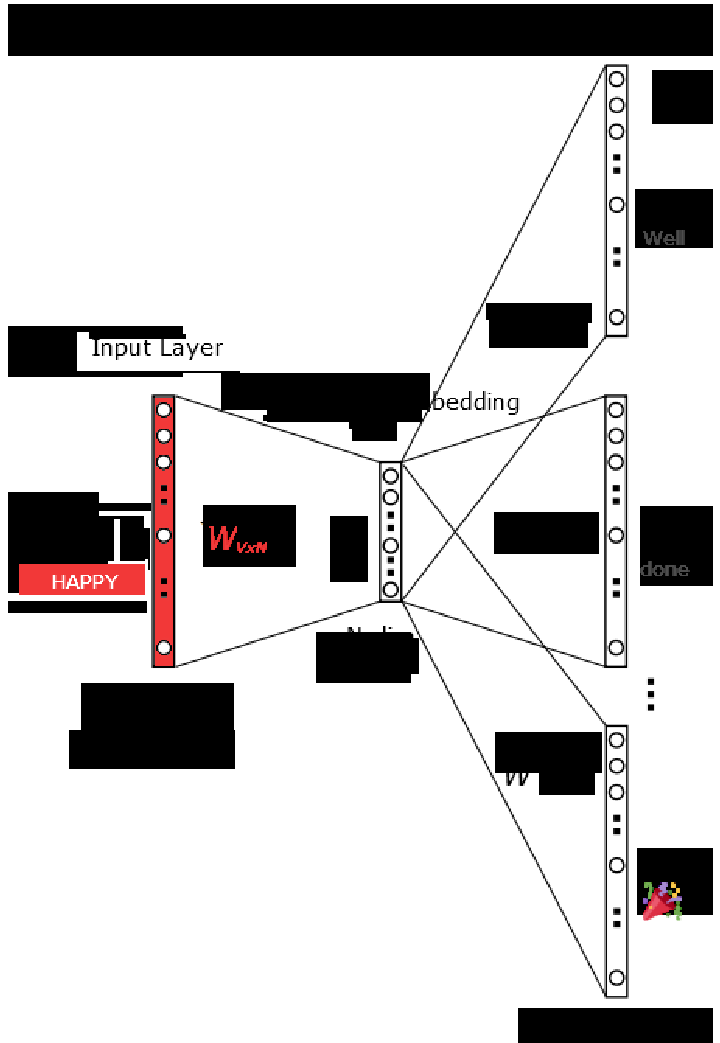 Figure: The DBOW-based training loop using emotion IDs to predict context words.
Experimental Evidence: Visualizing the "Circumplex"
The most striking result of the paper occurs when the authors apply Principal Component Analysis (PCA) to the 197 emotion vectors. Without any prior psychological input, the model naturally organized emotions into the four quadrants of the Valence-Arousal model:
- Quadrant 1 (High Arousal, Negative Valence): Pissed, Ridiculous, Disgusting
- Quadrant 2 (Low Arousal, Negative Valence): Sleepy, Lonely, Bored
- Quadrant 3 (High Arousal, Positive Valence): Honored, Surprised, Passionate
- Quadrant 4 (Low Arousal, Positive Valence): Relaxed, Chilled, Peaceful
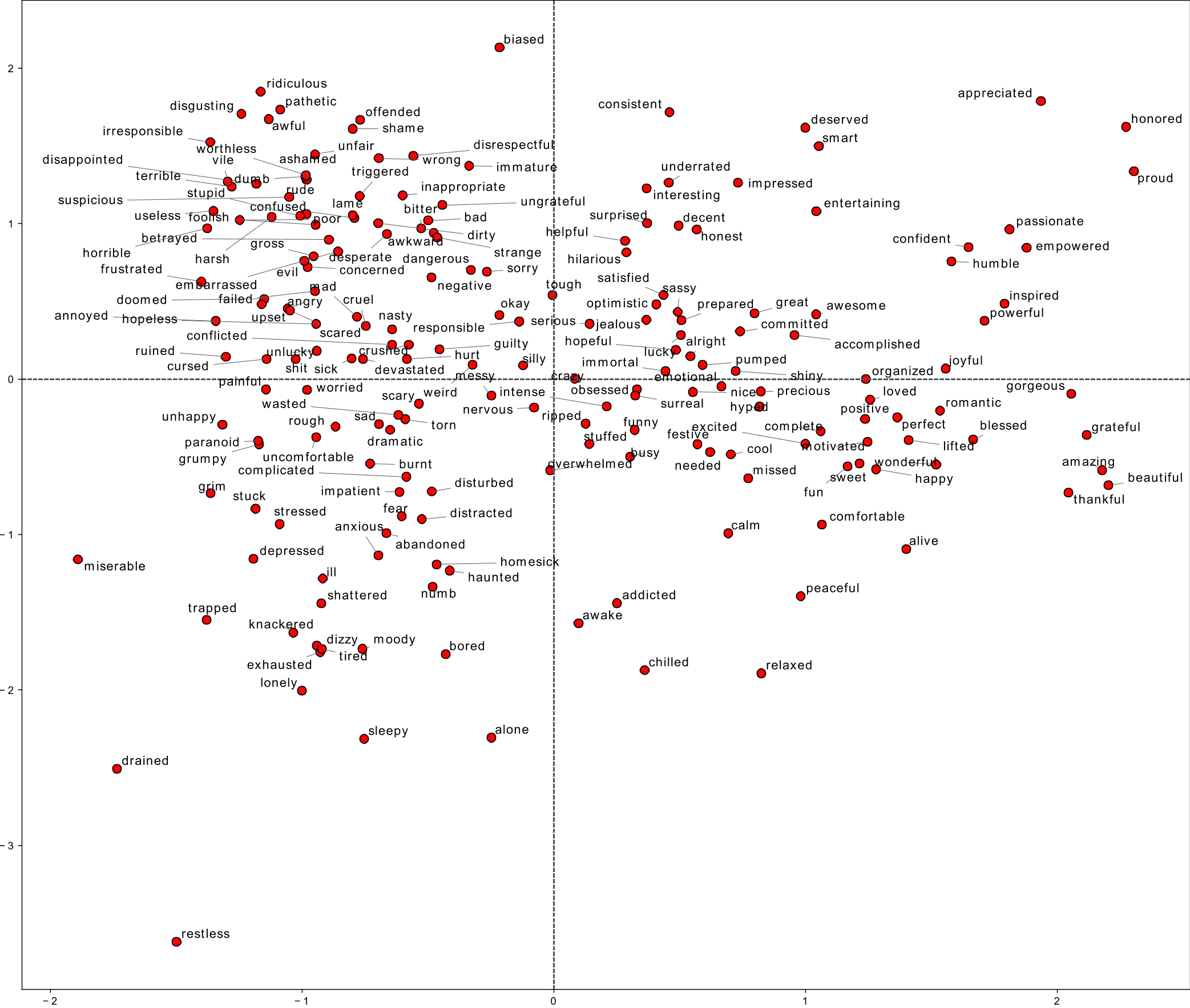 Figure: The Seemo emotion map. Note how it mirrors Russell’s Circumplex Model using purely data-driven methods.
Interestingly, Seemo placed "Excited" in the positive/low-arousal space, diverging from some theories. The authors found this was because, on Twitter, people often pair "excited" with "nervous" (e.g., "Wedding tomorrow! #nervous but #excited"), which dampens the pure "arousal" signal—a nuance only a data-driven model could catch.
Validation: Deciding the "Basic Emotions" Debate
One of the oldest debates in psychology is: What are the "foundational" emotions? The authors tested Seemo against 7 major theories (Ekman, Plutchik, etc.) by using basic emotions as cluster centroids. They found that Johnson-Laird’s theory (Anger, Disgust, Fear, Happiness, Sadness) best explained the clustering of the other 192 emotions, suggesting it is the most linguistically robust framework.
Future Outlook: Beyond Sentiment Analysis
Seemo isn't just an academic exercise; it has massive implications for Affective Computing:
- Customer Service: Detecting when a customer transitions from frustrated to angry—a critical "breaking point" for human intervention.
- Mental Health: Building early-warning systems that detect subtle shifts in "valence" or "arousal" in user journals or social posts.
- Adaptive Systems: E-learning platforms that sense "boredom" (low arousal/negative) and adjust content difficulty in real-time.
Conclusion
Seemo proves that we can "see" emotions through the lens of big data. By transforming subjective feelings into objective vectors, it provides a powerful toolkit for any researcher or developer aiming to build systems that truly understand the human condition.
Limitations: The model relies on Twitter data, which is notoriously noisy and non-grammatical. However, the robustness of the results suggests that with cleaner datasets (e.g., literary works), the resolution of the emotion map will only increase.