
Seg-Zero: Activating Emergent Reasoning for Segmentation via Cognitive Reinforcement
Seg-zero: Reasoning-chain guided segmentation via cognitive reinforcement
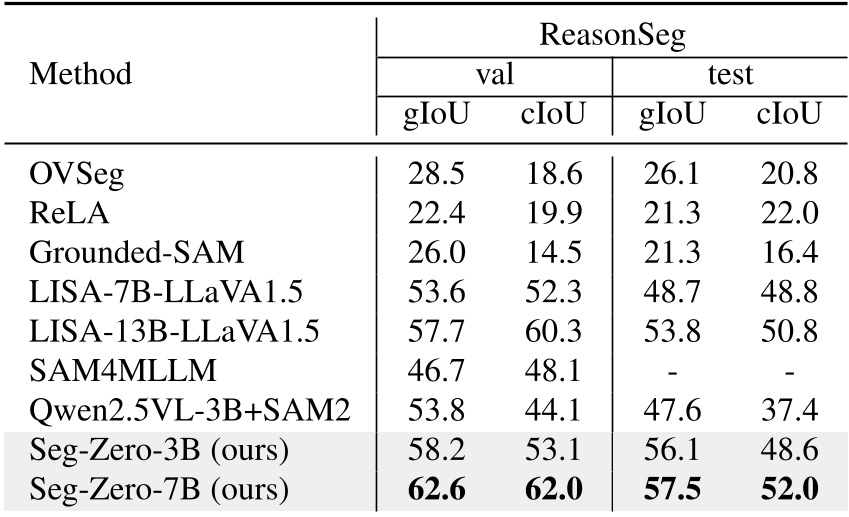
Seg-Zero is a novel reasoning segmentation framework that decouples the visual reasoning process from mask generation. By utilizing a "reasoning model" (Qwen2.5-VL) to produce Chain-of-Thought (CoT) analytical steps and a "segmentation model" (SAM2) for pixel-level masks, it achieves state-of-the-art zero-shot performance on ReasonSeg, outperforming LISA-7B by 18%.
TL;DR
Researchers from CUHK and HKUST have introduced Seg-Zero, a framework that treats reasoning segmentation not as a simple mapping problem, but as a cognitive reasoning task. By ditching traditional Supervised Fine-Tuning (SFT) in favor of Group Relative Policy Optimization (GRPO), Seg-Zero achieves "emergent" Chain-of-Thought (CoT) reasoning. The result is a system that explains why it is segmenting an object before it actually does so, leading to an 18% performance gain in zero-shot scenarios.
The "Black Box" Problem in Segmentation
Current SOTA models for reasoning segmentation, like LISA, have a hidden weakness: they are often overfitted to specific datasets. When you ask them to find "food that provides sustained energy," they might succeed on training data but fail in the wild (Out-of-Distribution). Furthermore, standard SFT often causes catastrophic forgetting, where the model becomes a specialized segmenter but loses its ability to engage in general visual conversation.
The authors identified that the missing link was an explicit reasoning process. Instead of jumping from "Query" to "Mask," the model should analyze the scene first.
Methodology: Decoupling Reason from Execution
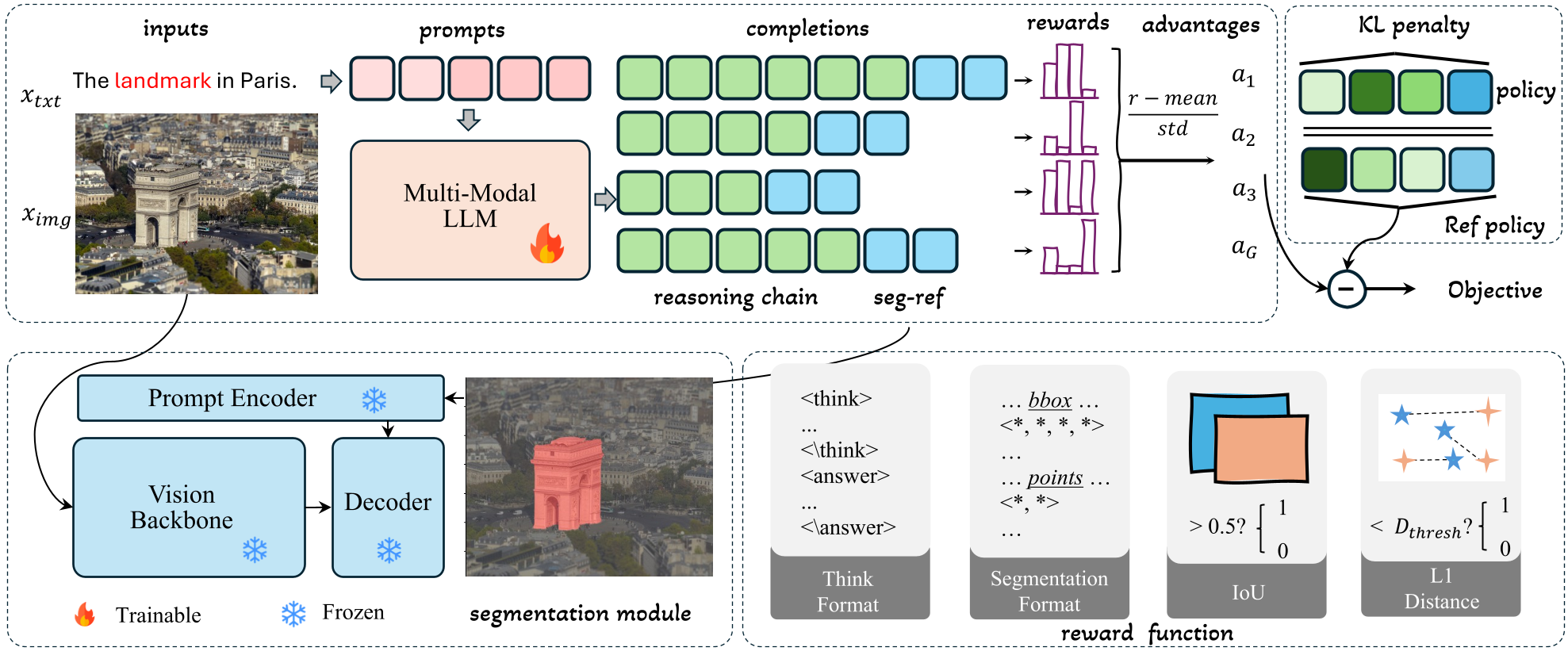
Seg-Zero splits the task into two distinct phases using a decoupled architecture:
- The Reasoning Model (Qwen2.5-VL): This acts as the "brain." It processes the image and the text query to generate a reasoning chain (CoT) wrapped in
<think>tags. It then outputs spatial prompts: a bounding box and two key points. - The Segmentation Model (SAM2): This acts as the "hands." It takes the geometry provided by the brain and performs high-precision pixel-level segmentation.
The Secret Sauce: Pure Reinforcement Learning
Unlike prior works that require thousands of hand-annotated reasoning steps, Seg-Zero uses Pure RL. Inspired by DeepSeek-R1-Zero, the model is guided by a reward system rather than direct instruction:
- Format Rewards: Ensure the model uses
<think>and<answer>tags correctly. - Accuracy Rewards: Calculated based on the IoU (Intersection over Union) and L1 distance between the predicted spatial prompts and the ground truth.
This "trial and error" approach under the GRPO algorithm allows the model to naturally discover that longer, more analytical reasoning chains lead to more accurate localization.
Experimental Results: Reasoning Wins
The most striking finding is the comparison between SFT and RL. As shown in the performance tables, RL consistently improves both in-domain and out-of-domain (OOD) performance.
- Zero-Shot Dominance: On the ReasonSeg benchmark, Seg-Zero-7B reached 57.5 gIoU, smashing previous benchmarks.
- VQA Preservation: While SFT models lose their ability to chat, Seg-Zero retains its full Vision-Language capabilities.
The qualitative results (Figure 7) illustrate how the CoT helps the model distinguish between similar objects. For example, when asked for a vehicle "suitable for a road trip with a place to sleep," the reasoner correctly identifies the Recreational Vehicle (RV) over a standard truck by analyzing the visible bed area and interior features.

Critical Insights
- Format vs. Accuracy: The authors observed a fascinating "U-shaped" curve in response length. Initially, the model outputs short answers to satisfy format rewards; once those are mastered, it begins to "think" longer to maximize accuracy rewards.
- Strict Rewards Matter: Using a "Strict Format" reward leads to significantly better OOD performance compared to "Soft" rewards, as it forces the model to adhere to the logical structure required for complex deduction.
- Decoupling works: By keeping the segmentation model frozen and only training the reasoner, the system benefits from the high-precision "edge handling" of models like SAM2 without needing to re-learn pixel mechanics.
Conclusion & Future Outlook
Seg-Zero proves that cognitive reinforcement can unlock the latent reasoning capacity of Multimodal LLMs for spatial tasks. While currently limited to single-object segmentation, this paradigm shift—from "segmenting by labels" to "segmenting by logic"—paves the way for more autonomous and intelligent robotic vision systems.
Future iterations will likely expand this to multi-object scenarios and iterative "test-time" refinement, where the model can correct its own masks through self-reflection.