
Precise Localization of AI Content: A Change Point Detection Approach
The paper introduces a novel framework for localizing LLM-generated segments within hybrid, human-LLM co-authored documents using Change Point Detection (CPD). It proposes the Weighted Change Point (WCP) and Generalized Change Point (GCP) algorithms, achieving state-of-the-art results in text segmentation by reducing localization errors by up to 50% compared to existing baselines.
TL;DR
As human-AI collaborative writing becomes the norm, binary "AI vs. Human" detection is no longer enough. This paper shifts the paradigm from classification to localization by treating text as a time series. By adapting a statistical technique called Change Point Detection (CPD), the authors can pinpoint the exact moment an LLM takes over the pen, reducing error rates by up to 50%.
The Localization Crisis: Why Binary Detectors Fail
Most current AI detectors (like FastDetectGPT or Binoculars) give you a single score for a whole document. But what if you wrote the methodology and used an LLM for the abstract?
The naive approach—running a detector on every individual sentence—fails because:
- Short-Sentence Noise: Short sentences provide very little statistical signal, leading to erratic "flip-flopping" labels.
- Context Blindness: Individual sentence scores don't account for the transition logic of a document.
Methodology: Text as a "Signal"
The authors propose that authorship transitions are identical to Change Points in time-series data—sudden shifts in the mean and variance of a signal.
The Weighted CUSUM Statistic
They introduce WCP (Weighted Change Point) detection. Instead of treating every sentence equally, they weight the detection scores based on their reliability. If a sentence is long, it gets a higher weight; if it's short, its score is treated with skepticism.
Mathematically, they adapt the Narrowest-Over-Threshold (NOT) algorithm. Instead of a single pass, the algorithm looks at various random intervals of the text to find the most "stable" boundaries.
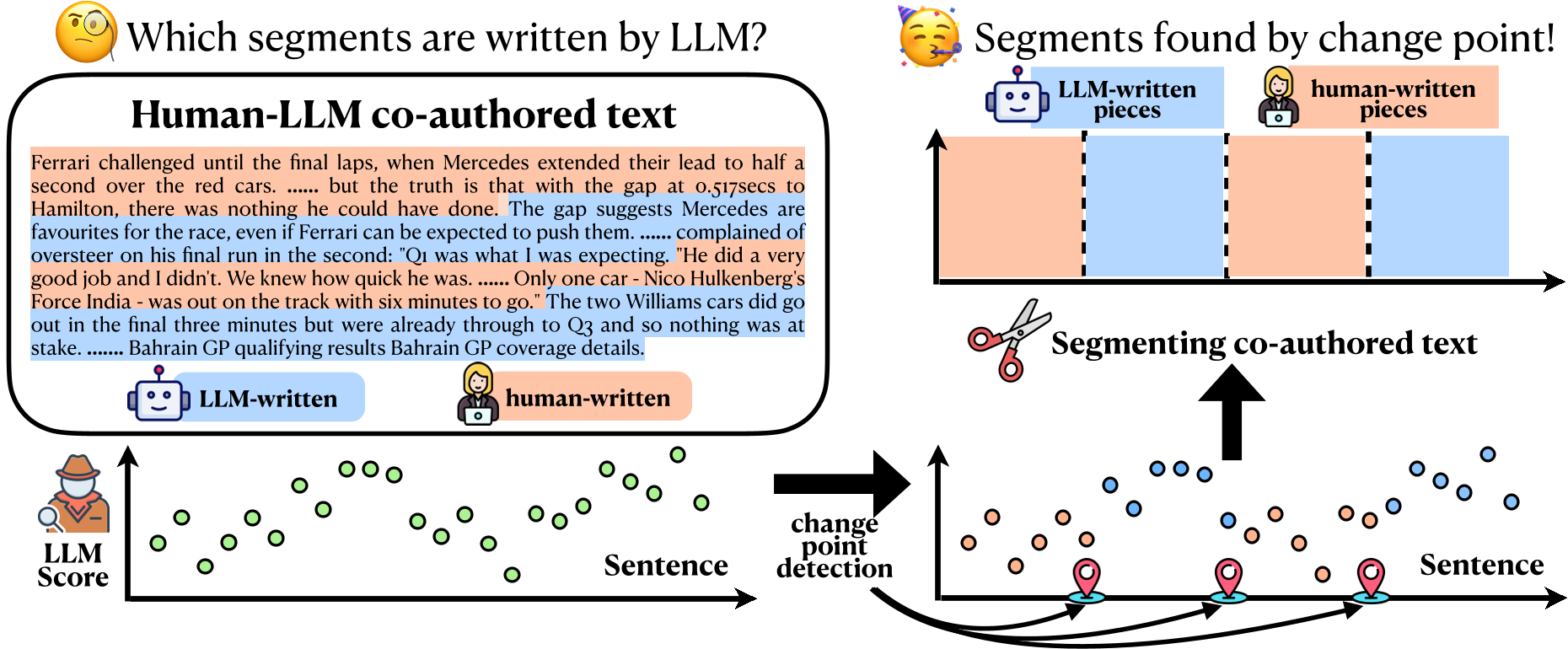 Figure 1: The workflow from raw text to detection scores, and finally to segmented authorship via CPD.
Minimax Optimality
The paper isn't just empirical; it provides a rigorous proof that their weighted approach is Minimax Optimal. This means that under the given noise conditions (heterogeneous sentence lengths), no other algorithm can theoretically achieve a lower error rate.
Experimental Battleground
The team tested their methods against diverse baselines, including direct LLM prompting and specialized detectors like PaLD and SegFormer.
Performance Highlights:
- Single & Multiple Transitions: In both cases, WCP consistently showed the lowest WindowDiff (WD), a metric specifically designed to penalize misplaced boundaries.
- Robustness: The method remained effective even under "adversarial" conditions like paraphrasing humans or deliberately making AI text less coherent (decoherence).
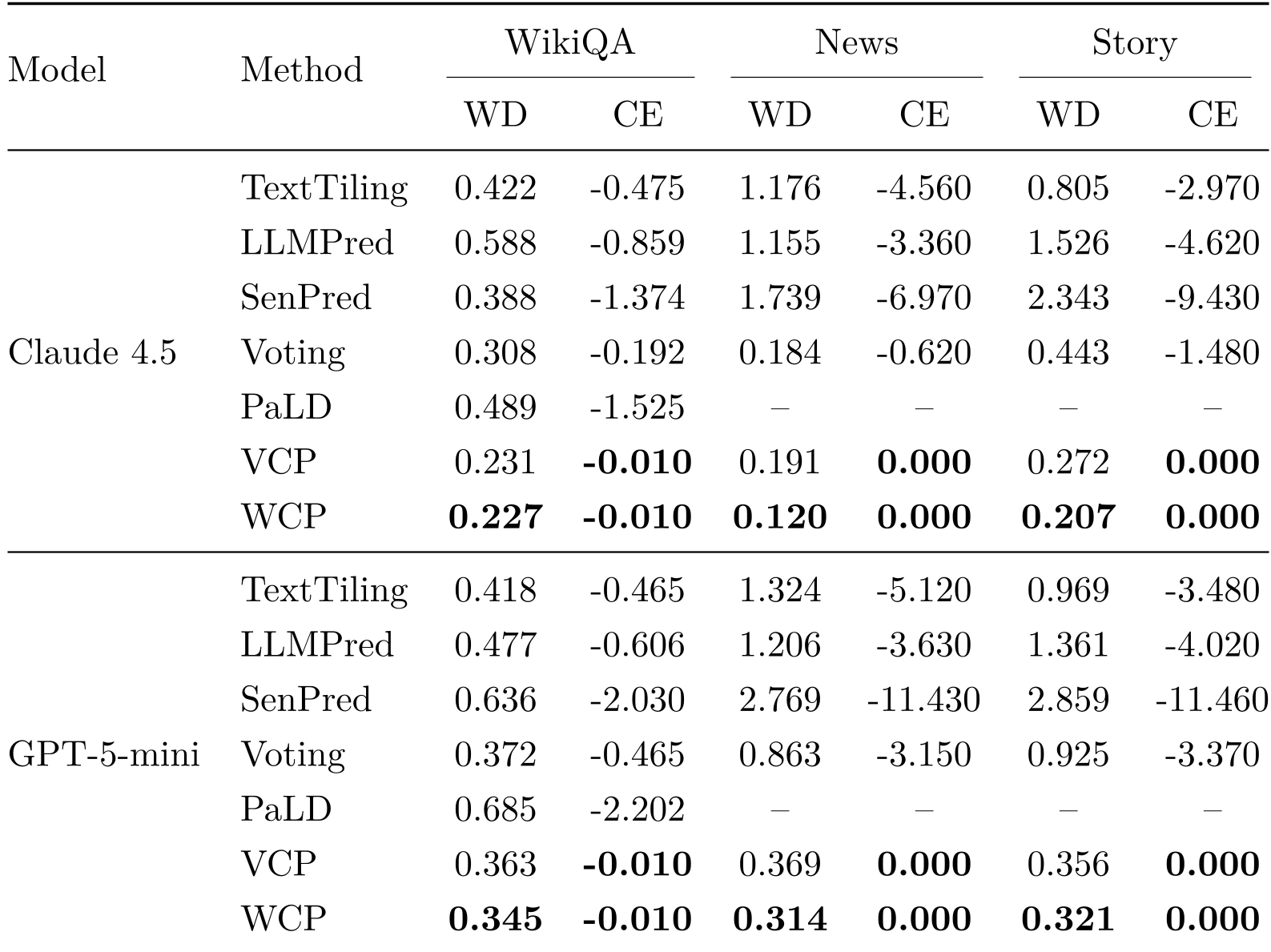 Table 1: Comparison showing WCP achieving the best (lowest) WD scores across Claude and GPT-generated datasets.
Real-World Mastery: The CoAuthor Dataset
The true test came with the CoAuthor Dataset, which contains actual human-GPT-3 interactions. The task was expanded to a three-class segmentation:
- Fully Human
- Fully LLM
- Collaboratively Written (Edited)
Surprisingly, the unsupervised WCP algorithm performed on par with or better than SegFormer (a complex supervised model), proving that a sound statistical foundation can often beat "black-box" training.
Critical Insight & Future Outlook
The brilliance of this work lies in the weighting. By recognizing that not all sentences provide the same amount of information, the authors solved the "fluctuation" problem that plagued previous sentence-level detectors.
Limitations: The algorithm's accuracy is still dependent on the quality of the "base" detector (the function). If the base detector is biased against a certain style, WCP will segment based on that bias.
The Takeaway: We are entering the era of "Provenance Statistics." Tools like WCP will likely be integrated into academic integrity platforms and CMS editors to provide a transparent "heatmap" of authorship, ensuring AI is a tool for assistance, not a tool for deception.