
Beyond Chaos: Modeling Social Segregation via Markov Bridge Processes
Segregation In Social Networks: Markov Bridge Models And Estimation
2024-10-01
Summary
Problem
Method
Results
Takeaways
Abstract
The paper introduces a novel community-based graph model that represents social segregation as a Markov bridge process. It leverages inhomogeneous Bayesian filtering (the Hidden Markov Bridge Filter) to recursively estimate segregation levels from noisy, partially sampled network data, outperforming traditional Hidden Markov Models (HMM).
## TL;DR
Social networks aren't just static snapshots; they are living systems that oscillate between integration and segregation. This paper introduces a **Markov Bridge (MB)** framework to model these transitions, specifically for events with known "end-points" like limited-time marketing campaigns. By using a specialized **Hidden Markov Bridge (HMB) filter**, the authors reduce estimation errors by 30% compared to standard HMM approaches.
## The Motivation: Why HMMs Fail at Social Events
In computational sociology, we often track how groups polarize or coalesce. Most existing models use **Hidden Markov Models (HMM)**, which assume that the time a system spends in a state follows a geometric distribution.
However, real-world social events—like a Black Friday sale or an election cycle—have **deterministic timing**. We know exactly when the "integration" state begins and when it must end. This "clamped" nature of reality is exactly what a **Markov Bridge** occupies: it is a one-dimensional Markov random field where the initial and final states are fixed.
## Methodology: The Anatomy of a Segregated Network
### 1. The Markov Bridge Model
The authors focus on a company-customer network. They divide nodes into "Fans" (stable loyalists) and "Utilitarian Customers" (sensitive to sales). The edge weight $W_{ij}(t)$ between the company and utilitarian customers evolves as a Markov Bridge.
Unlike a random walk, the MB transition probability is conditioned on the future state:
$$B_{a,b}^c(t) = P\{W_{ij}(t+1)=b | W_{ij}(t)=a, W_{ij}(T)=c\}$$
This ensures the network "knows" it must reach a specific level of connectivity by time $T$.
### 2. Monitoring via Conductance
To quantify segregation, the paper uses **Graph Conductance** ($\phi$), a metric of how easily a graph can be "cut" into two disconnected components.
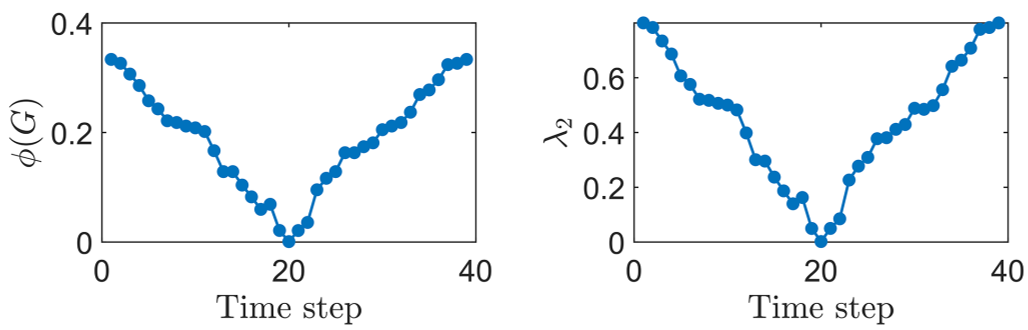
*Fig 1: The paper demonstrates that conductance is a reliable proxy for algebraic connectivity, showing a clear dip during segregation events.*
### 3. The Hidden Markov Bridge (HMB) Filter
Since we cannot see every edge in a massive network, the authors use **random edge sampling** (observing only a fraction $\gamma$). They prove via Monte Carlo simulations that the resulting observation noise is approximately **Gaussian**. This allows the deployment of a recursive Bayesian filter—the HMB filter—to track the "hidden" state of the network's segregation.
## Experiments: Proving the Advantage
The researchers simulated a network of 31 nodes over $(2T-1)$ time steps. They compared their HMB filter against a standard HMM filter that ignores the "bridge" constraint.
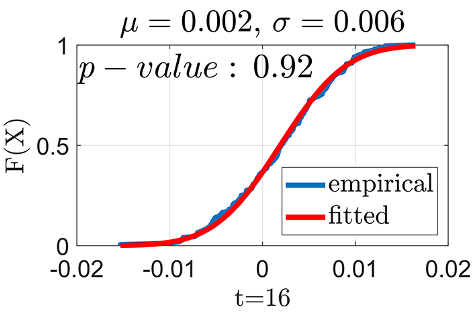
*Fig 2: Mean-Squared Error (MSE) results. The HMB filter (solid blue) consistently stays below the HMM (red dashed), regardless of the sequence length T.*
**Key Findings:**
- **Precision**: The HMB filter provides a ~30% improvement in accuracy.
- **Efficiency**: The filter requires only a small sample of total edges to maintain high tracking performance.
- **Robustness**: The Gaussian noise approximation holds true even with sparse sampling.
## Critical Insight: The Value of "Knowing the End"
The core "win" of this paper is the realization that **intent matters**. In many social and physical systems, we know the destination. Standard HMMs are "memoryless" regarding the future; HMBs are "destination-aware."
### Limitations & Future Work
While the model is elegant, it assumes a fixed network structure where only weights change. In real social networks, nodes appear and disappear (churn). Extending the HMB framework to **dynamic topologies** where the number of vertices $|V|$ is non-constant would be a significant next step for the field of computational social science.
## Conclusion
The "Markov Bridge" approach offers a powerful new lens for Signal Processing in social contexts. Whether tracking political polarization or customer churn during a marketing blitz, incorporating the deterministic "bridge" of the event schedule leads to far superior state estimation than traditional stochastic models.