
Selective Propagation: Solving the Privacy-Relevance Paradox in Decentralized Social Networks
Selective Propagation of Social Data in Decentralized Online Social Network
This paper introduces a Decentralized Online Social Network (DOSN) architecture designed to enhance user privacy and curb information overload. The core method, "Selective Propagation," utilizes a relationship model that adaptively filters social data based on user feedback across different semantic interest categories.
TL;DR
The dominance of centralized social networks like Facebook has created "information silos" where users trade their privacy for connectivity. This paper proposes a decentralized architecture where users host their own data and uses a dynamic relationship model to filter out the noise. By calculating relationship "strengths" based on semantic feedback, the system ensures that you only receive updates your friends actually care about, without a central server ever seeing your data.
Background: The Price of Centralization
Current Online Social Networks (OSNs) face two terminal problems:
- Privacy Loss: To share a photo with a friend, you must first give it to a corporation that mines it for ads.
- Information Overload: With an average of 130+ friends, users are flooded with irrelevant updates.
While Decentralized OSNs (DOSNs) solve the privacy issue by letting users host their own FOAF (Friend-of-a-Friend) files or P2P nodes, they often lack the "smart" filtering that centralized algorithms provide. The authors argue that we need a way to filter information at the source (the sender's side) before it even hits the network.
Methodology: Semantic Relationship Modeling
The hallmark of this research is move from "one-size-fits-all" friendship to context-aware relationships.
The Feedback Loop
The system treats every interaction as a data point. When you "Like," "Comment," or even just "Ignore" a post, your agent sends a feedback signal (F) back to the sender.
- Type 1 (Share/Comment): High interest (F = 0.9)
- Type 4 (Ignored): Low interest (F = 0.3)
The Mathematical Intuition
The strength of a relationship () for a specific interest category () is updated using:
This is essentially a moving average that gives the relationship "inertia." It prevents a single irrelevant post from destroying a friendship link but allows the connection to "fade away" if interests diverge over time.
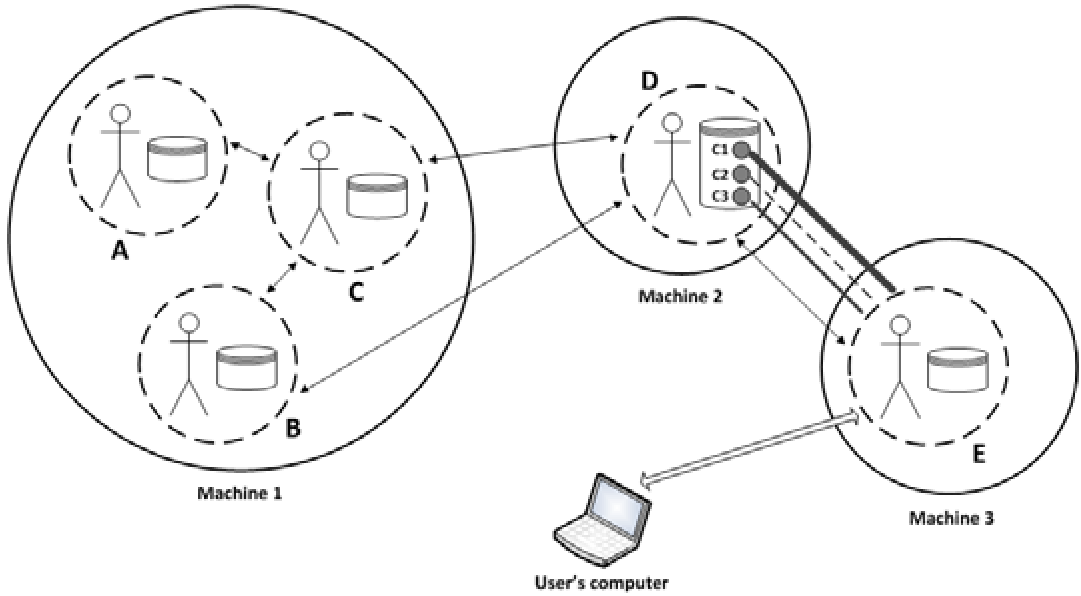 Figure 1: In this DOSN architecture, User D propagates "Category 1" content to User E because their relationship is strong, but filters "Category 2" content due to a weak relationship strength.
Experiments: Simulating a 1-Million Node World
To prove this works at scale, the authors designed a simulation using:
- Datasets: Real-world graph structures from Facebook and StudiVZ.
- Interest Distribution: 25 categories (e.g., sports, news) distributed exponentially to mimic real-world "preferential attachment" (where popular topics stay popular).
Key Observations:
- System Convergence: The relationship models successfully "learn" friend interests. Over time, the number of irrelevant messages circulating in the network drops significantly.
- Sender-Side Computation: By performing the filtering at the sender's node, the system saves bandwidth across the entire network—a crucial requirement for P2P systems with limited resources.
 Equation 1: The core mechanism for updating relationship weights based on incoming feedback.
Critical Analysis & Conclusion
Takeaway
The paper shifts the burden of "relevance" from a centralized AI to a distributed set of small, local models. This is a significant step toward Sovereign Social Networking, where the user’s agent acts as a protective gatekeeper.
Limitations
- Cold Start: Initially, the system sets all relationship strengths to 1, meaning everyone gets everything until the system "learns." This could be annoying during the first week of use.
- Tagging Burden: The system assumes content is tagged with categories. While the authors mention "extracting semantics," the accuracy of local NLP on edge devices remains a challenge.
Future Outlook
This work paves the way for "Local-First" social media. In an era where Twitter/X and Meta are under fire for algorithmic transparency, a system where you control the filtering logic through your own relationship model is a compelling alternative.