
Decoding Social Choice: The Mathematical Mechanism of Online Interaction
Research on the selecting mechanism of individual interactive object for online social network
This paper proposes an Individual Interactive Model designed to quantify and predict how users select interaction objects in Online Social Networks (OSNs). By integrating familiarity and similarity metrics, the method achieves a predictive accuracy rate of up to 50% for future user interactions on real-world platforms.
TL;DR
Human behavior on social media isn't random. This paper introduces a quantitative Individual Interactive Model that predicts who a user will talk to next by measuring "Interaction Possibility" (IP). By balancing past familiarity with demographic and interest-based similarity, the model successfully predicted 50% of real-world interactions on a Chinese social platform.
Academic Context: This work moves beyond traditional human dynamics (which focus on when people act) to address the where and with whom—the selective mechanism of social connectivity.
The "Why" Behind the Click: Motivation
For decades, social scientists assumed human activity followed a Poisson distribution. However, the "big data" era revealed that we are bursty and selective. While we know people prefer "familiar" and "similar" others (Homophily), quantifying this into a predictive algorithm is difficult. Most existing SOTA models focus on topological growth (how the network forms) rather than the microscopic decision-making of an individual user selecting a specific target from hundreds of friends.
Methodology: The Interaction Possibility (IP) Framework
The core contribution is the Interaction Possibility (IP) formula:
1. Quantifying Familiarity ()
The authors treat the social network as a weighted graph. Familiarity isn't just a binary "friend" status; it's a measure of past communication intensity. Using the "Six Degrees of Separation" principle, they calculate weights based on the minimum message count across paths between nodes.
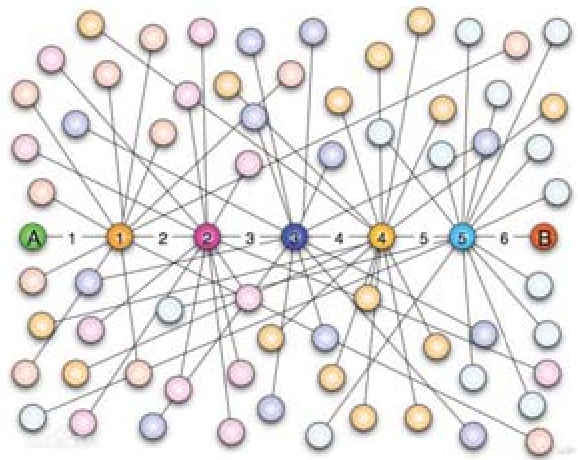 Figure: The model re-arranges the network into 7-layers of concentric circles based on the root user's distance.
2. Quantifying Similarity ()
Similarity is split into:
- External Similarity (): Age and education levels.
- Internal Similarity (): A 6-dimensional interest vector (Work, Life, Mood, etc.).
- The Balancing Act: The authors use an adjusting coefficient . When interacting with strangers, external traits (age/job) matter more; when interacting with friends, internal interests take over.
Experiments and Empirical Evidence
The researchers crawled data from two distinct Chinese platforms: Renren (Facebook-like) and China Mobile Group Blog.
SOTA Comparison and Veracity
First, they verified that the crawled networks follow Power-law distributions and Small-world principles, ensuring the data was representative of real human society.
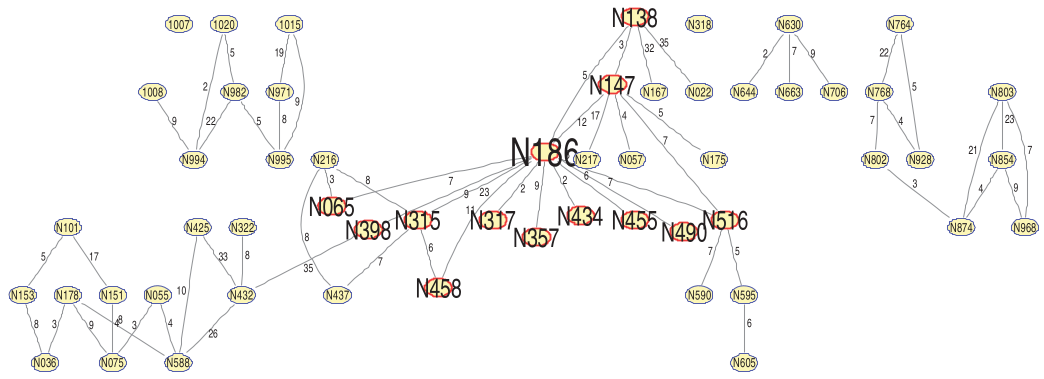 Figure: Simulation of interaction messages on the Blog platform. Red nodes represent the root user's active selections.
Predictive Power
The most impressive result was the predictive accuracy. By calculating the IP values in June, the model predicted the top 10 most likely interaction objects for July.
- Accuracy: 40% (July), 50% (August).
- Insight: Relative IP is significantly more meaningful than absolute values; the model effectively "ranks" potential social targets.
Critical Insight & Outlook
The value of this paper lies in its Inductive Bias: it assumes that social interaction is an optimization problem where users seek the highest "relational resonance."
Limitations:
- The model currently ignores the type of interaction (e.g., a "like" vs. a long "comment").
- The interest vectors are manually categorized into 6 types; in a modern transformer-based world, these could be replaced with LLM-generated embeddings for much higher resolution.
Future Work: This framework provides a solid foundation for building recommendation engines that don't just show you "the most popular" content, but content from the "most probably interactive" person in your social orbit.