
Beyond Interests: Rethinking Activity Selection in the Social Web
Selection and Ranking of Activities in the Social Web
The paper introduces a comprehensive semantic framework for selecting and ranking real-life social activities (Spatial-Temporal Objects or STOBs) within social networking services. By integrating thematic interests with spatiotemporal constraints and social signals, the proposed system significantly outperforms traditional content-based recommenders in predicting user participation.
TL;DR
Recommending a physical event is fundamentally different from recommending a book or a movie. This paper introduces a semantic framework that moves beyond simple "Thematic Interest" by integrating Feasibility (calendar availability) and Reachability (geographical distance) into the social recommendation engine. The result is a more accurate and human-centric system that understands the physical and temporal costs of participation.
The "Activity" Problem: Why Movies and Events Aren't the Same
Most recommendation engines are designed for "evergreen" items. If you like Inception, you'll likely like Interstellar regardless of when or where you are. Real-life activities (STOBs - Spatial-Temporal Objects) have three brutal constraints:
- Ephemerality: Once a concert is over, the recommendation is worthless.
- Physicality: You must be physically present at a specific latitude and longitude.
- Exclusivity: You cannot attend two overlapping events simultaneously.
The authors argue that current social network "Events" features fail because they ignore the user's propensity to move and their existing calendar commitments.
Methodology: The Anatomy of a Recommendation
The framework operates in two distinct phases: Selection and Ranking.
1. Selection (The Filter)
This phase acts as a "hard gate," discarding activities that are geographically impossible or fall below a baseline interest threshold. It reduces the computational load by focusing only on the "working pool."
2. Ranking (The Intelligence)
This is where the magic happens. The system calculates specialized factors:
- Feasibility (FSB): Checks if the user actually has time between existing appointments (including travel time).
- Reachability (RCH): Measures the distance against the user’s "propensity to move."
- Social Interest (SOC): Not just "likes," but a weighted score where "Joined" friends count more than "Interested" ones.
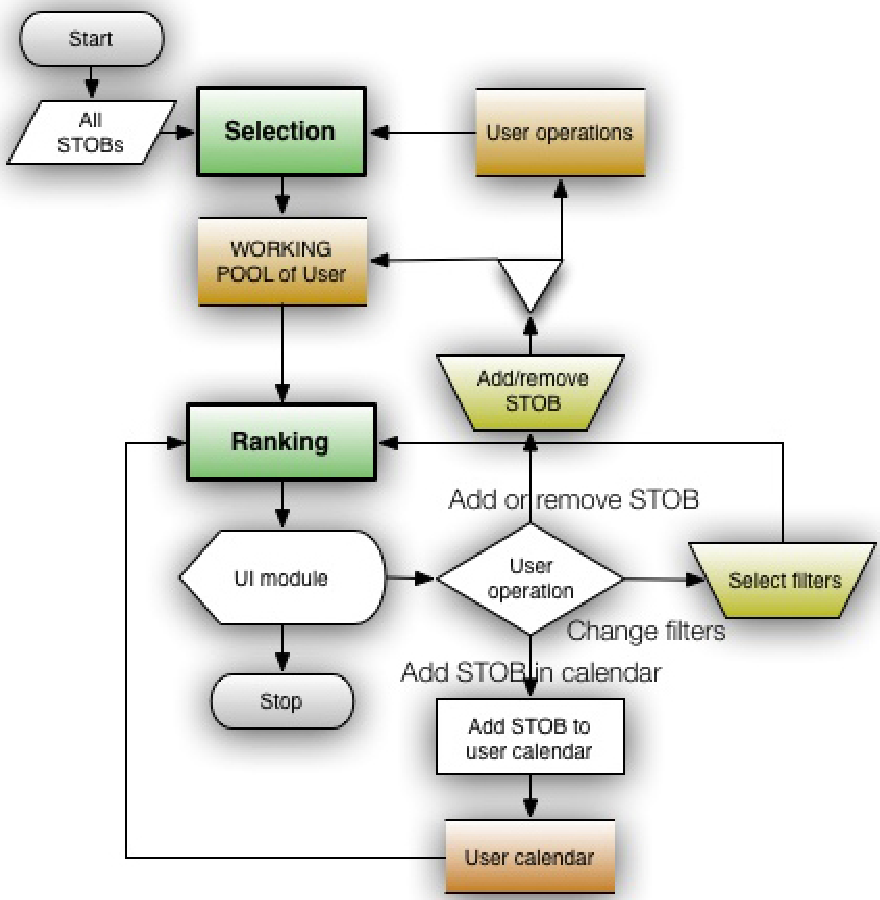
The final rank is a weighted sum of these factors, allowing users to fine-tune their experience (e.g., "I'm willing to travel more today for live music").
Mathematical Intuition: Reachability & Feasibility
The paper doesn't just use binary distance. It uses a linear decay function for reachability: This accounts for the user's "center" (c) and their flexible movement radius (). Similarly, feasibility is defined as 0 if the user can attend less than half the required time, scaling linearly up to 100% if they can attend the full duration.
Experiments: Proving the Need for Context
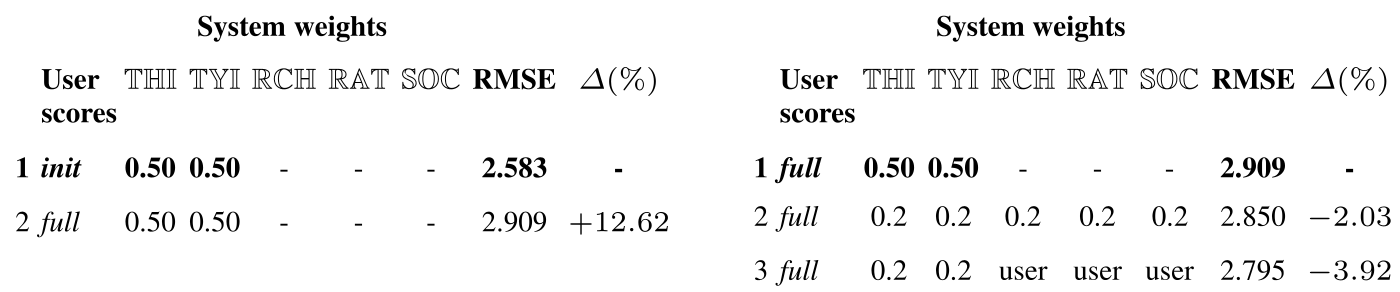
The authors conducted a user study with 200 participants across 15 events. They tested several configurations to see how "Accuracy" (measured by RMSE) shifted.
Key Findings:
- Context Matters: Recommending based only on "Themes" (THI) and "Type" (TYI) while the user is actually weighing distance and friends' presence led to a 12.62% increase in error.
- User Weights are Superior: When users could weight their own factors (Social vs. Distance), the system achieved its best performance, reducing error by 3.92%.
Critical Insight & Conclusion
This paper serves as a bridge between Semantic Web (using OWL 2 ontologies to describe events) and Context-Aware Computing.
The Takeaway: High-quality social recommendation involves more than just understanding what the user likes; it requires understanding the logistical friction of their daily life. While the evaluation is subjective (user-reported scores), the logic is sound: a recommendation you can't attend is no recommendation at all.
Future Outlook: The next frontier is Group Recommendation. How do we find an activity that is feasible and reachable for four friends with different calendars and locations? This framework provides the mathematical foundation to start solving that puzzle.