
Selective Robust Image Encryption: Balancing Privacy and Social Media Usability
Selective Robust Image Encryption for Social Networks
The paper introduces a robust and selective image encryption scheme designed for Social Networks, utilizing Discrete Cosine Transform (DCT) coefficient shuffling. The method maintains decodability even after lossy JPEG compression and downsizing, achieving high image quality (PSNR > 35dB) after recovery from significant degradation.
TL;DR
Researchers have developed a new image encryption scheme tailored for social networks like Facebook and Twitter. Unlike traditional encryption that breaks if a single pixel changes, this method allows images to be resized and compressed by the platform while still remaining decryptable. It uses DCT Coefficient Shuffling and a clever Scaling Factor to ensure high recovery quality (PSNR > 35dB) while offering a "selective" mode that shows a blurred preview to unauthorized users.
The "Social Media" Paradox in Encryption
In a typical cryptographic setup, ciphertext is immutable. However, social media platforms are "active" intermediaries: they automatically downsize high-resolution uploads and apply heavy lossy JPEG compression to save bandwidth.
If you upload a standard AES-encrypted image to Facebook, the platform's re-compression will scramble the bits, making decryption mathematically impossible at the receiver's end. This forces a trade-off: do we sacrifice our privacy to the platform, or do we lose the ability to use social sharing features?
Methodology: Shuffling in the Frequency Domain
The authors propose that the solution lies not in the pixels themselves, but in their frequencies. Since JPEG compression and resizing primarily act as low-pass filters (removing high-frequency details), encryption should be applied in a way that aligns with this physical reality.
1. DCT Shuffling & Scaling
The core mechanism involves:
- Transforming image blocks into the Discrete Cosine Transform (DCT) domain.
- Shuffling coefficients that have the same spatial frequency across different blocks. This ensures that the global statistical properties remain somewhat stable, aiding robustness.
- The Scaling Hack: To solve the common problem of "overflow" (where shuffling causes pixels to go beyond the 0-255 range, creating ugly white/black artifacts), the authors introduce a scaling factor . By scaling coefficients down before shuffling and up after, they tighten the image histogram and significantly boost PSNR.
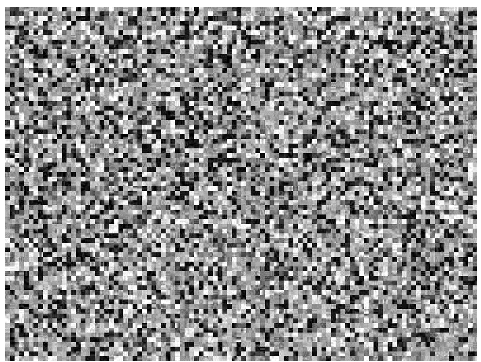 Figure: (a) Original, (b) Shuffling without scaling - note the noise, (c) Shuffling with scaling - notice the narrowed contrast in the histogram (e).
2. Selective Encryption (Privacy with a Preview)
One of the most practical features is Selective Encryption. By choosing not to shuffle the DC (0-frequency) coefficients, the encrypted image looks like a heavily blurred version of the original.
- Public: Can see a "thumbnail" or blurred gist of the image.
- Authorized Friends: Can use the key to restore the high-frequency shuffled components, regaining the sharp, full-detail image.
Experimental Performance
The researchers stress-tested the algorithm against the two biggest "killers" of encrypted data: Compression and Downsizing.
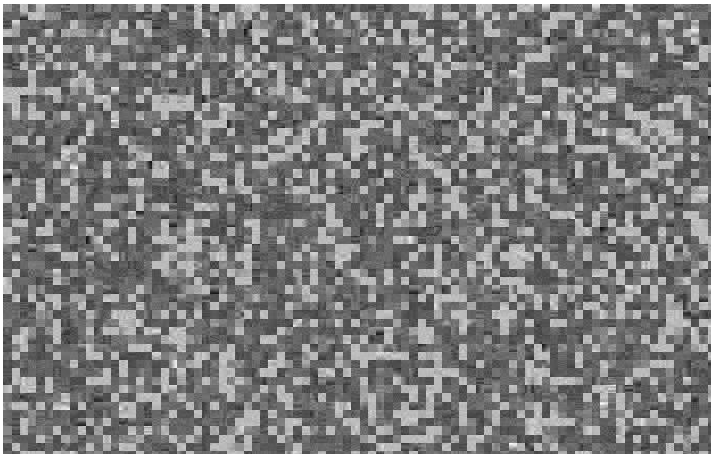 Figure: (a) Full encryption result looks like white noise. (b) Successful decryption even after JPEG Q80 compression.
Key Findings:
- JPEG Robustness: Even at a low quality factor of Q50, the median PSNR stays around 35dB, which is considered good quality for human viewing.
- Geometric Robustness: When the image is downsized to 90% of its size and compressed at Q75, the selective encryption version maintains a PSNR of ~33.8dB.
| Encryption Type | JPEG Q100 | JPEG Q80 | JPEG Q60 |
|---|---|---|---|
| Full (64 coef) | 43.37 dB | 36.78 dB | 35.31 dB |
| Selective (63 coef) | 43.65 dB | 36.83 dB | 35.34 dB |
Critical Insight & Future Outlook
While the security of this method relies on the strength of the shuffling key (potentially using chaotic sequences), it is fundamentally a "translucent" encryption rather than a "black box."
Pros:
- Real-world compatibility with social media pipelines.
- Low computational overhead (DCT is natively supported by hardware).
- Prevents "blown out" pixels via the scaling factor.
Cons:
- Security-Robustness Trade-off: The more robust the encryption (by leaving more low frequencies un-shuffled), the more information is leaked to a casual observer or an AI de-blurring attack.
- Vulnerability: Shuffling-only encryption is often susceptible to known-plaintext attacks or jigsaw-solver algorithms if the block size is too large or patterns are too predictable.
Conclusion: This paper provides a crucial building block for "Client-to-Client" security on Web 2.0/3.0 platforms, proving that we don't have to choose between a broken image and a total loss of privacy.