
Beyond Model Size: Selective Shallow Integration for High-Speed Emotion Detection
Selective shallow models strength integration for emotion detection using GloVe and LSTM
The paper introduces a novel emotion detection technique that integrates "Selective Shallow Models" to achieve high performance with minimal computational overhead. By combining parallel LSTM-based shallow architectures using GloVe embeddings, the system achieves 86.16% accuracy while maintaining a real-time inference speed of 0.98ms per input.
TL;DR
In the race for larger and deeper models, Aditya Vijayvergia and Krishan Kumar provide a refreshing counter-perspective. Their paper proposes a system that selectively combines the strengths of two shallow LSTM-based models to achieve 86.16% accuracy with an incredible inference speed of 0.98ms. This architecture is designed specifically for real-time monitoring of public sentiment to predict social unrest.
Problem & Motivation: The Real-Time Bottleneck
While deep learning has pushed the boundaries of Emotion Detection (ED), it has introduced a "compute tax." Large models (like Transformers or deep GRUs) are often too slow for real-time processing of high-volume social media streams. Furthermore, a single "monolithic" model often struggles to balance the variance and bias needed to detect diverse emotions like 'shame' versus 'joy.'
The authors' insight is grounded in a "Divide and Conquer" strategy: instead of one model trying to learn everything, why not use two smaller models that focus on different linguistic distances?
Methodology: The "Strength Integration" Architecture
The proposed framework is divided into four distinct phases, prioritizing parallel execution and specific feature extraction.
The Two-Pronged Approach
- Phase 1 (Embedding): Sentences are tokenized and converted into 100-dimensional vectors using GloVe (Global Vectors for Word Representation).
- Phase 2 (The Short-Range Expert - Model A): A 3-layer LSTM stack designed to catch local dependencies. This model excels at identifying 'Joy' and 'Disgust'.
- Phase 3 (The Long-Range Expert - Model B): This model uses a 1D-Convolution layer to compress features before feeding them into a 2-layer LSTM. The convolution acts as a spatial filter, helping the model grasp long-distance relations. This model is superior for 'Guilt' and 'Fear'.
- Phase 4 (Selective Integration): A final fully connected layer learns to assign higher weights to whichever "expert" is more reliable for a specific emotion class.
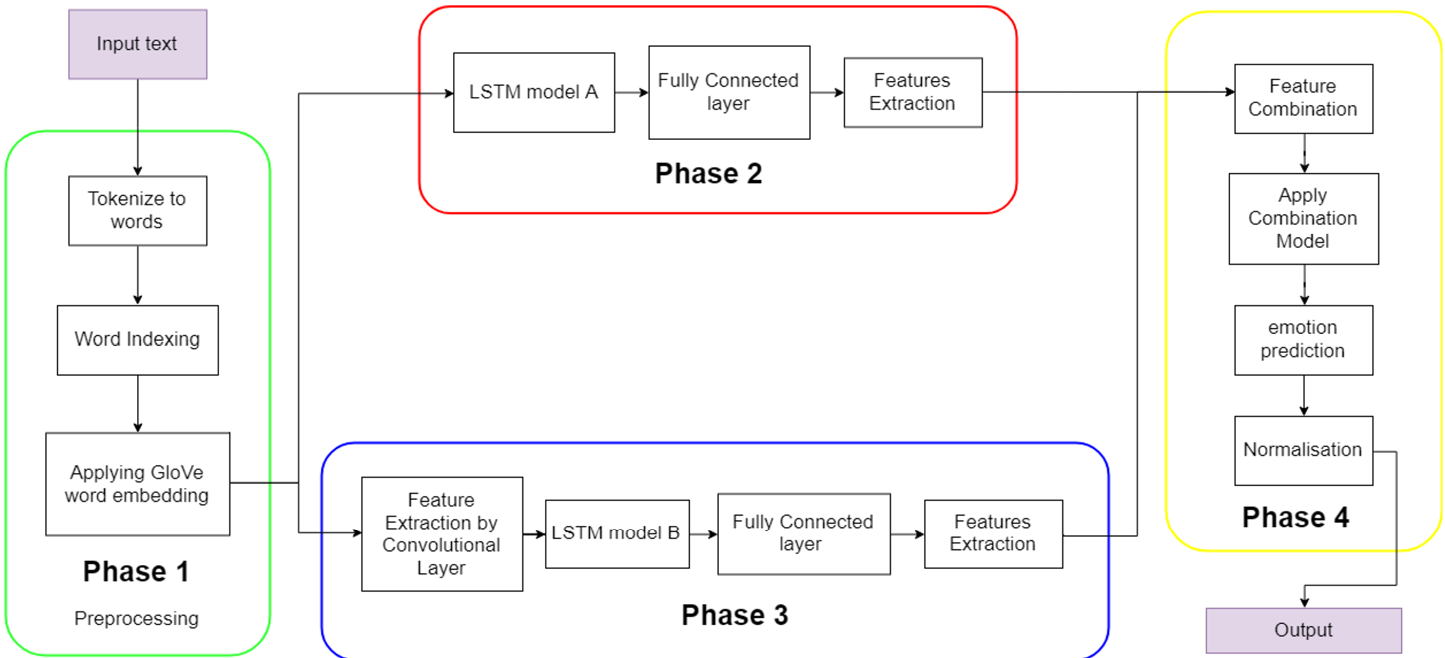 Figure 1: The four-phase pipeline showing parallel feature extraction.
Experiments & Results: Efficiency Meets Accuracy
The authors tested their model against a self-labeled Twitter dataset and established baselines.
Key Performance Metrics:
- Accuracy: The combined model hit 86.16%, outperforming Model A (81.03%) and Model B (80.96%) individually.
- Latency: The "Proposed Combination" takes only 0.98ms per input, making it viable for live social media dashboards.
- Emotion-Specific Brilliance: The model achieved F1-scores as high as 0.94 for Fear and 0.90 for Joy and Anger.
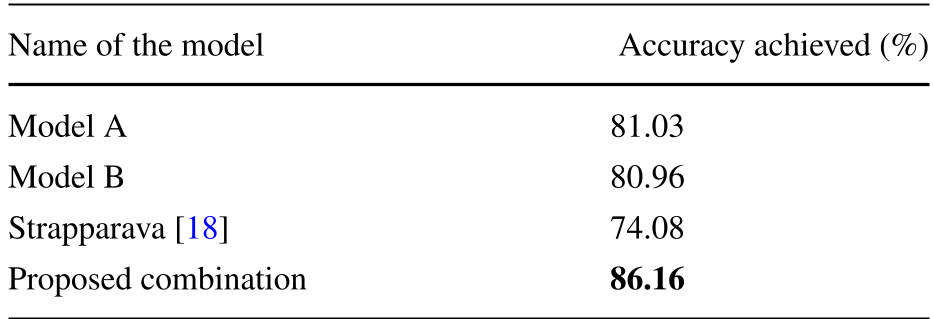 Table 1: Accuracy comparison against independent models and baselines.
The confusion matrix heatmaps in the paper illustrate the "selective" nature of the model: Phase 4 successfully ignores the misclassifications of one sub-model if the other sub-model shows higher confidence/historical accuracy for that specific emotion category.
Critical Insight: The Value of Shallow Ensembles
The core takeaway from this work is that Model Architecture > Model Depth for specific use cases. By utilizing parallel shallow models:
- Parallelism is maximized: Models A and B run simultaneously on GPU/CPU.
- Bias-Variance Tradeoff: The integration layer balances Model A's higher variance with Model B's structural bias (due to the Conv layer), creating a more robust final predictor.
Limitations & Future Work
While the results are impressive, the dataset is self-labeled, which might introduce bias. Additionally, the reliance on GloVe (a static embedding) means the model might struggle with polysemy (words with multiple meanings depending on context) compared to modern contextual embeddings like BERT. However, for the goal of "Real-Time" performance, the trade-off is clearly justified.
Conclusion
This paper serves as a blueprint for building "production-first" AI. By focusing on selective strength integration, the authors prove that we can achieve SOTA results without the massive footprint of modern LLMs, specifically for targeted tasks like emotion detection.