
Scaling Indoor Precision: Self-Calibrating Localization via Deep Transfer Learning
Self-Calibrating Indoor Localization with Crowdsourcing Fingerprints and Transfer Learning
This paper introduces a self-calibrating indoor localization system that utilizes crowdsourced Channel State Information (CSI) fingerprints and deep transfer learning. By combining historical database records with frequently updated user reports via a Multi-Kernel Maximum Mean Discrepancy (MK-MMD) framework, the system achieves meter-level accuracy (approx. 1.08m) in dynamic indoor environments.
TL;DR
Indoor localization is moving beyond static "fingerprinting." This paper presents a self-calibrating system that uses crowdsourced CSI data and Transfer Learning to combat signal drift. By minimizing the distribution gap (MK-MMD) between old and new signal maps, the authors achieve ~1-meter accuracy using standard smartphones without the need for constant, manual recalibration.
Background & Motivation: The "Static Map" Trap
Traditional indoor positioning relies on a "Radio Map"—a database of signal signatures (CSI or RSSI) tied to specific coordinates. However, indoor environments are chaotic: moving furniture, people, and even humidity change how signals bounce.
The industry faces a dilemma:
- Manual Resurveying: Precise but prohibitively expensive and slow.
- Crowdsourcing: Cheap, but user-reported data is often "noisy" or inaccurately labeled due to IMU sensor drift.
The author's insight is that we shouldn't just replace the old database with new, noisy data. Instead, we should transfer the knowledge from the precise historical data to the fresh, time-relevant crowdsourced data.
Methodology: Bridging the Gap with MK-MMD
The heart of this paper is a Deep Transfer Learning framework. The goal is to find a mapping function that makes the feature distributions of the historical data () and the updated data () as close as possible in a High-Dimensional Hilbert Space.
1. The Multi-Kernel Approach
Standard Domain Adaptation often looks at the total signal distribution. This paper uses Multi-Kernel Maximum Mean Discrepancy (MK-MMD), which refines the process by looking at:
- Marginal Distribution: The overall spread of CSI signals.
- Conditional Distribution: The specific signal behavior given a certain location area ().
2. Neural Network Architecture
The authors utilize a 5-layer CNN to extract generic features from CSI subcarriers, followed by a Fully Connected (FC) layer where the domain adaptation (transfer) actually happens.
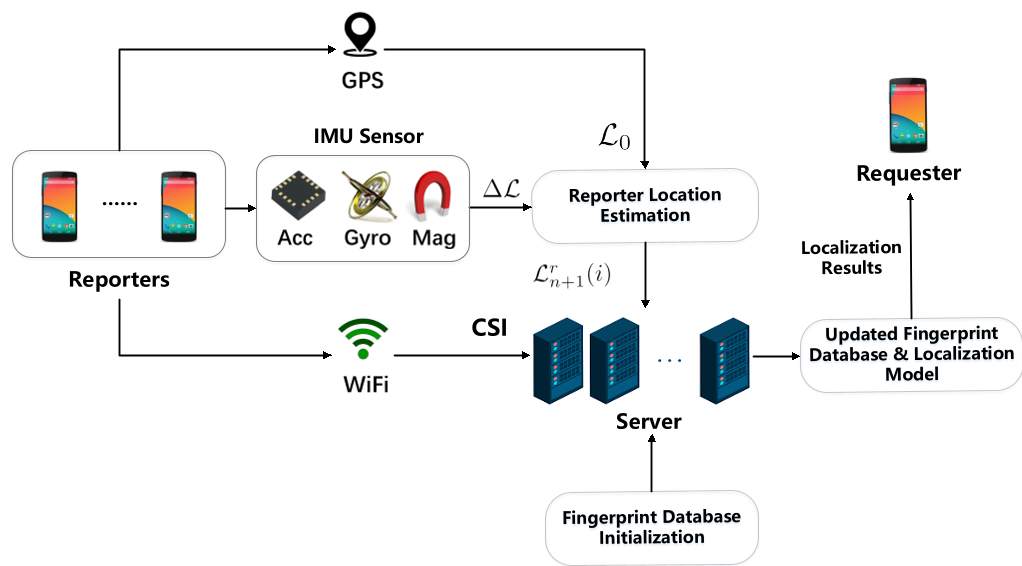 Figure 1: The proposed crowdsourcing workflow including the initialization, reporting, and online localization phases.
Experimental Validation
Testing was conducted in a real-world laboratory scenario using TP-LINK routers and Nexus 5 smartphones (via the Nexmon tool for CSI extraction).
SOTA Comparison
The proposed method was compared against Joint Distribution Adaptation (JDA) and non-updated KNN.
- Accuracy: The deep transfer method achieved 1.08m MDE, whereas JDA lagged at 1.37m.
- Robustness: Even with only 50% of the fingerprint database being updated via crowdsourcing, the system maintained its meter-level precision.
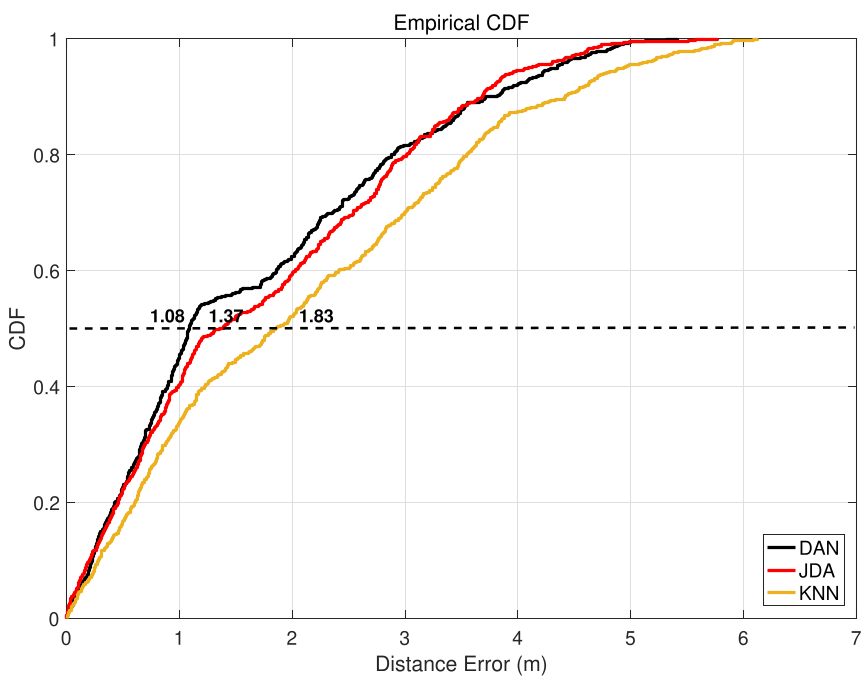 Figure 2: The laboratory layout (Red spots = training grids; Green = testing points).
Computational Efficiency
While the training phase involves complex optimization, the online inference is remarkably fast. Because the "knowledge" is stored in the neural network's weights, the system avoids the heavy iterative matrix calculations required by classic transfer learning methods (like JDA), making it suitable for mobile deployment.
| Method | Inference Time (1000 samples) | Accuracy (Mean Error) |
|---|---|---|
| Baseline 1 (KNN) | 0.1s | Poor (Non-adaptive) |
| Baseline 2 (JDA) | 31.6s | 1.37m |
| Proposed Method | 5.61s | 1.08m |
Critical Insight & Conclusion
The real value of this research lies in its self-calibrating nature. Most AI models fail when the "input distribution shifts" (e.g., a new wall is built in the office). By embedding domain adaptation into the localization pipeline, the system learns to "heal" its own radio map.
Limitations: The system still relies on "opportunistic GPS" or reliable PDR for labels, which might be scarce in deep underground bunkers or windowless warehouses. Future work might look into "Unsupervised Domain Adaptation" where no location labels are needed for the updated fingerprints at all.
Final Takeaway: This is a robust step toward 6G's vision of "zero-maintenance" high-precision indoor positioning.