
Beyond Anonymity: How UX Professionals Use Self-Disclosure to Build Expertise on Reddit
"What do you recommend a complete beginner like me to practice?": Professional Self-Disclosure in an Online Community.
This paper explores "professional self-disclosure" within an online User Experience (UX) community on Reddit (/r/userexperience). Using a mixed-methods approach (content and discourse analysis), the authors identify how intentionally revealing personal information about one’s career and skills supports professional development and relationship building in an emerging, interdisciplinary field.
TL;DR
In a world where professional identity is often tied to a rigid LinkedIn profile, how do experts and novices interact in pseudonymous spaces? This study analyzes the r/userexperience subreddit to reveal that revealing "who you are" (self-disclosure) is not just a social act—it's a strategic move to gain credibility, seek help, and foster a global professional community.
The "Super-Creative Core" Dilemma
UX Designers belong to what Richard Florida calls the "Creative Class." Their field is volatile, interdisciplinary, and lacks firm boundaries. Many practitioners work in "minority disciplines" within companies that don't fully understand their value.
The authors argue that because formal education and organizational support often lag behind industry needs, Reddit becomes a "backstage" where designers prepare their "front stage" professional identities. But why would someone disclose their failures or salary on a pseudonymous forum?
Methodology: Coding the Human Narrative
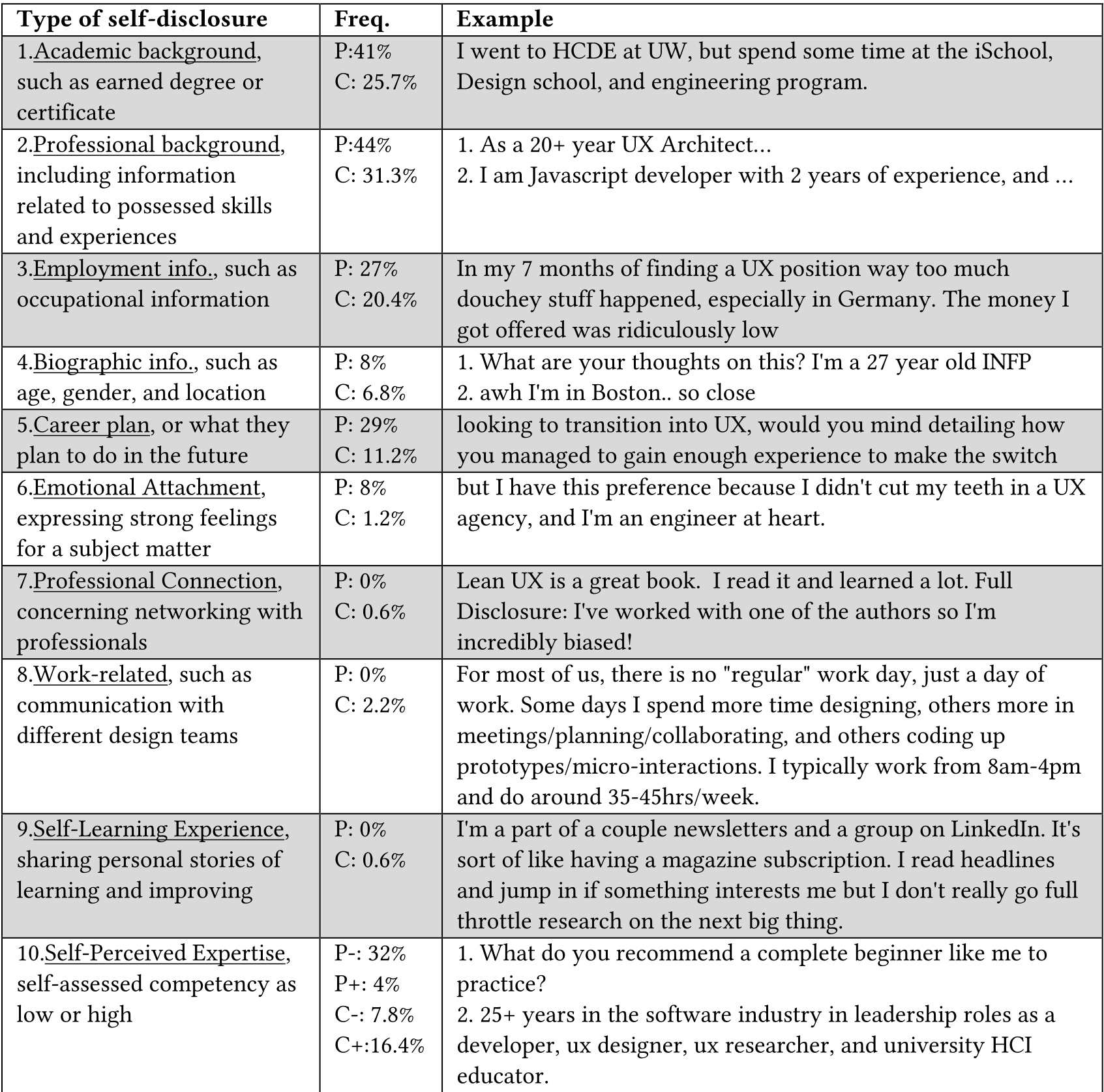
The researchers analyzed over 11,000 comments, identifying 10 types of professional self-disclosure. They looked at how these disclosures functioned within the "flow" of conversation.
How Professionals "Talk" Identity
The heart of the paper lies in the discursive functions of disclosure. They found that disclosure isn't just about sharing facts; it's about shifting power dynamics:
- Credibility Adjusting: A user starts a comment with "As a 20+ year UX Architect..." to immediately boost the weight of their advice.
- Evidence-Based Reasoning: Instead of saying "CS degrees are good," a user shares their personal journey from dev to designer to prove marketability.
- Empathy and Reciprocity: When a user posts about failing an interview, others disclose their own "horror stories" to provide social support.
- Legitimate Peripheral Participation (LPP): Newcomers use disclosure (e.g., "I'm a complete beginner") as an entry ticket, admitting their status in exchange for the community’s "insider" knowledge.
Key Findings: The "Disclosure Effect"
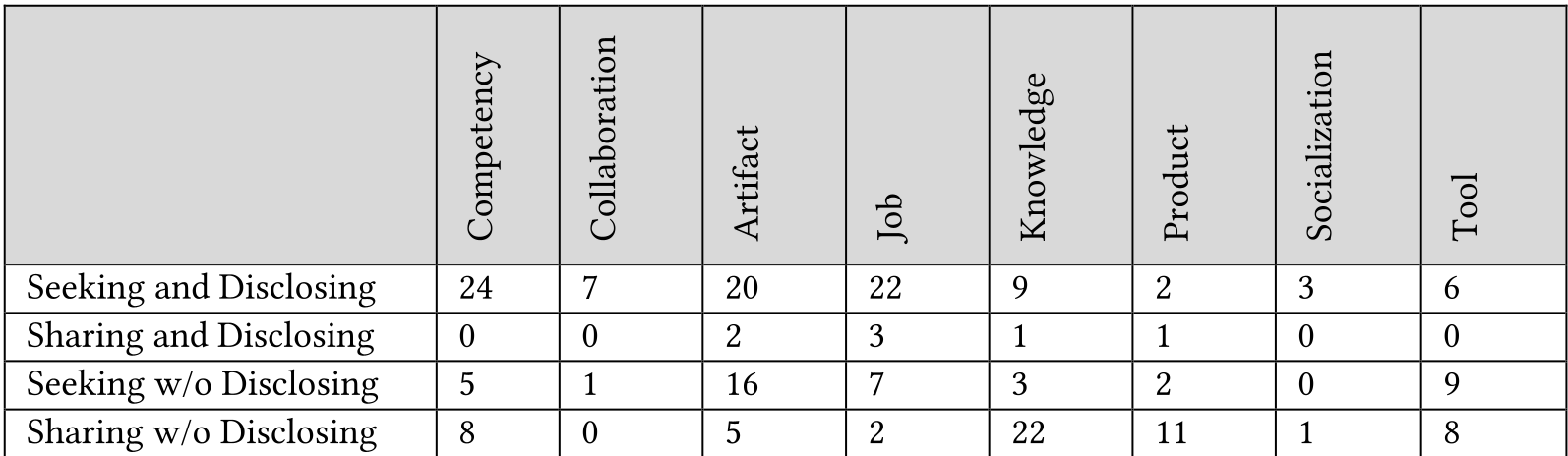
The statistics confirm the intuition: Disclosure breeds engagement.
- Disclosing posts attract significantly more comments.
- Disclosure acts as a "situational trigger"—if the OP (Original Poster) discloses, the commenters are far more likely to open up in return.
- There is a clear hierarchy: Posters tend to be newcomers seeking resources, while commenters are often senior members providing "mastery" perspectives.

Critical Insight & Future Outlook
This work challenges the idea that professional spaces must be tied to "Real ID" to be valuable. In fact, the pseudonymity of Reddit may actually encourage more honest self-disclosure about sensitive topics like salary or workplace frustration, providing a level of support that LinkedIn simply cannot.
The Takeaway for Platform Designers: If you are building a tool for professionals (e.g., an internal Slack or a niche forum), don't just focus on "profiles." Focus on discursive tools. Give users ways to signal their seniority or newcomer status dynamically within a thread to help the community self-organize into a mentor-mentee ecosystem.
Conclusion
The phrase "What do you recommend a complete beginner like me to practice?" is more than a question. It is an act of identity signaling that keeps the UX community alive and evolving. As work becomes more distributed, professional self-disclosure will be the "glue" that holds these global communities together.