
Beyond the Student Bubble: How Experienced Users Share Secrets Online
Self-disclosure in social media
2011-05-07
Summary
Problem
Method
Results
Takeaways
Abstract
This research investigates self-disclosure behaviors in Computer-Mediated Communication (CMC) using a mixed-methods approach (surveys, interviews, and experience sampling). Focusing on experienced professional users rather than students, the study identifies how information intimacy and tool characteristics (e.g., Email vs. Twitter) drive sharing patterns in social media.
## TL;DR
While we often hear about "privacy-blind" teens, this research pivots to **experienced professionals** to understand the true stable state of online self-disclosure. By analyzing five communication tools (Email, IM, Blogs, Facebook, Twitter) across varying levels of personal intimacy, the study reveals a sophisticated "sorting mechanism" where users match the weight of their secrets to the perceived intimacy of the digital channel.
## The Research Context: Why Professional Users Matter
In the early 2010s, most HCI (Human-Computer Interaction) research on privacy was obsessed with university students. The author, Javier Velasco-Martin, argues that students are in a state of flux—navigating life transitions and experimenting with new identities. To see the "future" of stable media use, we must look at **experienced professional adults**.
The core question is: **Why do people broadcast private information in public spaces?** Is it a therapeutic need, a cultural expectation of reciprocity, or is there something inherent in the computer interface that tricks our brains into feeling a false sense of intimacy?
## The "Hierarchy of Intimacy" Methodology
The study employs a robust mixed-methods approach. The most compelling data comes from **Study 1**, a survey of over 1,000 participants from 53 countries.
Researchers tested four specific scenarios against five tools:
1. **Low Intimacy**: Political upset.
2. **Moderate Intimacy**: Having a "bad day" (mood).
3. **High Intimacy**: Family conflicts and medical news.
### Visualizing the Findings: Tools vs. Scenarios
The research clearly defines a spectrum of **Tool Intimacy**.
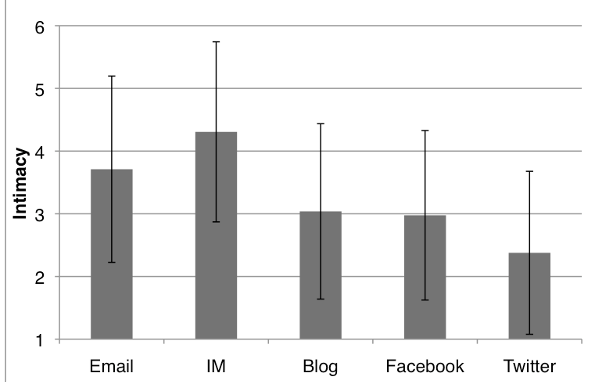
*Figure: Tools like Instant Messaging (IM) and Email are consistently rated as the most intimate, whereas Twitter sits at the extreme public end.*
## Key Insights: The Disclosure Filter
The results provide a fascinating look at the "logic" of sharing:
- **Intimate Scenarios are Siloed**: When it comes to "Health" or "Family" issues, users almost exclusively stick to intimate tools (Email/IM).
- **Public Tools for Public Thoughts**: Political opinions—often seen as less personally intimate but socially charged—are the only content regularly shared on public-facing tools like Twitter and Blogs.
- **The Facebook Paradox**: Interestingly, in 2011, there was no significant difference in how users perceived the intimacy of Blogs versus Facebook, suggesting that Facebook was viewed more as a broadcasting platform than a private enclave.
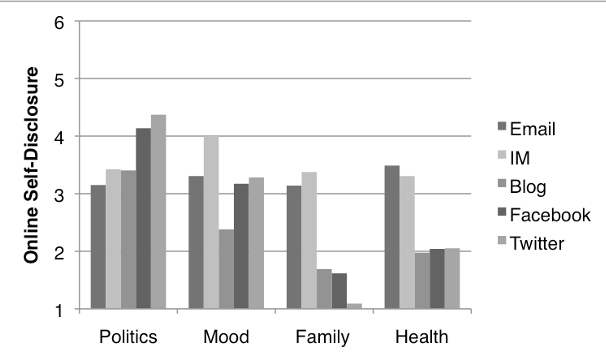
*Figure: This chart highlights the sharp drop-off in sharing likelihood as scenarios become more intimate on public platforms.*
## Critical Analysis & Future Implications
Velasco-Martin's work highlights that **self-disclosure is contextual**. We don't just "share" or "not share"; we calculate the "intimacy weight" of the information against the "intimacy capacity" of the tool.
### Limitations
As a conference paper from 2011, the technological landscape has shifted. "Instant Messaging" has evolved into platforms like WhatsApp (which bridge the gap between private and group chat), and the concept of "Blogs" has largely been consumed by long-form social media threads.
### Why This Still Matters
For developers and UX designers, the takeaway is clear: **Context is king.** Users don't want a "one size fits all" privacy setting. They need tools that recognize the emotional weight of the content being created. A "political rant" requires different UI cues and audience controls than receiving "bad news from the doctor."
As we move toward AI-integrated social tools, understanding these human boundaries of intimacy will be the difference between a tool that feels supportive and one that feels like a privacy violation.