
Digital Ties: How Self-Disclosure Transforms into Social Capital in the SNS Era
Self-disclosure on social networking sites, positive feedback, and social capital among Chinese college students
This study investigates the link between self-disclosure on Social Networking Sites (SNS) and the accumulation of social capital among Chinese college students. Using structural equation modeling (SEM) on data from 264 students, the researchers found that self-disclosure directly enhances bridging social capital while indirectly fostering bonding social capital through the mediation of positive feedback.
TL;DR
The transition to college is a social reboot. This study reveals that for Chinese freshmen, "oversharing" (strategic self-disclosure) on Renren (a Facebook-like SNS) is a primary engine for building social networks. While disclosure directly expands your reach (Bridging Capital), you only gain deep emotional support (Bonding Capital) if your peers hit the "like" button or leave positive comments.
Problem & Motivation: The "How" of Virtual Networking
In the mid-2010s, we knew that people who spent more time on social media generally felt more "connected." But academic literature faced a "black box" problem: what specific action inside the app creates that value?
The researchers identified Self-Disclosure—the act of revealing personal thoughts, photos, and info—as the likely suspect. They focused on the transition to residential college, a "developmental juncture" where old ties are strained and the need for new resources is at its peak. They also sought to challenge the "rich-get-richer" hypothesis: does SNS only help those who are already social butterflies, or can it help the shy ones too?
Methodology: Mapping the Social Engine
To capture the nuance of online behavior, the researchers split self-disclosure into three tiers:
- General Info: Hometown, birthday, contact details.
- Visual Evidence: Photos ranging from solo shots to intimate family portraits.
- Self-Description: The breadth and depth of one's inner opinions and feelings.
They then mapped these against Bridging Capital (access to new info/diverse perspectives) and Bonding Capital (emotional support/intimacy).
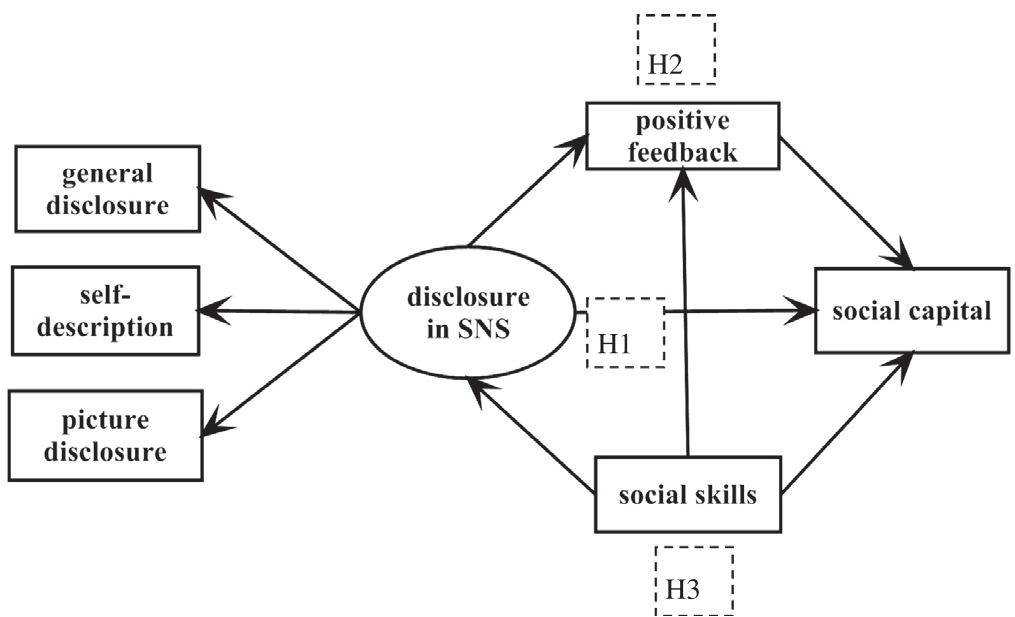 Figure 1: The hypothesized path where Social Skills act as a covariate and Positive Feedback acts as a mediator.
Experiments & Results: Breadth vs. Depth
The findings, derived from 264 students across three Beijing universities, revealed a fascinating split in how social capital is "earned":
1. The Direct Path to Bridging Capital
If you want to expand your network, just post. The data showed a strong direct link between self-disclosure and bridging capital. By providing the "hooks" of your life (interests, education), you make it easy for "weak ties" to connect with you. Positive feedback wasn't necessary here; the mere presence of information was enough to lower the barrier for instrumental support.
2. The Mediated Path to Bonding Capital
Bonding capital is harder to earn. Self-disclosure alone did not increase emotional support. Instead, disclosure only led to bonding when it triggered positive feedback.
- Insight: Positive comments serve as "relationship maintenance signals." They affirm that the shared vulnerability was accepted, thereby strengthening the bond.
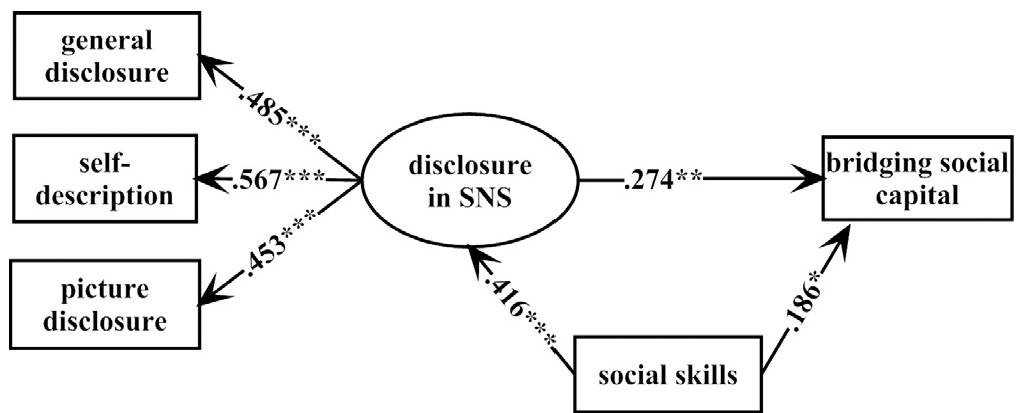 Figure 2: Statistical model showing the direct influence of disclosure on bridging capital.
3. Does Skill Matter?
While students with higher social skills (the "socially rich") did disclose more and receive more feedback, the benefits of SNS remained significant for all students. This suggests that SNS provides a vital "social lubricant" for less adept individuals to build a safety net during transitions.
Critical Analysis & Conclusion
Takeaway
The study proves that SNS is more than just a time-sink; it is a laboratory for social adjustment. For the individual, the takeaway is clear: Active participation beats lurking. For platform designers, the insight is that fostering a "culture of positivity" (feedback loops) is essential for users to derive actual emotional value from the service.
Limitations
- The "Renren" Context: Collected in 2014 in China, the platform was desktop/web-centric. Modern mobile-first, ephemeral platforms (like Stories/Snapchat) might change the intimacy of disclosure.
- Self-Reporting: Students might overestimate their "social skills" or misremember the volume of their posts.
- Cultural Specificity: The value of "face" and collective harmony in Chinese culture may influence the type of positive feedback expected compared to Western contexts.
Future Outlook
As we move into an era of AI-curated feeds, we must ask: Does the algorithm prioritize the "positive feedback" that leads to bonding, or does it prioritize the "controversy" that destroys it? This 2014 study provides the baseline for understanding the fundamental human need for digital validation.