
The Social Dilemma: A Risk-Utility Perspective on Why We Share Online
Self-disclosure under social networking sites: a risk-utility decision model
This research proposes a Risk-Utility Decision Model to explain self-disclosure behavior on Social Networking Sites (SNSs). It integrates the Disclosure Decision Model (DDM) and Communication Privacy Management Theory (CPMT) to analyze how users balance perceived privacy risks against expected utilities across three dimensions: intimacy, amount, and accuracy of shared information.
TL;DR
In the digital age, self-disclosure is no longer just a social impulse; it is a calculated strategic move. This paper introduces a Risk-Utility Decision Model for Social Networking Sites (SNSs), arguing that users perform a psychological "cost-benefit analysis" before hitting 'post.' By examining perceived utility, privacy risks, trust, and control ability, the authors provide a roadmap for understanding the complex mechanics behind our online transparency.
Context: Why Traditional Models Fail
For years, sociologists analyzed face-to-face (FtF) disclosure, where social norms like reciprocity are clear and physical proximity offers a sense of control. However, SNSs changed the game. The existence of visual anonymity, de-individuation, and uncontrollable retransmission (the "viral" effect) created a vacuum that traditional models couldn't fill. Users don't just decide "to share or not to share"; they modulate the depth (intimacy), breadth (amount), and accuracy of their information based on their environment.
The Core Mechanism: The Strategic Trade-off
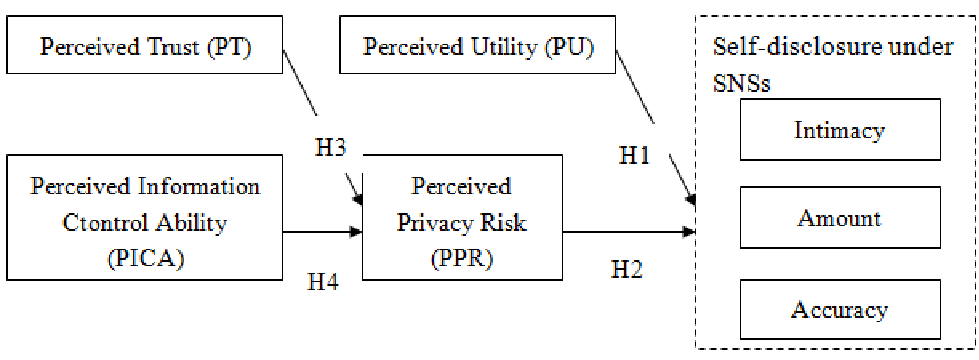
The researchers posit that self-disclosure is governed by two opposing forces:
- Perceived Utility (The Pull): The desire for social recognition, relief of psychological emotion, and the maintaining of intimate relationships.
- Perceived Privacy Risk (The Push): The fear of losing control over personal images or career identities due to unanticipated leaks or predatory data usage.
The "Aha!" moment of this research lies in how users manage that risk. Instead of just "trusting" a site, users look for Perceived Information Control Ability (PICA). If a user feels they have the tools to "gate" their content, their perception of risk drops, even if the absolute danger remains the same.
Deconstructing the Methodology
The authors utilize a two-pronged theoretical foundation:
- Disclosure Decision Model (DDM): Suggests that humans are rational actors who estimate risks before adjusting their "privacy boundaries."
- Communication Privacy Management Theory (CPMT): Views privacy as a dynamic process of boundary regulation where "ownership" of information is the central concern.
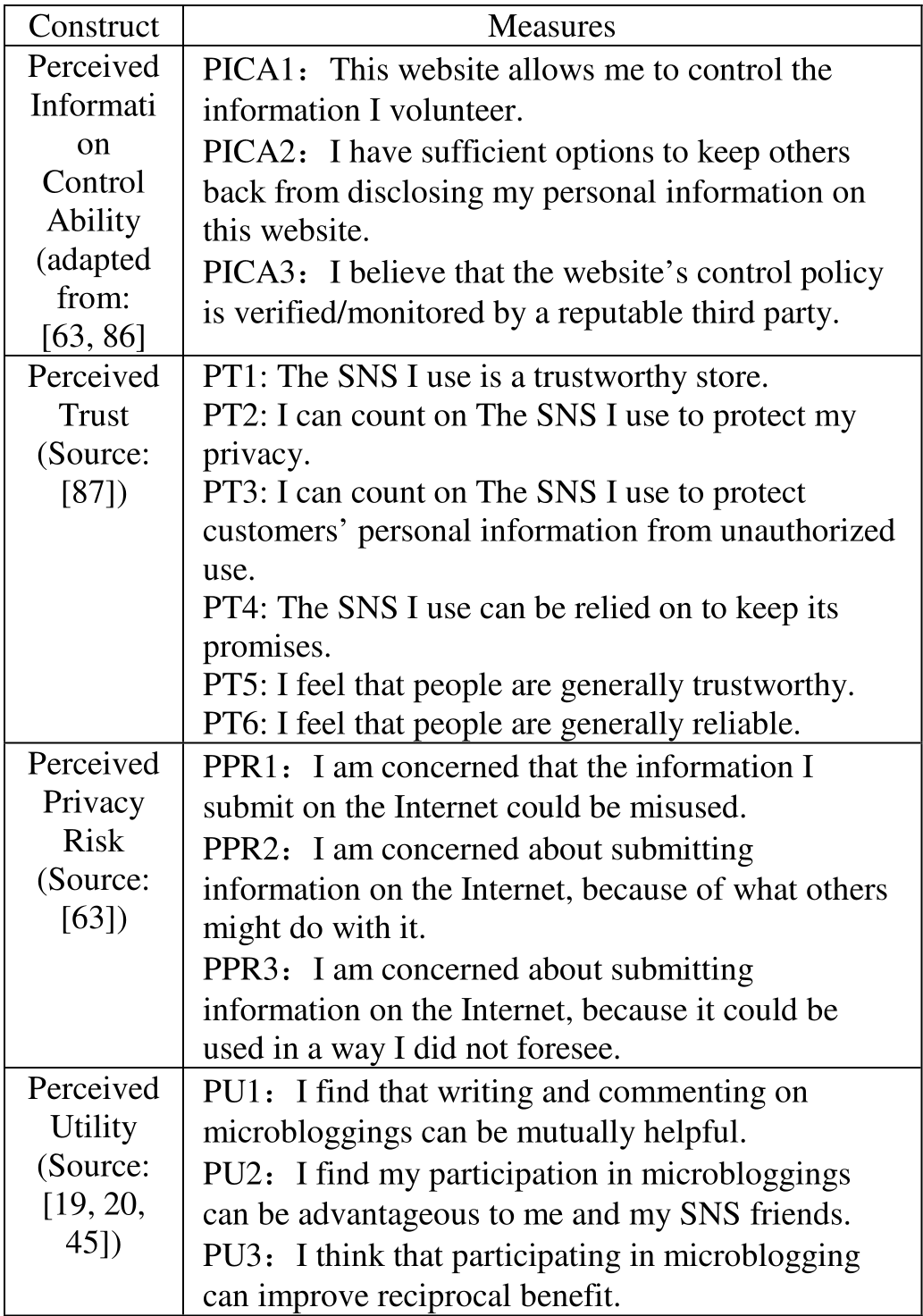
To validate this, they developed a rigorous questionnaire focusing on specific measurable constructs:
- PICA Scale: Does the website allow me to control volunteered info? Are there options to stop others from sharing MY data?
- PT (Trust) Scale: Is the platform reliable? Are "people in general" trustworthy?
Strategic Insights for the Industry
The study provides a critical takeaway for platform architects and policy makers: Trust is not enough.
In the SNS context, Control > Trust. While a user might trust a platform (PT) to be ethical, they are more significantly influenced by their own perceived ability to manage their data (PICA). To increase user "Breadth and Depth" of sharing, platforms should focus on granular privacy settings and transparent data-handling tools rather than just PR-focused trust campaigns.
Critical Analysis & Future Outlook
While the model is robust, it was developed in the early 2010s. Since then, algorithmic surveillance and AI data harvesting have made "control" largely illusory. Future research should investigate whether users' Perceived Control (PICA) has become decoupled from Actual Control in the era of Big Data. Nevertheless, this paper remains a foundational pillar for understanding the cognitive architecture of the digital self.