
Beyond the Binary: Does Your "Gender Role" Actually Shape Your Online Privacy?
An Influence of Self-evaluated Gender Role on the Privacy Management Behavior in Online Social Networks
This paper investigates the causal impact of self-evaluated gender roles (masculinity and femininity) on privacy management behaviors in Online Social Networks (OSNs). Integrating Communication Privacy Management (CPM) theory and the Theory of Planned Behavior (TPB), the authors utilize Structural Equation Modeling (SEM) to test how psychological gender traits influence the disclosure and control of private information.
TL;DR
In a world where we share everything from breakfast to business secrets, does our psychological sense of masculinity or femininity dictate how we lock our digital doors? This study applies Structural Equation Modeling (SEM) to test the link between self-evaluated gender roles and OSN privacy management. Surprisingly, it finds that despite strong theoretical foundations, psychological gender traits have no significant impact on how we manage our privacy boundaries online.
Problem & Motivation: The Gender Conflict in Privacy
For years, researchers have disagreed on who is more "privacy-conscious." Some studies suggest women are more protective due to social risks, while others claim men are more guarded. However, most research treats gender as a simple biological checkbox.
The authors of this paper argue that this is too simplistic. Drawing on Communication Privacy Management (CPM) theory, they suggest that privacy is a rule-based system shaped by internal traits. They hypothesized that "sex-typing"—the degree to which you view yourself with masculine (e.g., competitive, independent) or feminine (e.g., sensitive, compassionate) traits—would be a better predictor of privacy behavior than biological sex alone.
Methodology: Bridging CPM and TPB
The researchers built a sophisticated causal model by merging two heavyweight theories:
- CPM (Communication Privacy Management): Defines how we set boundaries and ownership of information.
- TPB (Theory of Planned Behavior): Connects attitudes, subjective norms, and behavioral control to actual intentions.
To measure gender personality, they used the Bem Sex Role Inventory (BSRI), which scores individuals on scales of Masculinity and Femininity regardless of their biological sex.
 Figure 1: The conceptual model merging CPM foundations with the TPB behavioral mechanism.
The "Messy" Reality of Data
The analysis followed a rigorous two-step process:
- CFA (Confirmatory Factor Analysis): This was used to validate the BSRI traits. Interestingly, the researchers had to trim several items (like "Aggressive" from masculinity or "Gentle" from femininity) because they didn't fit well in the context of Online Social Networks.
- SEM (Structural Equation Modeling): This was the "moment of truth" to see if gender traits caused changes in privacy attitudes.
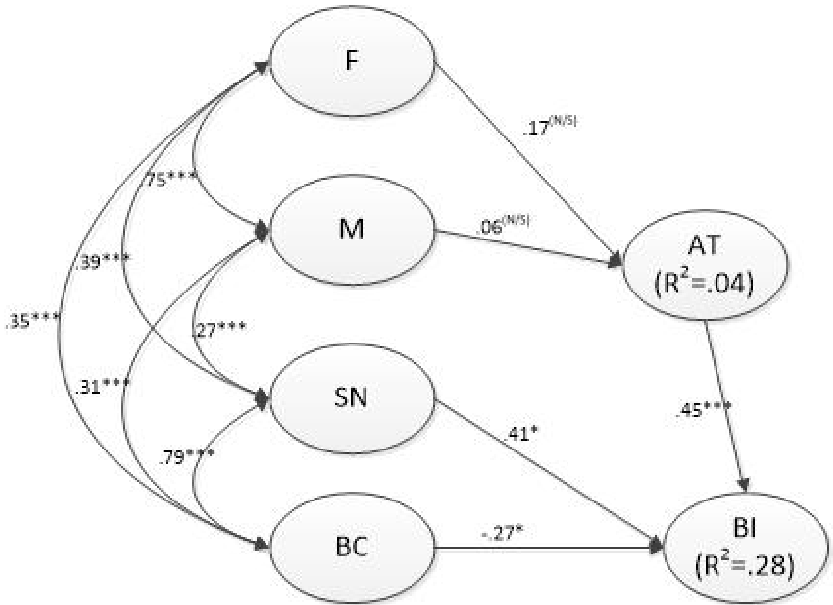 Figure 2: The final SEM path diagram. Note the non-significant beta values for Masculinity and Femininity.
Key Results: A Statistical "No-Show"
Despite a high-quality sample (N=400) and a model that "fit" the data mathematically, the results were clear:
- Masculinity to Attitude: (Statistically Insignificant)
- Femininity to Attitude: (Statistically Insignificant)
Essentially, it doesn't matter if you see yourself as "competitive" or "compassionate"—your attitude toward controlling how much private information you post on Facebook or LinkedIn remains largely unaffected by these traits.
Critical Insight & Conclusion
Why did the theory fail to meet the data? The authors offer several provocative insights:
- Contextual Obsolescence: The BSRI was developed in the 1970s. Traits like "loves children" or "forceful" might not translate to how we perceive gender roles in 2024's digital landscape.
- The Digital Neutralizer: OSNs often force users into a "one-size-fits-all" privacy setting, which might suppress individual psychological tendencies.
- The Privacy Paradox: People might say they value privacy based on their traits, but their actual behavior is driven by platform design and social pressure rather than internal personality.
Takeaway for Designers: If you are building privacy features, don't waste time tailoring them to gender stereotypes. Users manage their digital boundaries based on factors far more complex than their self-perceived masculinity or femininity.