
The "Corporate" Computer: Borrowing Economic Logic to Build Self-Aware Systems
Towards self-managing systems inspired by economic organizations
This position paper introduces a framework for self-managing technical systems inspired by the organizational behavior of socio-economic entities. It proposes the use of "Symbolic Models" to bridge the gap between internal self-adaptation and external self-organization, enabling systems to achieve a form of machine-readable "Self-Awareness."
Executive Summary
TL;DR: As computing environments grow into hyper-complex "ecosystems" (like federated clouds), simple reactive algorithms are no longer enough. This paper argues that technical systems should manage themselves the way companies do: by being "self-aware." By using Symbolic Models to represent their own identity and their environment, nodes can balance internal optimization with external collaboration.
Academic Positioning: This is a seminal position paper that bridges Autonomic Computing with Management Science. It moves beyond the "MAPE-K" loop toward a more holistic, socio-technically inspired architecture for self-adaptive and self-organizing systems (SASO).
The Problem: The Great Divide in Self-Management
In the current landscape of autonomous systems, we see a friction between two paradigms:
- Self-Adaptation: Focuses on the individual. A system monitor's its own internal state and fixes itself (e.g., a server rebooting).
- Self-Organization: Focuses on the group. Emergent behavior comes from simple local interactions (e.g., swarm intelligence).
The missing link? Real companies don't just do one or the other. A car manufacturer optimizes its internal assembly line (self-adaptation) while simultaneously negotiating with global suppliers (self-organization). The authors argue that current technical systems lack the "Self-Awareness" to handle both views simultaneously.
Methodology: The Power of Symbolic Models
The authors suggest that the solution lies in Symbolic Models—machine-readable representations of the "Self" and the "Environment."
The "Self" as a Data Structure
Instead of hard-coded logic, the system maintains an ontology that defines:
- Internal View: Components, CPU load, resource constraints.
- External View: Suppliers (energy, storage), laws (carbon emission regulations), and competitors.
- Abstract Layer: Relationship rules and contracts.
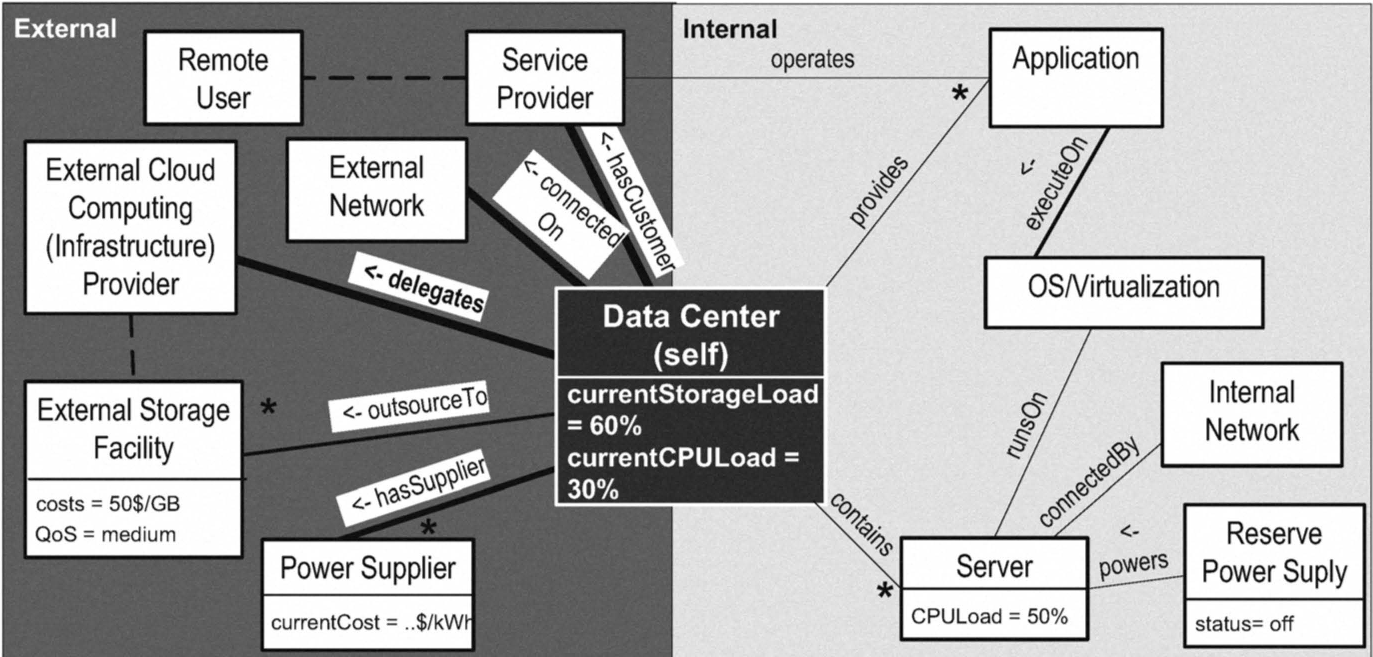 Fig 1: Example of a symbolic model where a Data Center node balances internal server health with external storage facility relationships.
By utilizing these models, a node (like a Cloud Data Center) can reason about complex trade-offs: “If my internal energy cost is high and Law X requires lower carbon output, should I outsource this computation to a partner node in a different region?”
Bridging Socio-Economics and Engineering
The paper identifies several "Management" concepts that are ripe for technical translation:
- Structuration Theory: Understanding how individual actions create and are constrained by social structures.
- Identity: How a node differentiates itself in a network.
- Knowledge Management: Managing the flow of "tacit" knowledge for strategic decision-making.
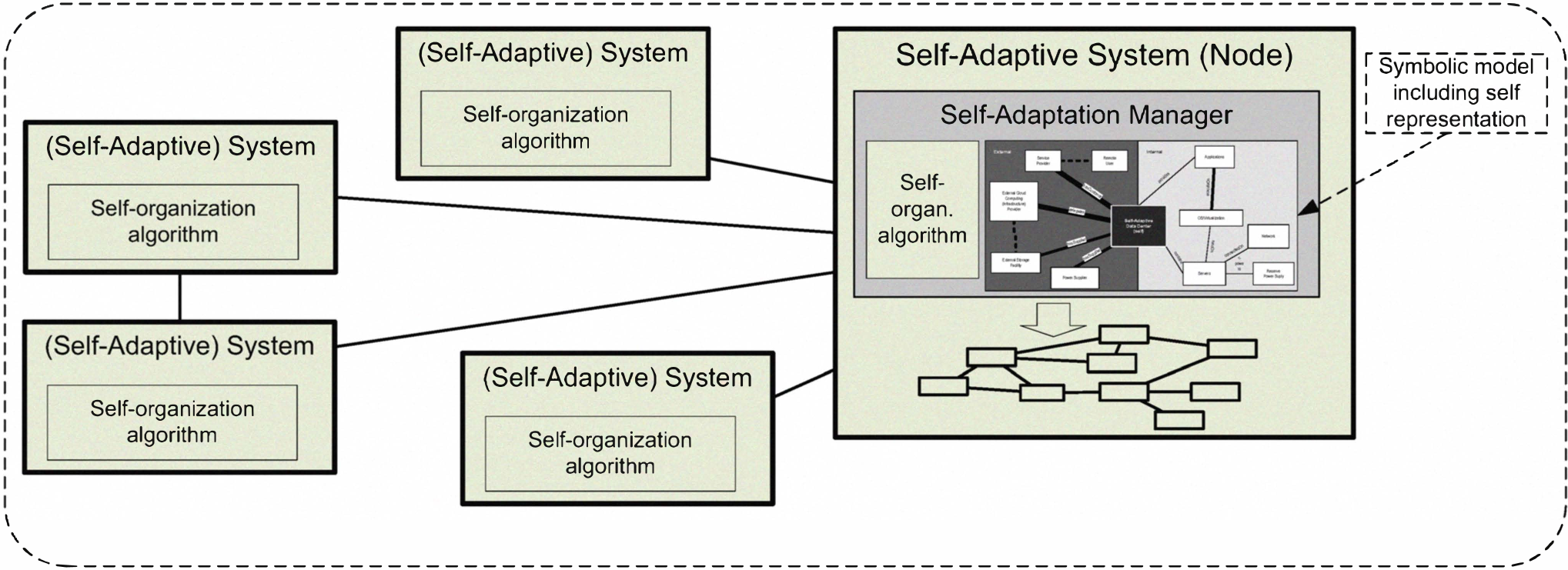 Fig 2: The proposed Self-Adaptation Manager using a Symbolic Model to drive both internal adaptation and external social interaction.
Critical Analysis & Research Frontier
While the conceptual framework is robust, the authors acknowledge significant hurdles:
- Adaptive Reasoning: How do we build "abductive" reasoning that can infer logical explanations for observations?
- Concept Drift: In data-stream environments, the "Model of the Self" must evolve in real-time as the environment changes.
- Trust and Reputation: In a decentralized system, how does a node calculate the "Trustworthiness" of others without a central authority?
Conclusion: Toward Autonomous Ecosystems
The value of this work lies in its Inductive Bias: it assumes that the structures humans evolved to manage economic scarcity (companies, contracts, laws) are mathematically and logically applicable to technical resource scarcity.
As we move toward a world of "Edge-to-Cloud" orchestration, the ability of a node to say "I know who I am and who I am working with" (Symbolic Self-Awareness) will be the cornerstone of resilient, autonomous infrastructure.