
Beyond Centralization: A Self-Organized Future for P2P Social Networks
A Self-Organized Architecture for Efficient Service Discovery in Future Peer-to-Peer Online Social Networks
The paper proposes a novel self-organized, Peer-to-Peer (P2P) architecture for next-generation Online Social Networks (OSNs) to replace fragile centralized models. It introduces decentralized service discovery mechanisms that leverage social homophily and latent semantic analysis (PLSA/LDA) to optimize resource location in highly dynamic, unstructured networks.
TL;DR
The dominant centralized architecture of today's social networks (Facebook, X, etc.) is fundamentally flawed regarding privacy and scalability. This paper proposes a self-organized P2P architecture that treats users as autonomous nodes. By combining Latent Semantic Analysis and Social Homophily, the authors create a system where service discovery is decentralized, context-aware, and resilient to the "churn" of users entering and leaving the network.
The "Single Point of Failure" Crisis
Modern Online Social Networks (OSNs) suffer from an inherent irony: they connect the world through a bottleneck. Because data is stored in centralized silos, users lose ownership of their privacy, and the entire system is vulnerable to single points of failure.
The authors point out that traditional decentralized alternatives, like DHTs (Distributed Hash Tables) used in file-sharing, aren't the silver bullet. DHTs are technically efficient at finding exact numeric keys but fail miserably when:
- Semantic Nuance is Needed: Users don't search for "Hash_A123"; they search for "Services similar to my hobbies."
- High Churn Happens: In mobile social networks, nodes constantly go offline, causing massive overhead to keep the "tables" updated.
Methodology: The Social-Semantic Synergy
The core innovation lies in how the system "finds" services without a central index. The authors propose a two-layered solution:
1. The Semantic Layer (The "What")
Instead of simple keyword matching, the architecture uses PLSA (Probabilistic Latent Semantic Analysis) and LDA (Latent Dirichlet Allocation).
- The Intuition: It maps heterogeneous service descriptions (like WSDL or OWL-S) into a "Latent Factor Space."
- The Benefit: It solves the synonym problem (e.g., realizing "Social Media Management" and "Community Engagement Tool" are related) without needing a central dictionary.
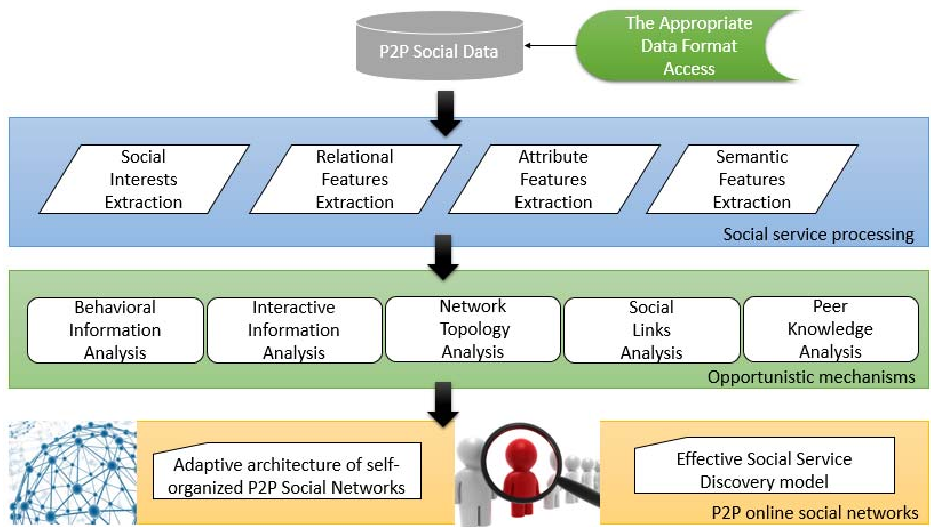
2. The Social Layer (The "How")
Inspired by the Homophily Theory ("birds of a feather flock together"), the network topology is self-organized. Nodes connect to others based on similar interests and interaction history.
- Random Walk with Restart (RWR): To forward a query, the node doesn't flood the whole network. It uses a stochastic RWR process to find the most "promising" neighbors—those with the highest probability of being linked to the target service type.
Experimental Insights: Simulating the Social Mesh
The authors developed a simulation platform to test these theories in a dynamic environment. By extending the Gnutella protocol, they modeled network churn and social interaction patterns extracted from real-world datasets.
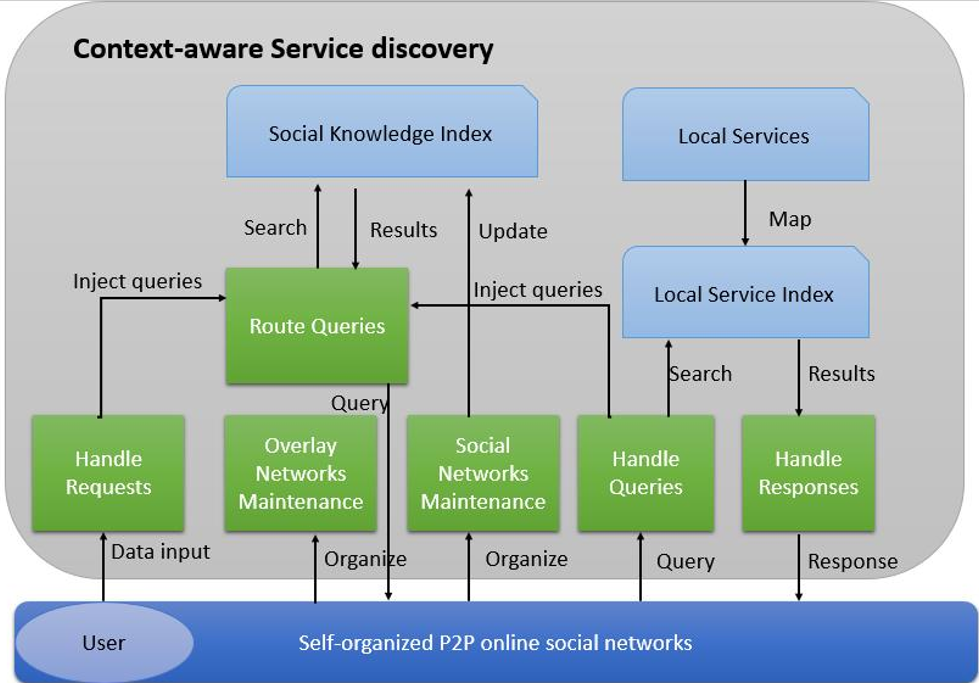
Key evaluation metrics included:
- Recall & Precision: How many relevant services were found?
- Average Path Length: How many "hops" did it take to find the service?
- Message Overhead: Did the search process clog the network?
The results suggest that leveraging social characteristics significantly reduces redundant message traffic while maintaining high discovery accuracy, even when the network topology is constantly shifting.
Critical Analysis & Future Outlook
While this visionary architecture provides a robust roadmap for decentralization, a few challenges remain:
- Bootstrapping: How does a new user with no social history find their "clique"? The paper mentions credit and social proximity, but the "cold start" problem remains non-trivial.
- Security vs. Efficiency: Decentralized systems often Trade speed for encryption. While the authors mention privacy, the overhead of "distributed environment encryption" in a high-churn mobile setting needs more stress-testing.
Conclusion
This paper effectively argues that for the next generation of social networks to be truly scalable and private, they must resemble socio-ecological systems. By mimicking the self-organizing nature of human relationships, P2P OSNs can finally break free from the performance and privacy bottlenecks of the centralized era.