
Population Coding: Evolving Specialized Labor in Robot Swarms for Collective Construction
Self-Organized Construction by Population Coding
This paper introduces a "population coding" approach for self-organized collective construction in swarm robotics. Using a multi-objective evolutionary algorithm (NSGA-II) and finite state machine templates, the authors evolve both homogeneous and heterogeneous robot swarms to build a ring-shaped shelter around a light source.
TL;DR
Researchers have successfully applied the Population Coding paradigm to the challenge of collective construction. By treating a robot swarm as a "recipe" of different controller types, they used evolutionary algorithms to discover that while simple tasks favor uniform swarms (homogeneous), complex tasks with conflicting goals naturally drive the emergence of specialized roles (heterogeneous).
The "Cake Baking" Motivation: Why Population Coding?
In traditional evolutionary robotics, we often evolve one "brain" and copy it into every robot. But what if the task requires some robots to stay put and others to explore? Manually designing these roles is tedious, and evolving them from scratch leads to a combinatorial explosion of possibilities.
The authors propose a "Population Coding" approach:
- Define a Controller Template (Physical logic).
- Enumerate a finite but large set of possible Controller Types.
- Evolve the Swarm Composition—choosing which "ingredients" (robot types) and in what quantities to include in the swarm.
The Methodology: FSMs and Dual-Part Genomes
To make evolution efficient, the robots use a Finite State Machine (FSM) template with three core states: Exploration, Phototaxis (moving toward light), and Anti-phototaxis (moving away).
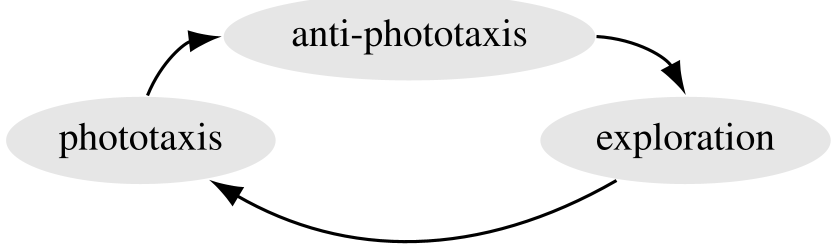 Fig 1: The FSM template used to generate 750^3 possible controller configurations.
The "secret sauce" of this paper is the two-part genome:
- Robot Genes: Define the logic for 10 potential robot types.
- Selector: Assigns each of the 10 physical robots in the swarm to one of those types.
This structure allows the system to easily evolve a "Sparsity" objective—rewarding the swarm for using fewer different types of robots, which is better for real-world manufacturing and maintenance.
Experiments: When is Diversity Necessary?
The authors tested three scenarios in a 10m x 10m arena where 10 robots must pull 20 cylinders to form a ring around a light source.
1. The Basic Scenario
In this task, the only goal is construction (light coverage).
- Result: Evolution favored homogeneous swarms.
- Intuition: The task is simple enough that everyone can be a generalist. Robots find a cylinder, drag it to the light, and leave.
2. The "Stay-In" Scenario (Conflicting Subtasks)
Robots are rewarded for building a shelter and staying close to the light. These are contradictory: you can't find new cylinders while staying at the light.
- Result: Heterogeneous swarms emerged as the winners.
- Specialization: The swarm evolved "Stay-bots" (who sat near the light) and "Move-bots" (who fetched building blocks). Interestingly, stay-bots even evolved a trick to "hold" a cylinder to trick their FSM into staying in a phototaxis state.
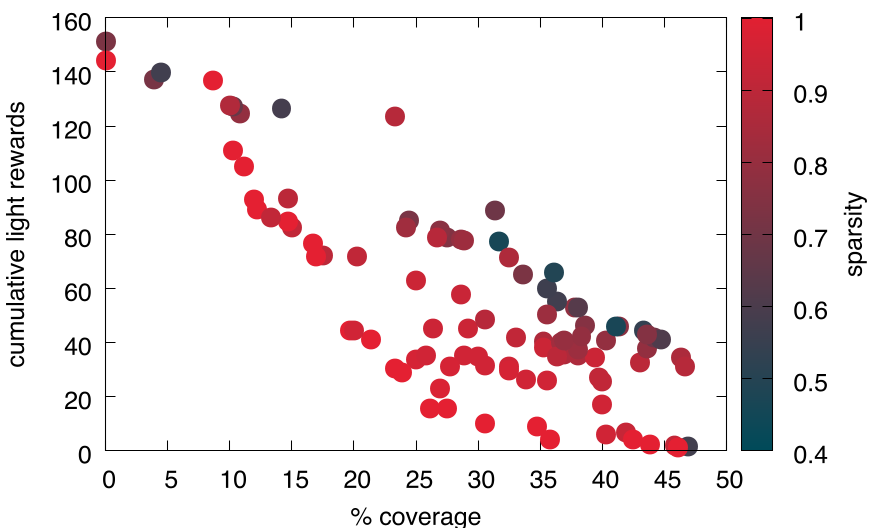 Fig 2: The Pareto front for the Stay-In scenario showing the trade-off between coverage, stay-reward, and sparsity.
Critical Insight: The "Chicken-and-Egg" of Cooperation
The authors note that evolving these swarms is much like evolving a communication system. For specialization to work, a sub-population specialized in Task A is useless without a sub-population doing Task B. This "Population Coding" successfully bridges that gap by allowing the evolutionary process to adjust the "mix" of the swarm until a synergistic balance is found.
Conclusion & Future Look
This research proves that heterogeneity is a functional requirement for complex swarm tasks. By using sparsity as a secondary objective, we can maintain the robustness of swarm robotics while gaining the efficiency of specialized labor. The next step? Moving these swarms into 3D environments and implementing "self-repair" strategies for the constructed shelters.
Academic Takeaways
- SOTA Achievement: Successful application of population coding to collective construction with quantitative Pareto optimality.
- Inductive Bias: The FSM template provides a strong inductive bias that simplifies the search space compared to raw neural network evolution.
- Robustness: The work highlights that more controllers lower redundancy, suggesting that "Sparsity" is a critical objective for high-reliability swarms.