
The Engine of Exchange: Why Self-Regulation is the Secret to Online Learning Communities
The way we share and learn: An exploratory study of the self-regulatory mechanisms in the professional online learning community
2010-03-27
Summary
Problem
Method
Results
Takeaways
Abstract
This study develops and validates a self-regulation model to explain knowledge-sharing behavior in professional online learning communities. Using Partial Least Squares (PLS) analysis on data from a K-12 teachers' community in Taiwan, it identifies how social capital and cognitive factors—specifically community identity, social awareness, and self-efficacy—serve as primary drivers of collaborative practice.
## TL;DR
Why do some online communities thrive with vibrant knowledge exchange while others turn into digital ghost towns? This study argues that the answer lies in **Self-Regulation**. By analyzing a K-12 teacher community, the authors reveal that knowledge sharing isn't driven by external rewards, but by a psychological cocktail of **Community Identity**, **Social Awareness**, and **Self-Efficacy**.
## Problem & Motivation: Beyond the 'Field of Dreams' Fallacy
In the early days of Knowledge Management (KM), the prevailing logic was "Build it and they will come." Organizations spent millions on IT platforms, yet users remained hesitant to share their "secret sauce."
The authors identify a critical gap: knowledge is inherently personal and social. Sharing involves risk—fear of criticism, loss of expert status, or simply the effort required to codify tacit wisdom. Traditional models focusing on monetary rewards often backfired. This paper shifts the focus to **Self-Regulation**: how individuals monitor their own motivations and social environment to decide if sharing is "worth it."
## Methodology: The Social-Cognitive Architecture
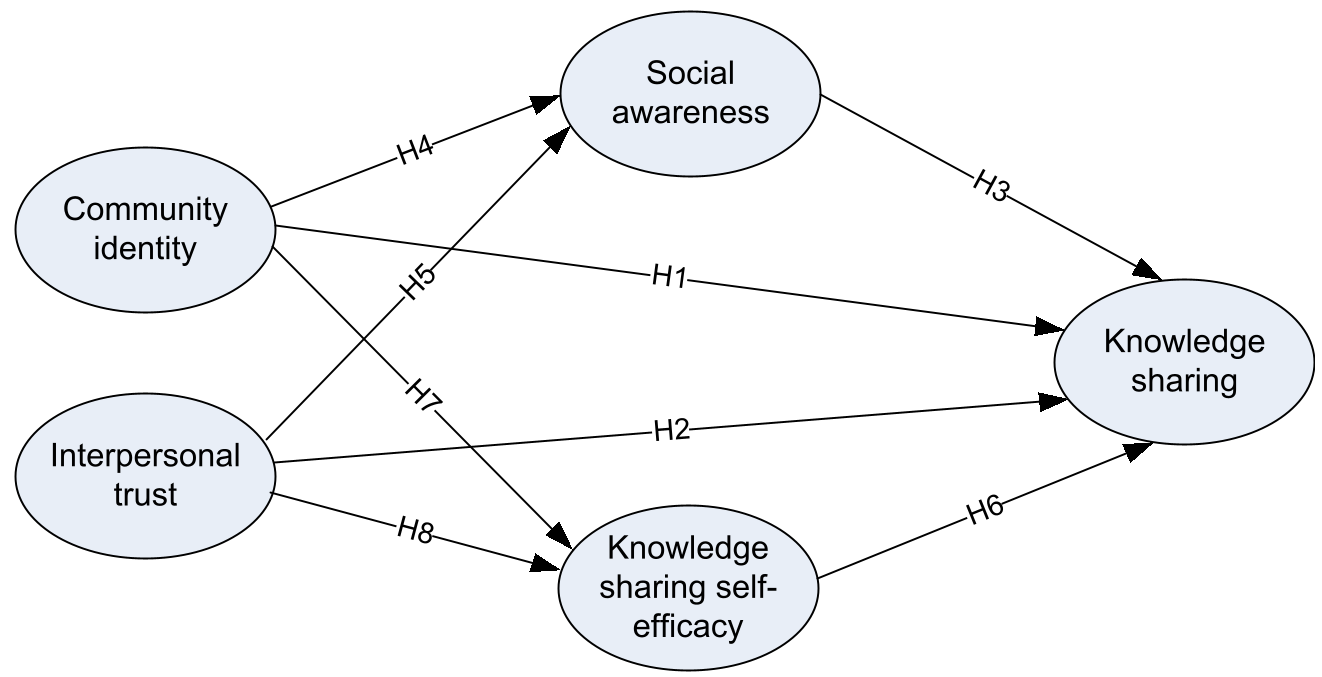
The research employs a structural equation model (using SmartPLS) to test how social capital transforms into action. The core insight is that **Social Capital (Trust and Identity)** doesn't lead to sharing directly; it must first be "digested" by the individual’s cognitive system into:
1. **Social Awareness**: "I know exactly who can help me and who needs my help."
2. **Self-Efficacy**: "I am confident that my experience is valuable and that I can explain it clearly."
## Key Insights from the Results
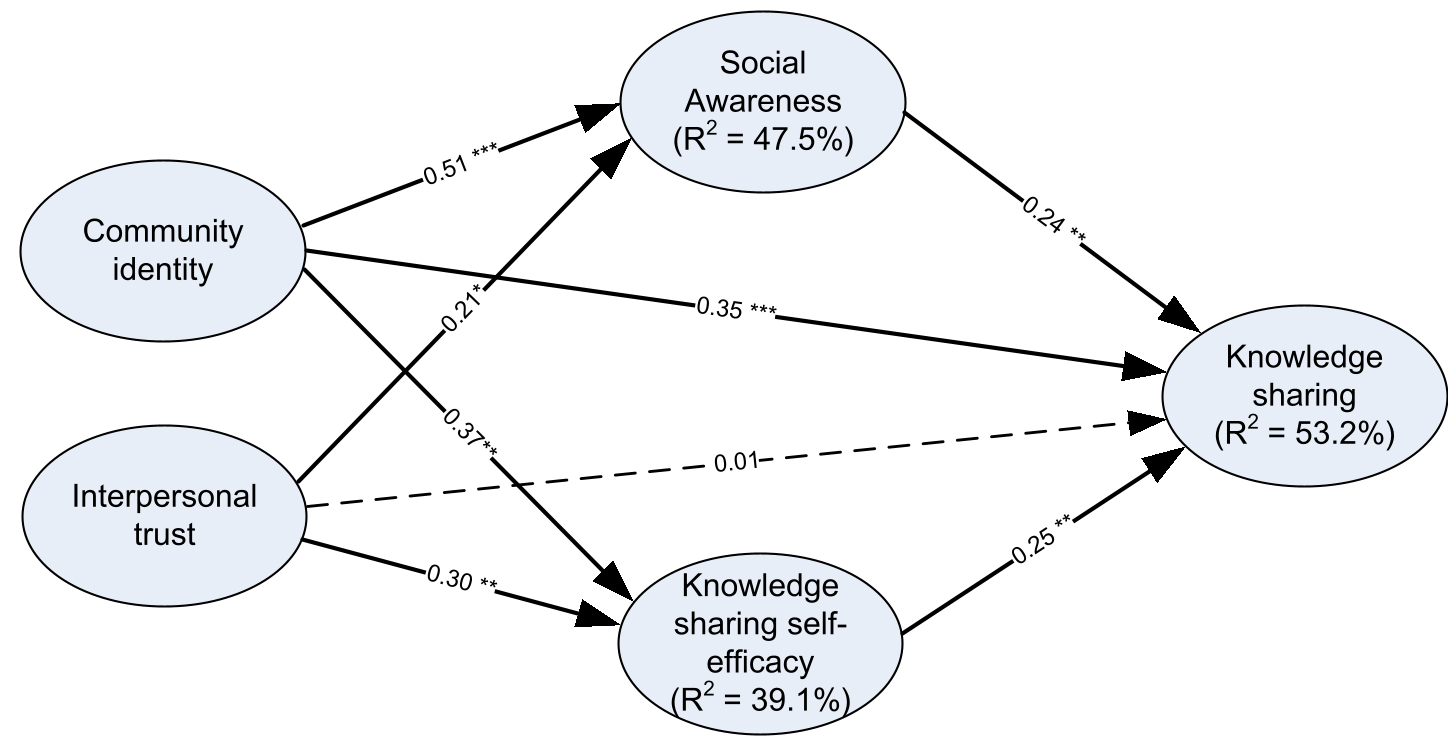
The data from 161 professional educators revealed several "Counter-Intuitive" truths:
* **The Trust Paradox**: Interestingly, Interpersonal Trust had **no significant direct effect** on sharing behavior ($H2$ was rejected). Instead, trust is the *foundation*. It makes people more aware of others' expertise and boosts their own confidence. Without trust, the "cognitive engine" never starts.
* **Identity as a Catalyst**: Community Identity was the strongest direct predictor of behavior ($\beta=0.35$). When members feel "this is my tribe," they share as a matter of moral obligation and altruism.
* **The Value of 'Knowing Who Knows'**: Social Awareness acts as a bridge. It reduces the "search cost" of finding knowledge, making the community feel like a collective brain (Transactive Memory).
## Critical Analysis & Conclusion
This work is a seminal reminder for the "AI-driven" era. As we move toward LLMs and automated knowledge bases, the **human element** remains the ultimate filter.
### Takeaway for Practitioners
If you are building a professional network:
* **Foster Identity over Incentives**: Stop offering gift cards; start building a "Sense of Belonging" through shared tasks and recognition.
* **Enhance Visibility**: Implement features that show "Who knows what" (Expertise Mapping) to boost Social Awareness.
* **Build Confidence**: Create safe spaces for "novice" sharing to build the Self-Efficacy of quieter members.
### Limitations
The study was conducted in Taiwan, a **collectivist culture**. As the authors note, results might differ in individualistic Western contexts where "Personal Brand" might outweigh "Community Identity."
**In summary**: Knowledge sharing is a self-regulated act of faith. By nurturing trust and identity, communities can transform isolated silos of expertise into a powerful, collective intelligence.