
[arXiv 2024] Self-Routing: Is the Learned Router in MoE Redundant?
Self-Routing: Parameter-Free Expert Routing from Hidden States
The paper introduces Self-Routing, a parameter-free Mixture-of-Experts (MoE) routing mechanism that eliminates dedicated router projections. By using a specific subspace of a token's hidden state as expert logits, it achieves SOTA-competitive performance on GPT-2 language modeling and ImageNet-1K classification without requiring learned router parameters or explicit load-balancing losses.
Executive Summary
The Mixture-of-Experts (MoE) architecture has become the backbone of modern LLM scaling (seen in Mixtral, DeepSeek, etc.). Traditionally, we assume that choosing which expert should process a token requires a specialized "brain"—a learned router module. Self-Routing challenges this dogma by demonstrating that a simple slice of the hidden state can serve as the router, removing parameters entirely while actually improving load balancing. It positions itself as a structural simplification that proves sparse models can self-organize without explicit gating supervision.
Motivation: The Hidden Cost of "Smart" Routing
In current SOTA MoE models, routing is typically:
- Parameterized: Requires an weight matrix per layer.
- Unbalanced: Often collapses into using only a few experts, requiring a carefully tuned "Load Balancing Loss."
- Complex: Adds overhead in implementation and synchronization.
The authors' core Insight is: If a Transformer is powerful enough to process language, its hidden state must already contain the features needed for routing. Why project into a new space when we can just read the routing preference directly from a designated corner of ?
Methodology: The "Slice" Technique
Self-Routing is elegantly simple. Instead of calculating , it defines: Where is the number of experts. The last coordinates of the hidden vector are treated as the "votes" for each expert.
 Figure 1: Comparison between the standard Learned Gate (left) and the parameter-free Self-Routing Gate (right).
By forcing the model to use specific dimensions for routing, the backbone is incentivized during backpropagation to store "routing-relevant" features in those specific slots. This is a form of implicit specialization.
Experimental Performance & Expert Utilization
The authors tested this on GPT-2 (language) and DeiT (vision). The results show that not only does performance hold up, but the "quality" of routing improves.
Performance Comparison (GPT-2 Scale)
| Model | Router Parameters | HellaSwag (%) | LAMBADA (Ppl) |
|---|---|---|---|
| Learned Router | 12 × H × N | 38.5 | 19.3 |
| Self-Routing | 0 | 39.0 | 18.9 |
The "Dead Expert" Solution
One of the most striking findings is the Routing Entropy. Learned routers often become "lazy," sending all tokens to one or two "generalist" experts. Self-Routing, by contrast, naturally distributes tokens more broadly.
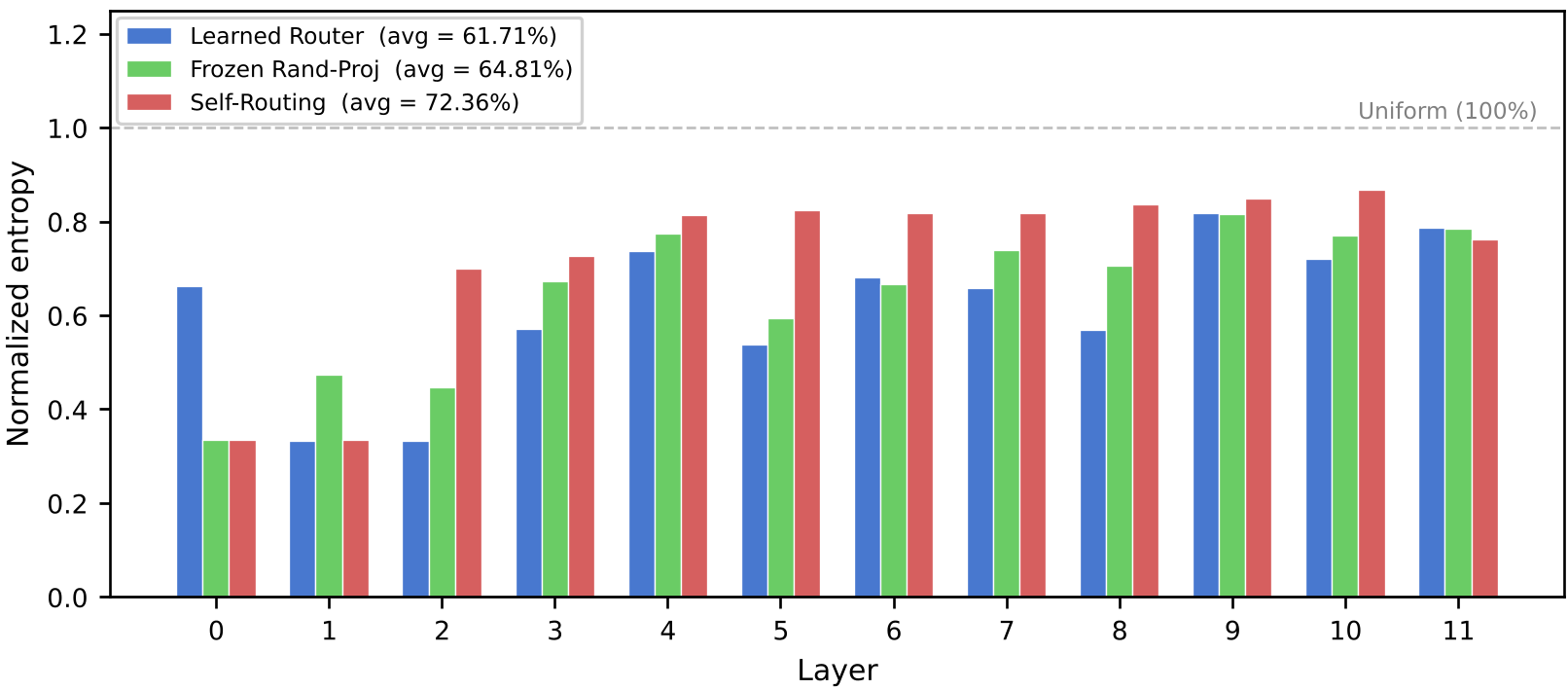 Figure 2: Layer-wise entropy. Self-Routing (blue) consistently achieves higher entropy (closer to 1.0), indicating more uniform and efficient use of the expert pool.
Critical Analysis & Conclusion
Why does it work?
Self-Routing suggests that routing is more about representational organization than it is about the "logic" of the router. By removing the learned projection, we remove a layer of abstraction that might otherwise oscillate or collapse during training.
Limitations
- Scale: This was tested at GPT-2 scales (~500M params). Whether this holds for 100B+ parameter models where routing dynamics are more volatile remains an open question.
- Fixed Subspace: Using the same coordinates across all layers might be restrictive. Future work could explore "coordinate hopping" or dynamic subspaces.
Takeaway
Self-Routing is a "less is more" breakthrough. It simplifies the MoE block, removes the need for auxiliary losses, and proves that the internal manifold of a Transformer is rich enough to direct its own data flow. For researchers building next-gen sparse models, this suggests that the route to efficiency might be internal reorganization rather than external complexity.