
Attention to Traces: Revolutionizing Anomaly Detection with Masked Span Prediction
Self-Supervised Anomaly Detection from Distributed Traces
The paper introduces a novel self-supervised anomaly detection method for distributed systems using Masked Span Prediction (MSP) on distributed traces. By leveraging a Transformer-based attention mechanism, it achieves SOTA performance, particularly outperforming LSTM-based models in identifying anomalies within long and complex execution paths.
TL;DR
This paper presents a shift in AIOps: moving from predicting the "next" event to understanding the "contextual" event. By introducing Masked Span Prediction (MSP), the authors utilize a self-attention mechanism to analyze distributed traces. This approach overcomes the limitations of LSTMs in long-sequence processing and offers a more robust, unsupervised way to detect failures in microservice architectures.
Background & Motivation: The Limits of "Next-Step" Thinking
In complex cloud environments, distributed traces are the "DNA" of a request, recording every microservice interaction. Historically, researchers treated these traces as simple sequences, using Long Short-Term Memory (LSTM) networks to predict the next span in a sequence.
However, this autoregressive approach has two fatal flaws:
- Forward Blindness: The model only looks at what happened before, ignoring the crucial context of what happens after a specific call.
- Vanishing Global Context: In long traces (typical in real-world systems), LSTMs tend to forget the beginning of the trace, leading to high false-negative rates.
Methodology: From Autoregression to Masked Modeling
The core innovation lies in treating a trace like a sentence in a language model. Instead of predicting the next span, the authors propose the Masked Span Prediction (MSP) task.
1. The MSP Workflow
During training, random spans in a trace are replaced with a [MASK] token. The model—a Transformer-based encoder—must predict the identity of the hidden span using the remaining context. This forces the model to learn the causal and structural relationships between services.
2. Architecture
The architecture follows a standard Encoder-Decoder structure:
- Encoder: Multi-head self-attention layers that allow each span to "attend" to every other span in the trace, regardless of distance.
- Decoder: A Softmax layer that outputs a probability distribution over the vocabulary of span templates (parsed via the Drain algorithm).
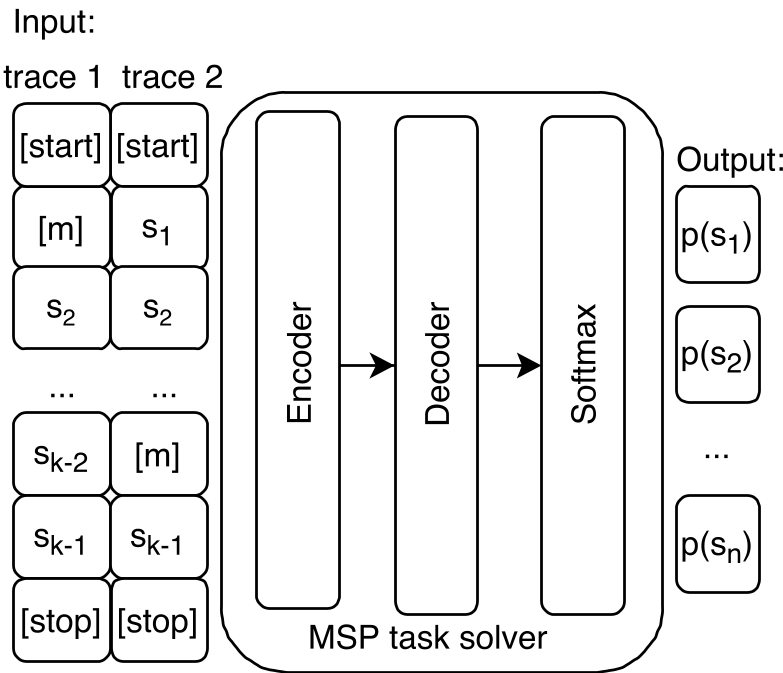 Figure 1: The Transformer-based architecture used for the Masked Span Prediction task.
Experiments & Results: Dominating Long Sequences
The authors tested their method on a custom OpenStack testbed, injecting real faults (like service restarts) and artificial anomalies (trace truncation).
Key Findings:
- The Length Advantage: On "Short Traces," LSTMs and the Attention model perform similarly. However, on "Long Traces," the Attention model maintains stable Precision and Recall, while the LSTM's performance degrades significantly.
- Robustness to Noise: The method uses a "Span Error Rate" threshold. By allowing a small number of prediction mismatches, the model avoids being overly sensitive to the natural jitter/noise inherent in distributed systems.
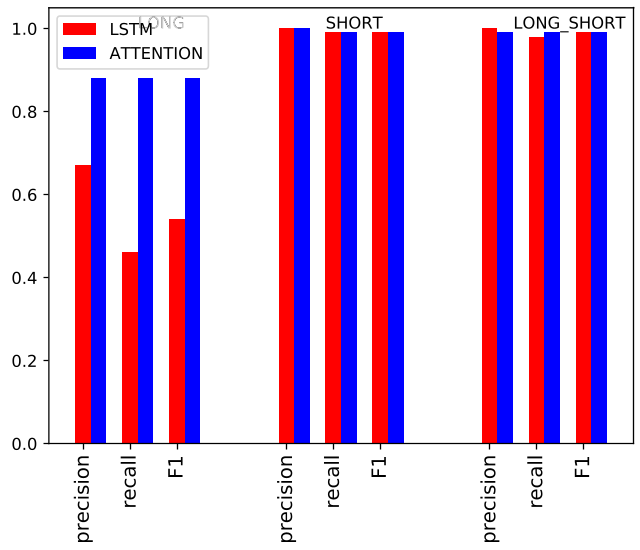 Figure 2: Performance metrics across different trace lengths. Note the stability of the Attention approach in long-trace scenarios (LS1).
Critical Insight: Why Bidirectional Context Matters
In a microservice call graph, a failure in a "downstream" service often manifests as a specific pattern in the "upstream" caller after the initial request. An autoregressive model (LSTM) might miss this because it only evaluates the failure at the moment it happens. The MSP approach, however, "sees" the entire execution path, allowing it to realize that a specific span is anomalous because it doesn't fit the surrounding lifecycle of the request.
Conclusion & Future Outlook
This work proves that the "BERT-ification" of system telemetry is not just a trend but a technical necessity. By utilizing the global context of distributed traces, we can build AIOps tools that are more accurate and scalable.
Future Directions:
- Multimodal Integration: Combining these structural insights with latency metrics (time-series) to detect performance regressions.
- Online Learning: Adapting the MSP model in real-time as microservice versions change and call graphs evolve.