
ASTERIS: A Software "Aperture Boost" for Deep Space Imaging Using Spatiotemporal AI
Deeper detection limits in astronomical imaging using self-supervised spatiotemporal denoising
The paper introduces ASTERIS (Astronomical Self-supervised Transformer-based Denoising), a self-supervised deep learning algorithm designed to enhance astronomical imaging. By integrating spatiotemporal information across multiple dithered exposures using a 3D U-Net and transformer-based attention, it surpasses standard SOTA co-addition techniques, effectively improving detection limits by 1.0 magnitude at 90% completeness and purity.
TL;DR
Astronomy has a "noise floor" problem: to see galaxies that are twice as faint, you typically need to observe for four times as long—or build a bigger telescope. ASTERIS changes this equation. By using a self-supervised 3D Transformer to exploit correlations across multiple dithered exposures, it pushes detection limits 1.0 magnitude deeper than standard stacking methods. In practical terms, it recently tripled the count of high-redshift galaxy candidates in JWST data, finding objects that were previously invisible to human and algorithmic eyes alike.
The Bottleneck: Why Stacking is Not Enough
In observational astronomy, the "Gold Standard" for reducing noise is co-addition (stacking). This involves taking multiple pictures of the same spot and averaging them. Mathematically, if you have exposures, the signal-to-noise ratio (S/N) improves by .
However, this assumes noise is random white noise. In reality, telescope noise is structured. Instrumental effects, the Point Spread Function (PSF), and atmospheric scattering create spatial and temporal correlations that simple averaging cannot "wash away." For the James Webb Space Telescope (JWST), going from 31 to 32 magnitudes in depth would normally require extending exposure time from 4 days to a full month—an impossible luxury in the competitive world of telescope time.
Methodology: The Spatiotemporal Insight
The authors realized that dithered exposures (shifting the telescope slightly between shots) contain a wealth of spatiotemporal information that is usually discarded. ASTERIS treats a stack of exposures as a 3D data cube (X, Y, and Time).
1. 3D Transformer Architecture
Rather than using standard 2D CNNs, ASTERIS employs a 3D U-Net structure. The "secret sauce" is the 3D Multi-Deconvolved-Head-Transposed-Attention (3D-MDTA). While standard CNNs have a limited "field of vision," this attention mechanism allows the model to look across the entire data cube, modeling pixel correlations across different time steps and spatial regions.
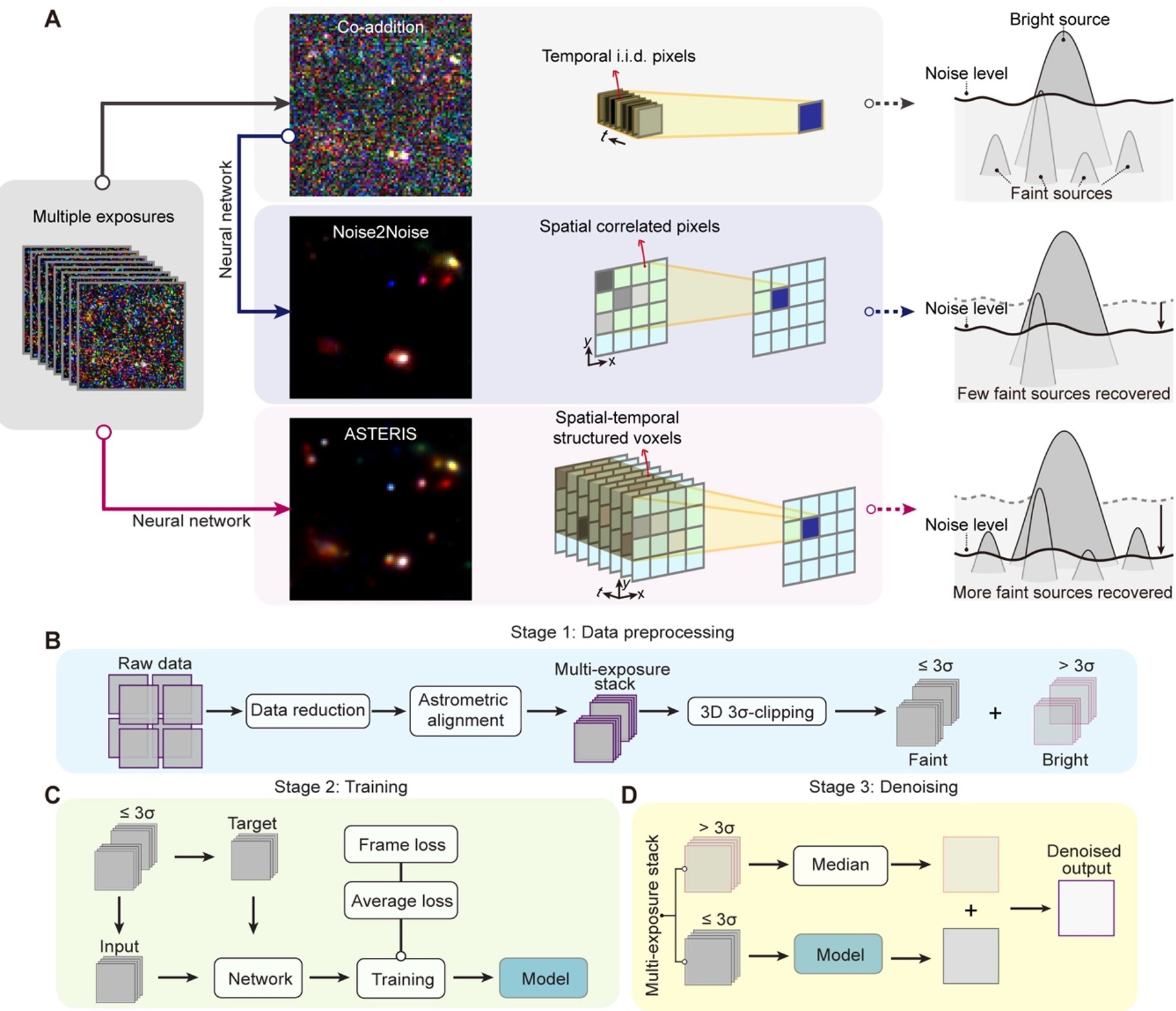 Fig 1. The ASTERIS pipeline separates the image into bright and faint parts, denoising the faint regions while preserving the high-quality bright signals.
2. Self-Supervised "Noise2Noise" Learning
How do you train an AI for space when there is no "clean" picture of the early universe to compare it to? ASTERIS uses a self-supervised approach. It splits 16 exposures into two sets of 8. Since both sets look at the same sky, the underlying signal is the same, but the noise realizations are independent. The network learns to predict Set B while looking at Set A, naturally converging on the common signal—the stars and galaxies.
Crucial Feature: The 3(\sigma) Clip
Deep learning models often struggle with high dynamic range; they might "blur" a bright star while trying to denoise the dark background. ASTERIS solves this by only denoising the faint part (pixels ). Bright stars are median-combined traditionally and then "pasted" back into the final image, ensuring that the photometric accuracy of bright objects is never compromised.
Results: Unveiling the Early Universe
The performance boost is quantifiable and significant. In mock tests, ASTERIS achieved a 90% completeness at magnitudes where standard co-addition dropped to near zero.
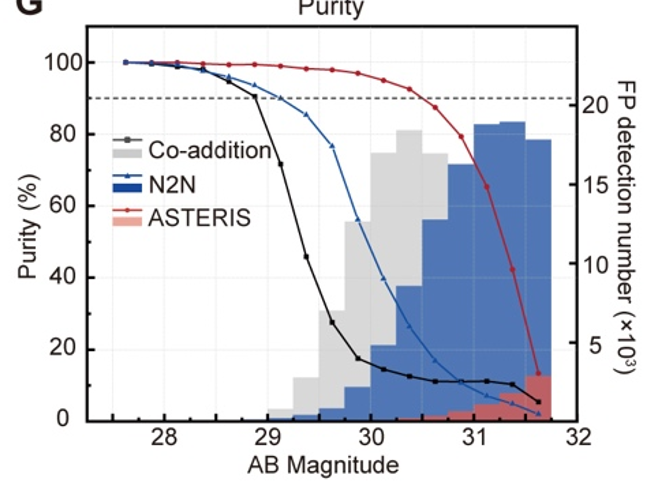 Fig 2. The F-score metric shows ASTERIS (red) maintaining high accuracy for much fainter magnitudes compared to standard stacking (black) and even other AI methods like N2N (blue).
Real-World Impact on JADES
When the team applied ASTERIS to the JWST Advanced Deep Survey (JADES):
- Redshift (z \gtrsim 9) Galaxies: Identified 162 candidates, triple the previous count.
- Fainter Frontiers: Detected galaxies with rest-frame UV magnitudes of (-16), a full magnitude fainter than previous studies.
- High-Redshift Champions: Found candidates at (z \approx 17) to (22.5), pushing back the curtain on when the first stars formed.
Critical Analysis & Takeaways
ASTERIS is essentially a "software-defined aperture increase." By extracting information from noise that was previously considered "uncorrectable," it allows astronomers to do more with the data they already have.
Limitations:
- Compute Heavy: Training takes ~26 hours on 4x A100 GPUs.
- Exposure Requirements: It currently requires an even number of exposures (ideally 8 or 16), which may not fit every historical observation strategy.
Conclusion: This work signals a paradigm shift. In the era of "Big Data" telescopes like JWST and the upcoming Rubin Observatory, the bottleneck is no longer just photons—it is how intelligently we can separate signal from structured noise. ASTERIS proves that deep learning, specifically spatiotemporal transformers, is the right tool for the job.