
SmileWave: Proving that Smiles are Contagious Even Behind a Screen
Investigating the occurrence of selfie-based emotional contagion over social network
The paper introduces "SmileWave," a custom social networking system designed to empirically test for selfie-based emotional contagion. By analyzing users' facial reactions via front-facing cameras, the study confirms that viewing smiling selfies significantly boosts the observer's own smile degree by an average of 15%, establishing the occurrence of the "first stage" of emotional contagion in digital environments.
TL;DR
Can a digital photograph trigger the same primitive, automatic physiological response as a face-to-face interaction? According to a 2-week "in-the-wild" study using a custom-built social network called SmileWave, the answer is a definitive yes. Researchers found that viewing smiling selfies increases a user's own "smile degree" by an average of 15%, proving that emotional contagion is alive and well in the age of the smartphone.
Background: The Digital Mirror
In psychology, emotional contagion is defined as the tendency to automatically mimic the expressions, postures, and vocalizations of others, eventually converging emotionally. While we know this happens in a coffee shop or a meeting room, proving it happens on Instagram or TikTok is harder. Social media is "noisy"—filled with text, memes, and videos that distract from pure facial mimicry.
The authors of this paper identify a critical gap: while the second stage of contagion (feeling the emotion) is often studied via sentiment analysis of text, the first stage (the physical mimicry of the face) remains under-explored in mobile social networks.
Methodology: High-Speed Facial Sensing
To isolate this effect, the researchers built SmileWave, a controlled SNS environment. The system's architecture is designed to capture the "micro-moment" of reaction.
1. The Reactive Loop
Whenever a user browses a selfie on SmileWave, the front-facing camera activates for exactly one second at 15 frames per second. This window was chosen after preliminary tests showed that human facial mimicry typically peaks within 11-13 frames of visual stimulus.
2. Measuring "Smile Degree"
Using the Face++ API (validated against human subjective scores), the system converts pixel data into a numerical "smile degree" (0-100%).
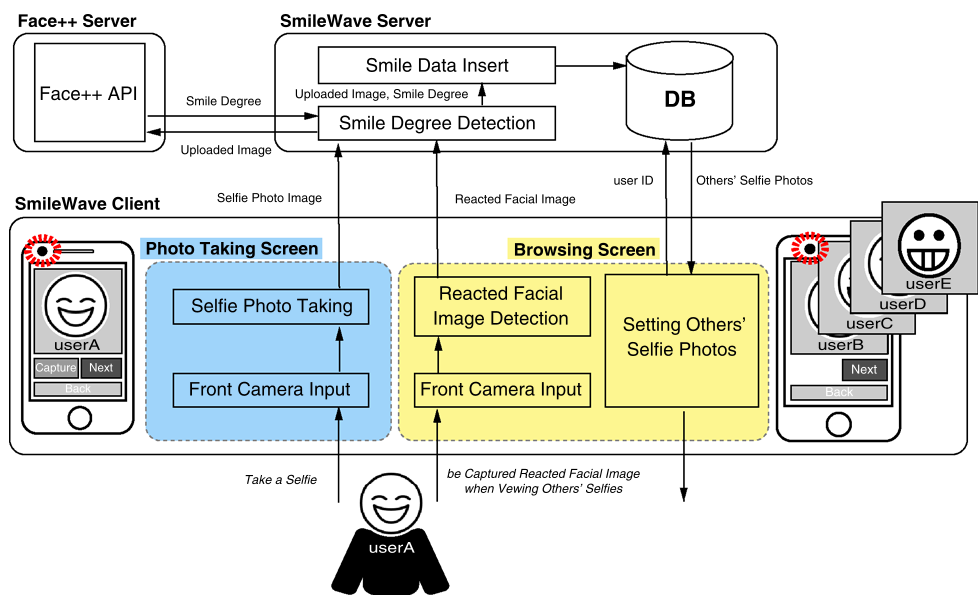 Fig 1: The SmileWave browsing interface (right) and the underlying data flow (left).
Evidence of Contagion
The study of 38 participants over 14 days yielded 9,798 reactive facial images. The findings were striking:
- The Mimicry Effect: There was a statistically significant jump from the user's initial expression to their peak smile degree (a 15% increase) while viewing others.
- Intensity Correlation: There is a weak positive correlation (0.26) suggesting that the "happier" the person in the photo looks, the more the viewer's smile intensifies.
- Gender Differences: Interestingly, women in the study exhibited higher baseline smile degrees and more intense mimicry reactions compared to men, though both showed significant contagion effects.
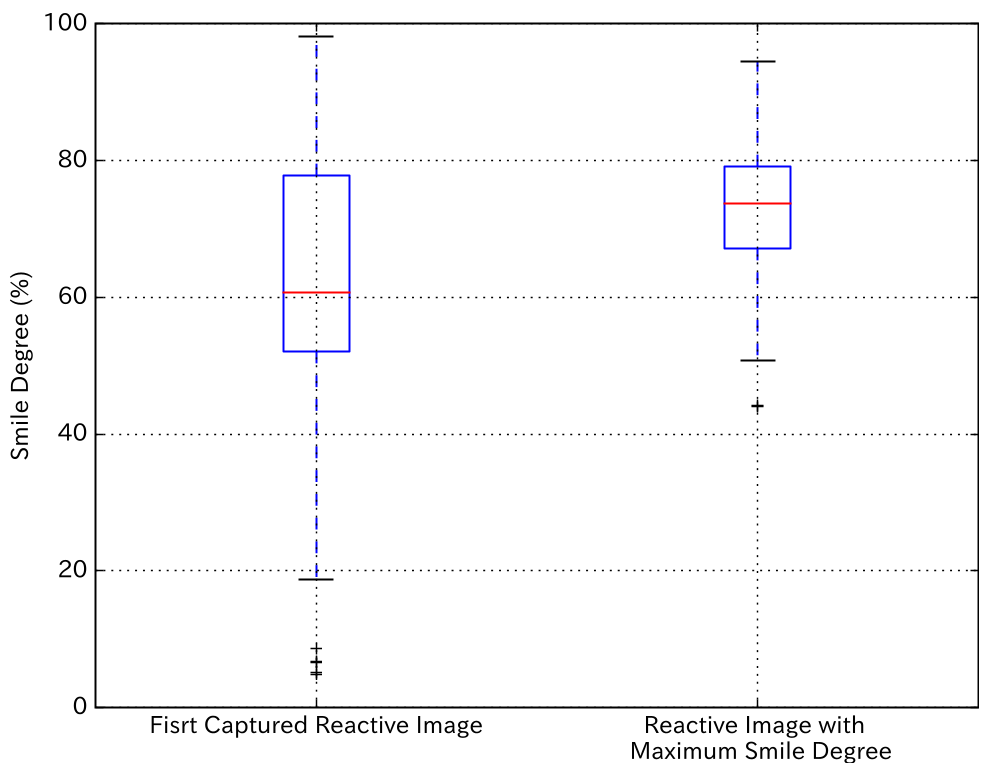 Fig 2: Quantitative proof of the "Smile Jump" – comparing initial vs. maximum reactive smile degree.
The "Peak-End" of Happiness
One of the most valuable insights for product designers is the ordering effect. The researchers tested different presentation strategies for selfies:
- Low-to-High: Showing less smiley faces first, ending with a broad grin.
- High-to-Low: Starting with the biggest smile and tapering off.
The "Low-to-High" strategy resulted in a 34.2% higher smile degree in the user's subsequent posts compared to "High-to-Low." This suggests that the progression towards happiness is more influential than the absolute amount of happiness viewed.
Critical Insight: Why This Matters
This study moves beyond "likes" and "shares" to measure the actual physiological resonance of social media. It suggests that:
- Algorithms have a biological footprint: The way we rank photos in a feed directly modulates the facial muscles (and by extension, the moods) of millions of users.
- Engagement through Emotion: Users were more likely to post their own selfies after viewing high-smile-degree content, indicating that positive emotional contagion is a driver of platform retention and content creation.
Limitations & Future Work
The study focused on college students, and while the "mimicry" is a universal human trait, the habits of smartphone use vary by age. The authors plan to scale this to larger, more diverse populations and integrate physiological sensors (like heart rate) to further validate the internal emotional shift following the external facial mimicry.
Conclusion
SmileWave proves that our smartphones are not just windows to look through, but mirrors that reflect—and amplify—the emotions of our social circles. The next time you see a friend's smiling selfie and find yourself grinning back at the screen, know that your biology is working exactly as intended.