
Correlation Induces Anarchy: Why Statistical Dependency Breaks Selfish Network Efficiency
Selfish Distributed Compression Over Networks: Correlation Induces Anarchy
The paper investigates the min-cost multicast problem with multiple correlated sources in a noncooperative game setting. It introduces the Distributed Compression Game (DCG) and utilizes Lagrangian duality and the supermodularity of conditional entropy to prove that source correlation significantly increases the Price of Anarchy (POA).
TL;DR
In the world of selfish routing, we often hope that if everyone acts in their own best interest, the system naturally finds an efficient state. This paper proves that source correlation—the statistical dependency between data points—acts as a catalyst for inefficiency. By modeling a Distributed Compression Game (DCG), the authors show that while independent sources can reach a "Price of Anarchy" (POA) of 1, correlated sources inevitably push the network toward a sub-optimal, high-cost equilibrium.
Background: The Invisible Hand in Networks
In large-scale systems like the Internet, agents (terminals) are selfish. They want to reconstruct data from multiple sources while paying the minimum possible for bandwidth and source access. When sources are independent, previous research (like Bhadra et al.) suggested that clever cost-splitting could align selfish interests with social welfare.
However, this paper identifies a fatal flaw: In the real world, sources are rarely independent. Whether it's sensors monitoring the same environment or mirrors of the same database, correlation is everywhere.
The Core Insight: Slepian-Wolf Meets Game Theory
The authors bridge information theory and game theory by placing the Slepian-Wolf (SW) region—which defines the possible compression rates for correlated sources—at the heart of the terminal's strategy set.
1. The Distributed Compression Game (DCG)
The terminals are the players. Their strategy involves choosing:
- Flows (): Which paths to use.
- Rates (): How much data to request from each source.
The cost functions for edges () and sources () are convex and increasing. The "anarchy" happens because terminals don't care about the total network cost; they only care about their share of it.
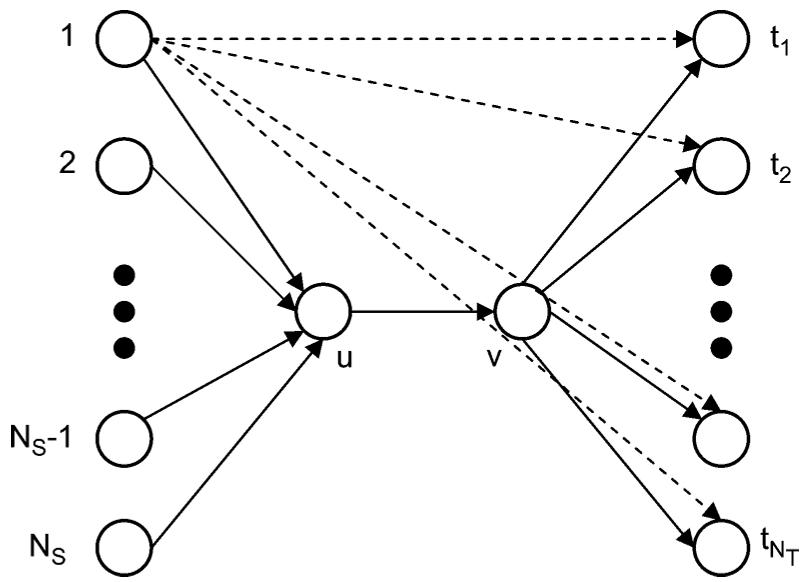 Fig 1: A network topology where terminals must decide between direct paths and shared paths under Slepian-Wolf constraints.
Methodology: Characterizing the Equilibrium
To understand why correlation breaks things, the authors first solved the "Social Optimum" using Lagrangian Duality. They discovered that the optimum is defined by four conditions, notably utilizing the supermodularity of conditional entropy.
They then established a critical bridge: A Wardrop Equilibrium (a state where no terminal can reduce its cost by moving an infinitesimal amount of flow) is actually an OPT solution for an altered version of the network's cost functions. This "mathematical mirror" allows them to calculate exactly how far the selfish equilibrium drifts from the true social optimum.
Experiments: Proving the Inefficiency
The paper provides a rigorous mathematical proof supplemented by "gadget" examples to show the POA in action.
- Independent Sources: The POA is consistently 1. The terminal's selfish choice aligns with the network's best interest.
- Correlated Sources: The authors construct a specific topology (Fig 1 and Fig 2) where the POA is strictly > 1.
For monomial cost functions (e.g., ), they derived a near-tight upper bound:
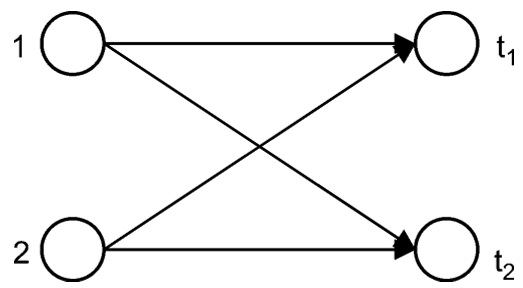 Fig 2: The classical Slepian-Wolf network setup demonstrating that even in simple bipartite graphs, correlation induces sub-optimal selfish behavior.
Critical Insight: Why is Correlation Different?
Why does correlation matter? When sources are independent, the rate requested from a source is fixed by its entropy (). There is no "room" for strategic rate manipulation.
When sources are correlated, terminals have flexibility. They can choose to take more from Source A and less from Source B (as long as the sum satisfies the Slepian-Wolf bound). Because terminals see different marginal costs on the paths from Source A vs. Source B, they make choices that help themselves but clog up the network or use "expensive" sources globally. Correlation creates a strategy space for selfishness that independence lacks.
Conclusion & Future Outlook
This work serves as a warning for decentralized network design: Statistical dependencies require centralized regulation or more sophisticated incentive alignment.
Future Directions:
- Dynamics: Can we design decentralized algorithms that converge to these equilibria in polynomial time?
- Capacity Constraints: How does finite bandwidth change the "Anarchy" landscape?
- Generalization: Extending these results from Slepian-Wolf regions to more general Polymatroidal structures found in multi-terminal source coding and the CEO problem.