
SMSHO: Re-Engineering Swarm Intelligence with Simplex Heuristics for Robust Data Clustering
A selfish herd optimization algorithm based on the simplex method for clustering analysis
This paper introduces SMSHO, a novel meta-heuristic clustering algorithm that integrates the Simplex Method into the Selfish Herd Optimization (SHO) framework. The hybrid approach replaces traditional mating operations with simplex operators (reflection, expansion, compression, and shrinking) to optimize cluster center vectors by minimizing Euclidean distance-based objective functions.
Executive Summary
Data clustering—the art of finding intrinsic patterns without prior labels—remains one of the most challenging NP-hard problems in machine learning. While the ubiquitous K-means is efficient, its tendency to get trapped in local optima is a well-known Achilles' heel. Swarm intelligence algorithms like Selfish Herd Optimization (SHO) offer a global search alternative, but they often lack the "finesse" to converge accurately in complex landscapes.
The paper "Method for Clustering Analysis" by Zhao et al. introduces SMSHO, a hybrid algorithm that embeds the Simplex Method into the SHO framework. By replacing genetic mating with geometric operations, the authors have achieved a SOTA status across multiple UCI benchmarks, significantly improving both convergence speed and solution stability.
The Core Problem: Why Swarm Intelligence Stalls
Swarm intelligence (SI) mimics nature—bees, wolves, or herds—to explore the solution space. However, many SI variants rely on stochastic "mating" or "crossover" to generate new candidate solutions. In the context of clustering, these methods often produce offspring too similar to their parents, leading to a loss of population diversity. This lack of variety causes the algorithm to stall (premature convergence), especially when dealing with high-dimensional data where the local optima are numerous and deceptive.
Methodology: The Simplex Edge
The authors' primary insight is replacing the SHO "Restoration Stage" (where killed prey are regenerated) with a series of Simplex operations.
The SMSHO Workflow
- Optimization as Clustering: Each individual in the population represents a potential set of cluster centers.
- Hamilton’s Logic: The algorithm simulates prey moving toward leaders (better solutions) while avoiding predators (worse solution markers).
- Simplex Regeneration: Instead of random mating, the algorithm selects the best (), sub-best (), and worst () individuals to form a "simplex" in the search space.
- Geometric Operators: Through Reflection, Expansion, and Compression, the algorithm mathematically "projects" new candidates away from the worst solutions, effectively "scouting" the landscape with higher precision.

Experimental Insights & Visual Evidence
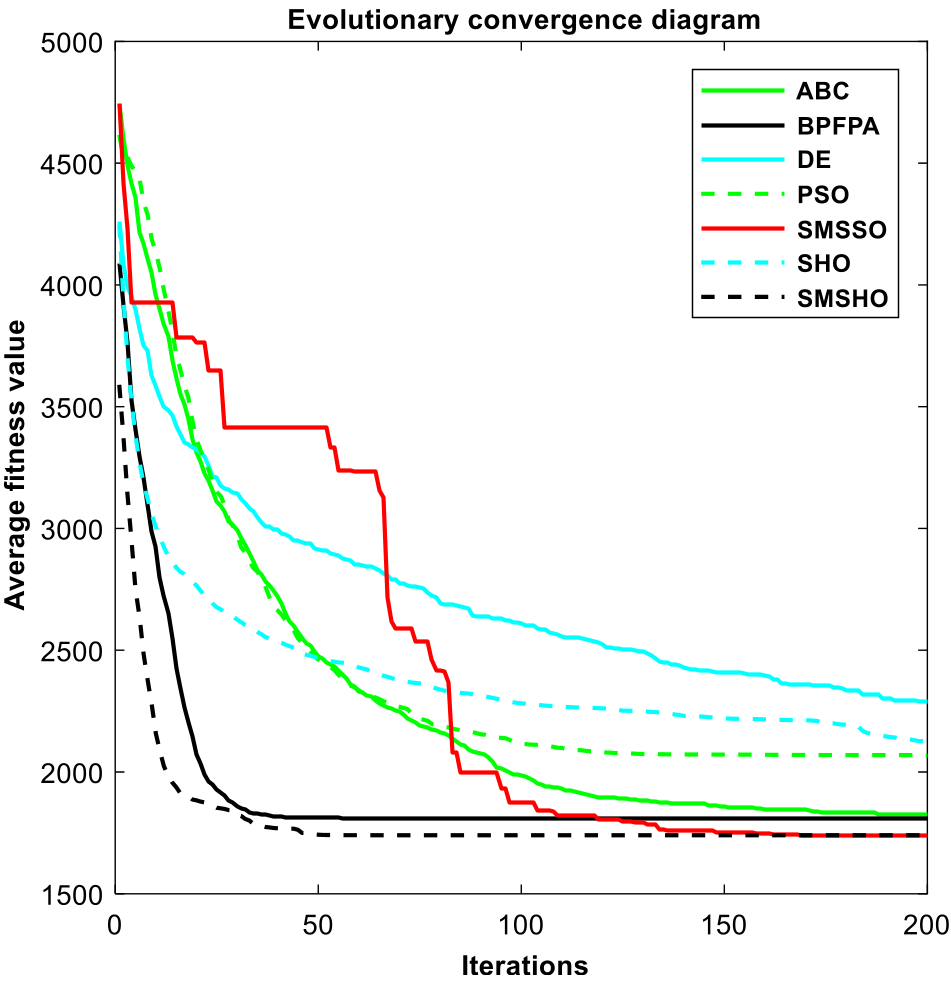
The power of SMSHO is most visible in its convergence behavior. Across 12 datasets—ranging from the simple Iris to the complex Contraceptive Method Choice (CMC)—SMSHO consistently found lower objective function values (lower total Euclidean distance) than its predecessors.
1. Superior Convergence Speed
As shown in the artificial dataset experiments, SMSHO (often the dark line in graphs) drops to the lowest error rate faster than ABC, PSO, or DE. The Simplex method acts as a local refinement tool that "pushes" the global search towards the true optimum.
2. High Stability
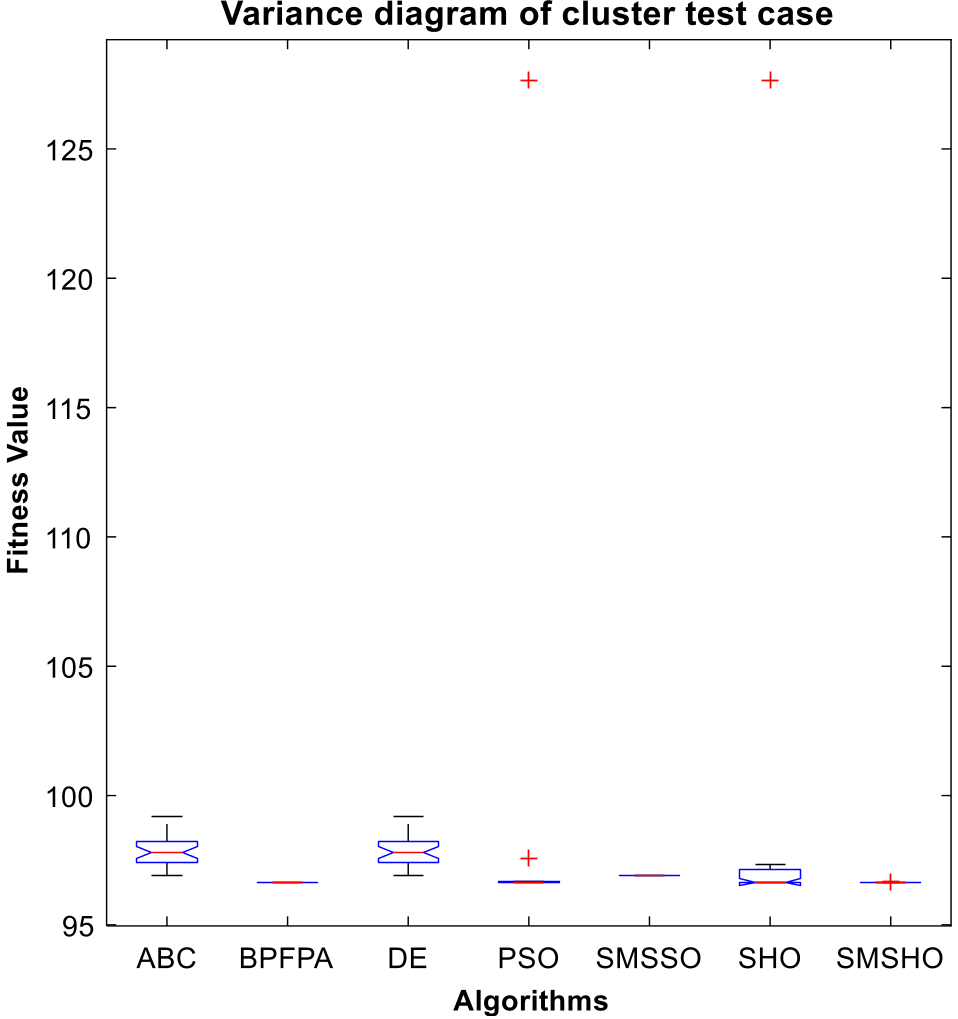
Standard deviation is a critical metric for meta-heuristics. A good algorithm should produce the same result every time. The Variance Diagrams provided in the paper demonstrate that SMSHO maintains higher population diversity in early stages, which paradoxically leads to more stable and consistent final results compared to the erratic fluctuations of PSO or K-means.
Critical Analysis: Is it the Ultimate Optimizer?
Strengths:
- Diversity: The Simplex method ensures the population doesn't cluster too quickly around a mediocre solution.
- Generalization: The algorithm performed exceptionally on both artificial and real-world UCI datasets.
- Accuracy: The Wilcoxon tests confirm the results are statistically significant, not just lucky runs.
Limitations:
- Computational Overhead: The Simplex operations (reflection, expansion, etc.) add complexity. While the paper claims the running time is "moderate," it is still slower than a simple PSO or K-means.
- Parameter Sensitivity: Swarm algorithms are notoriously sensitive to their hyperparameters (e.g., predator/prey ratios), and SMSHO adds Simplex coefficients () to that list.
Final Takeaway
SMSHO represents a sophisticated evolution in clustering analysis. By combining the biological intuition of Selfish Herds with the rigorous geometric search of the Simplex Method, it provides a robust toolkit for researchers tackling complex data mining and pattern recognition tasks. Its success on UCI benchmarks suggests it is ready for practical applications in fields like bioinformatics and business intelligence.