
SMSHO: Solving Clustering Challenges through Geometry and Swarm Intelligence
A selfish herd optimization algorithm based on the simplex method for clustering analysis
This paper introduces the SMSHO (Selfish Herd Optimization based on the Simplex Method), a hybrid meta-heuristic algorithm designed for partitional clustering. By replacing the traditional mating operation with the Nelder-Mead Simplex method, the approach achieves state-of-the-art results across 12 benchmark datasets, outperforming established methods like ABC, PSO, and k-means.
TL;DR
Clustering is a fundamental yet difficult NP-hard problem. While k-means is the industry standard, its tendency to get stuck in local optima often leads to poor data insights. This paper presents SMSHO, an algorithm that merges the biological intuition of a "Selfish Herd" with the mathematical precision of the Simplex Method, resulting in faster, more stable, and highly accurate data classification.
Problem & Motivation: The Local Optimum Trap
In clustering, we seek to find the "perfect" center for each group. Traditional methods like k-means are greedy; they move toward the nearest improvement but lack the "global view" to realize they might be heading toward a mediocre peak. Swarm intelligence algorithms (like SHO, PSO, or ABC) were designed to solve this via exploration.
However, the original Selfish Herd Optimizer (SHO) had its own flaw: its mating operation for regenerating "prey" was too similar to selection, which caused the population to lose diversity. Once diversity is lost, the algorithm collapses into the same local optima it was meant to avoid.
Methodology: High-Dimensional Geometry meets Biological Survival
The core innovation of this paper is the Selfish Herd Optimization based on the Simplex Method (SMSHO).
1. The Survival Framework
The algorithm simulates a predator attacking a herd of prey. Prey move toward the center of the herd for safety (Leader Following), while predators move toward individual prey (Hunting).
2. The Simplex Hybridization
Instead of using simple "mating" to replace prey killed by predators, the authors use the Nelder-Mead Simplex Method. This geometric approach uses four key operations to explore the search space:
- Reflection: Looking for better solutions on the opposite side of a bad point.
- Expansion: Pushing further in a promising direction.
- Compression & Shrinking: Refining the search area when close to a solution.
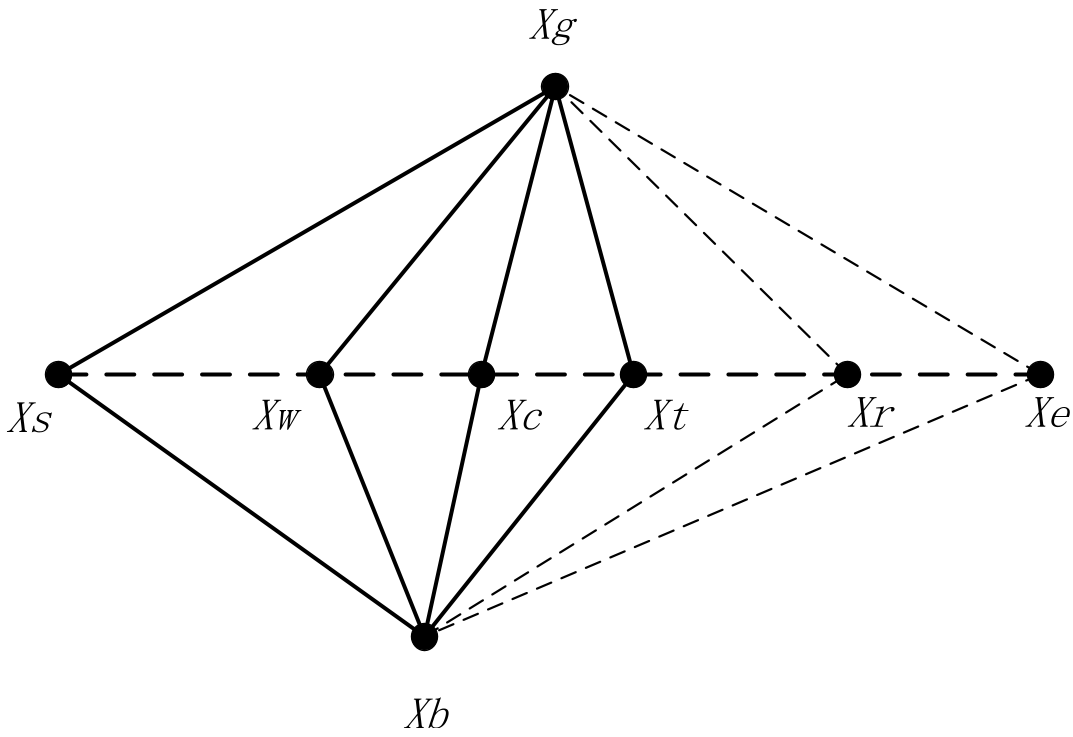 Figure: The geometric operations of the Simplex method integrated into the population update.
Experiments & Results: A New Benchmark in Accuracy
The authors tested SMSHO on 12 datasets, ranging from artificial 2D sets to complex real-world medical data (e.g., Cancer, Heart disease).
SOTA Comparison
Compared against k-means, PSO, ABC, and SHO, the SMSHO consistently found lower objective function values (smaller sum of squared errors).
- Convergence: SMSHO significantly outpaces other meta-heuristics, finding optimal solutions in fewer iterations.
- Stability: Unlike PSO, which can vary wildly between runs, SMSHO showed nearly zero variance in multiple tests, meaning it finds the same global optimum reliably.
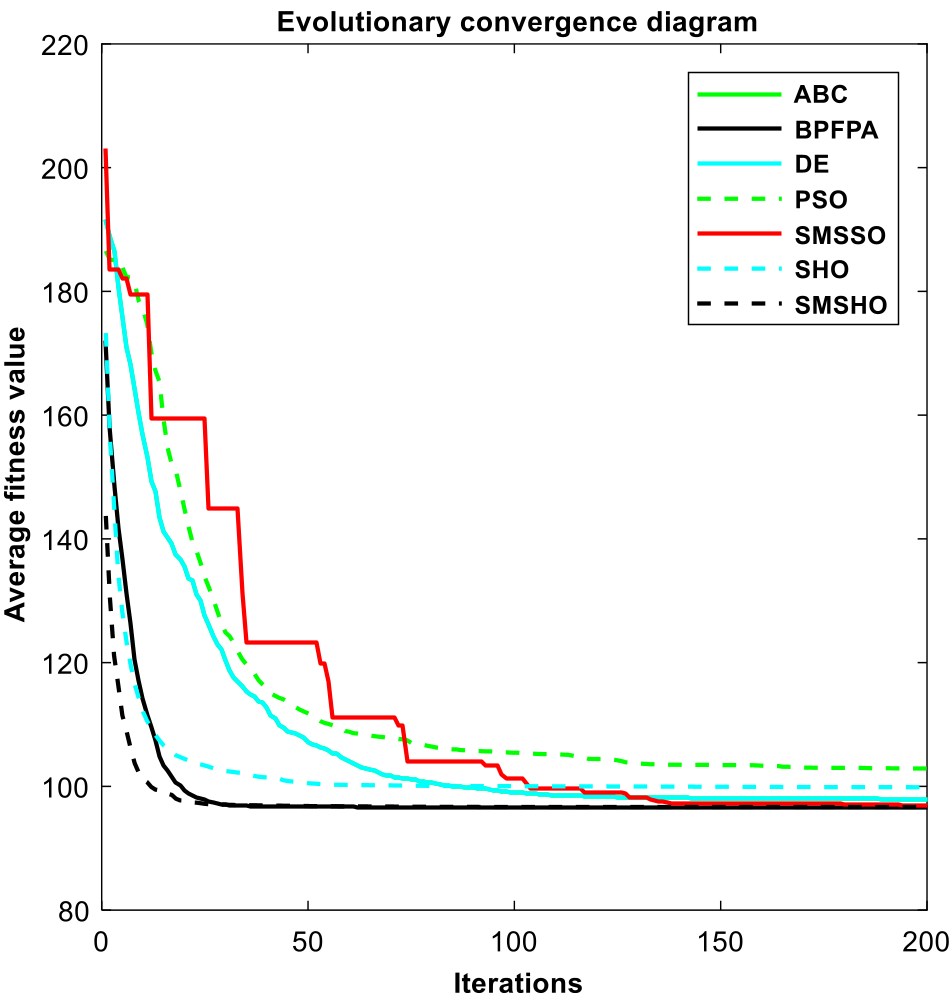 Figure: Performance comparison on the Iris dataset, showing SMSHO's superior convergence rate.
Critical Insight: Why it Works
Swarm algorithms usually struggle with the Exploration vs. Exploitation trade-off. By adding the Simplex method, the authors essentially gave the "herd" a better compass. Instead of blindly mating, the herd uses the geometry of the best and worst individuals to mathematically triangulate where the true center of a cluster resides.
Conclusion & Limitations
SMSHO represents a significant step forward for meta-heuristic clustering. Its ability to solve the "local optimum" problem while maintaining speed makes it a viable candidate for real-world applications in pattern recognition and data mining.
Limitations:
- The computational cost of Simplex operations makes the algorithm slightly slower than the original SHO (though the performance gains justify it).
- The paper focuses on partitional clustering; future work is needed to see if this hybrid approach works for density-based or hierarchical clustering.
Future Work: The authors aim to apply SMSHO to UAV path planning and image segmentation, where the search space is even more complex and local optima are even more numerous.