
The Vulnerability of Selfishness: Why Better Tech Can't Save Network Security
How Bad Are Selfish Investments in Network Security?
This paper investigates a network security game where strategic players choose security investments under positive externalities. It characterizes the Price of Anarchy (POA) using the "Effective-investment" and "Bad-traffic" models, proving that selfish behavior often leads to significant suboptimality in overall network safety.
TL;DR
In a world of interconnected systems, your security is only as good as your neighbor's. This paper mathematically proves that "selfish" (non-cooperative) security investments lead to a Price of Anarchy (POA) that grows with network size and traffic imbalance. Surprisingly, the authors demonstrate that doubling the effectiveness of security technology does nothing to improve the efficiency ratio of the network—the incentive gap remains the same.
Background: The Invisible Hand is Shaking
In classic economics, the "invisible hand" helps reach efficiency. In network security, the hand is often paralyzed by positive externalities. When User A buys a better firewall, User B benefits because User A's computer is less likely to become a bridgehead for a virus. Because User A doesn't "internalize" the benefit to User B, they under-invest. This paper seeks to quantify exactly how much this selfishness costs us.
Problem & Motivation: The Free-Rider's Dilemma
Existing literature often treated users as identical blocks. However, the real internet is a mess of heterogeneity:
- Cost/Value Imbalance: A bank values security more than a home user.
- Logical Dependency: Some nodes (like central servers) are "socially important"—if they fail, everyone fails.
The authors' core intuition is that the Price of Anarchy (POA)—the ratio of the worst-case Nash Equilibrium (NE) cost to the Social Optimum (SO)—is fundamentally tied to these dependencies.
Methodology: Mapping Social Importance
The authors split the problem into two distinct mathematical lenses:
1. The Effective-Investment (EI) Model
Here, your security risk is a function of the "weighted sum" of everyone's investment.
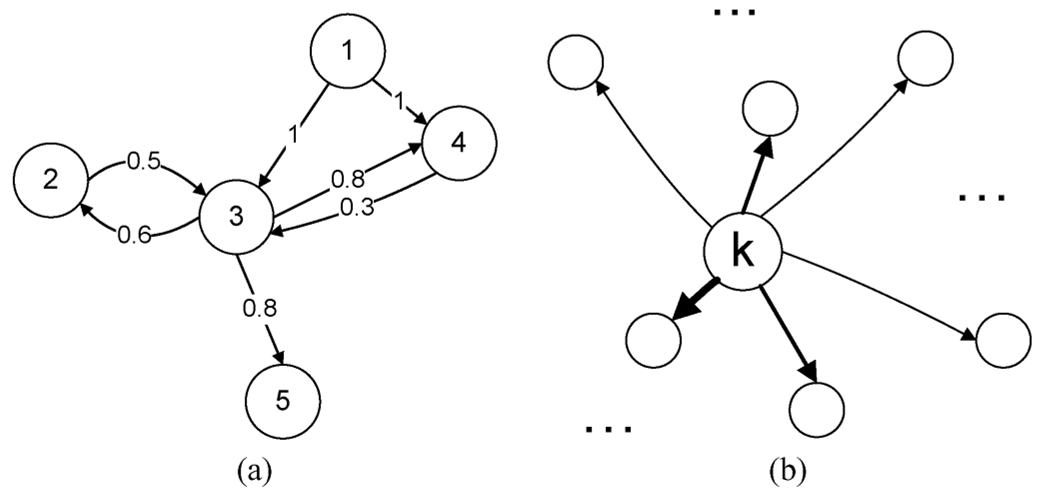
- The Bound: . If one node is vital to thousands of others, the POA can be massive.
2. The Bad-Traffic (BT) Model
This model focuses on the flow of "malicious packets" between nodes.
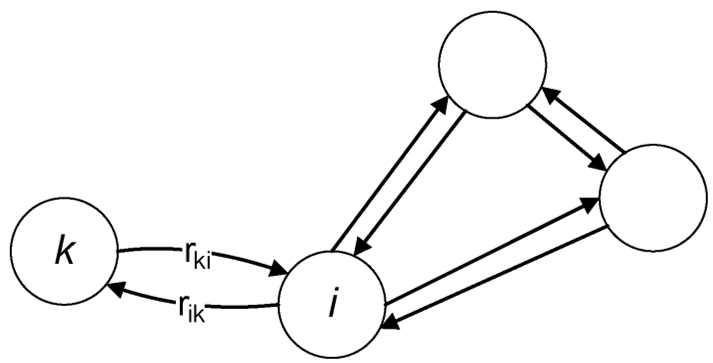
- The Bound: is determined by the "maximum imbalance" of traffic between any two nodes. If A sends much more traffic to B than vice versa, the incentive to protect that link is skewed.
Experiments & Results: The Technology Paradox
The most striking finding of the paper is the Invariance of POA to Technology.
Assume we invent a new antivirus that is times more effective. While the absolute social cost goes down, the ratio of inefficiency (the POA) remains exactly the same!
- Result: Technology moves the goalposts, but the "Selfishness Gap" persists. Solving the incentive problem (the "Why") is more effective than solving the technical problem (the "How").
Comparative Strategies
The paper also looks at:
- Repeated Games: If users interact repeatedly, they can "punish" free-riders. The authors show that the best Subgame Perfect Equilibrium (SPE) can often reach the Social Optimum, provided the discount factor is high enough.
- Correlated Equilibrium (CE): Interestingly, a "mediator" recommending actions can outperform a simple Nash Equilibrium, even without enforcing rules.
Critical Analysis & Conclusion
Takeaway
The study concludes that as networks grow and traffic becomes more unbalanced (e.g., the rise of central Cloud hubs), the Price of Anarchy naturally increases. We cannot "engineer" our way out of this with better firewalls alone.
Limitations
The model assumes "complete information" (everyone knows everyone else's costs), which is rarely true in the wild. Additionally, it treats security risk as a convex function, which might not hold during "zero-day" events where a single flaw bypasses all investment levels.
Future Work
The shift must move toward Mechanism Design: cyber-insurance, "due care" regulations, and protocol-level incentives that bake cooperation into the network's foundation.