
degNCG: Solving the Constant Price of Anarchy via Social Popularity
Selfish Network Creation with Non-uniform Edge Cost
The paper introduces the Degree Price Network Creation Game (degNCG), a parameter-free game-theoretic model where edge costs are proportional to the degree of the target node. It establishes the first known constant Price of Anarchy (PoA) for a broad class of network creation games.
TL;DR
Researchers have finally achieved what has eluded the Algorithmic Game Theory community for years: a proof of a constant Price of Anarchy (PoA) for a natural variant of the Network Creation Game. By abandoning the "one-price-fits-all" edge cost and replacing it with a cost proportional to a node's degree (popularity), the degNCG model demonstrates that selfish agents can indeed build globally efficient networks.
The Problem: The Tyranny of
In the classic Network Creation Game (NCG) introduced by Fabrikant et al. (2003), every edge costs a fixed value . While elegant, this model creates a mathematical bottleneck. The network's efficiency (PoA) is hostage to the value of , and proving that the PoA remains constant for all possible values of is a notorious open problem.
More importantly, uniform costs are unrealistic. In a social context, "connecting" to a celebrity (a high-degree node) usually requires more effort or resources than connecting to a peer.
The Insight: Endogenous Popularity-Based Cost
The authors propose the Degree Price Network Creation Game (degNCG). The cost function for an agent is:
This simple change has profound implications:
- Parameter-Free: There is no to tune. The "price" is baked into the network structure.
- Social Realism: It models "popularity-based" link costs.
- Efficiency: It penalizes the creation of massive "hubs" unless they providing significant distance reductions to the rest of the network.
Methodology: Tree-Based Diameter Bounds
The core of the paper’s contribution lies in its structural analysis. The authors prove that in a Nash Equilibrium (NE), the diameter of the network must be constant.
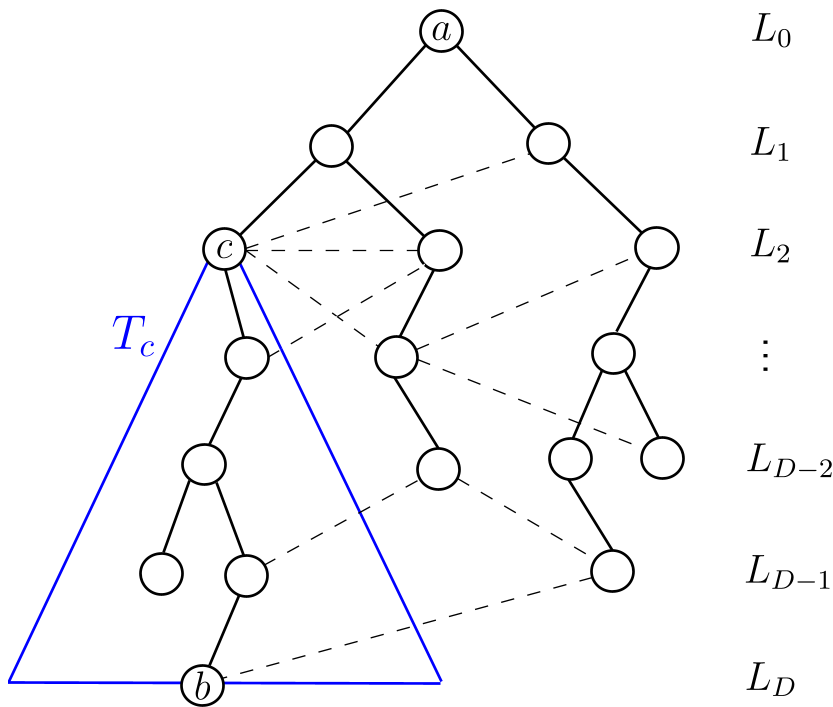 Figure 1: The shortest-path tree analysis used to bound the diameter by evaluating the cost-benefit of adding "shortcut" edges.
By showing that an agent would always find it profitable to buy an edge to a distant node if the diameter were too large, they constrain the equilibrium networks to be tightly connected. This leads to the constant PoA proof, the most significant theoretical result of the paper.
Hardness and Dynamics
Despite the efficiency of the equilibrium, reaching it isn't easy. The authors prove:
- NP-Hardness: Finding a "Best Response" strategy is computationally difficult, reducing from the Set Cover problem.
- Non-Convergence: Unlike potential games, the degNCG can enter infinite loops of strategy changes (Improving Response Cycles).
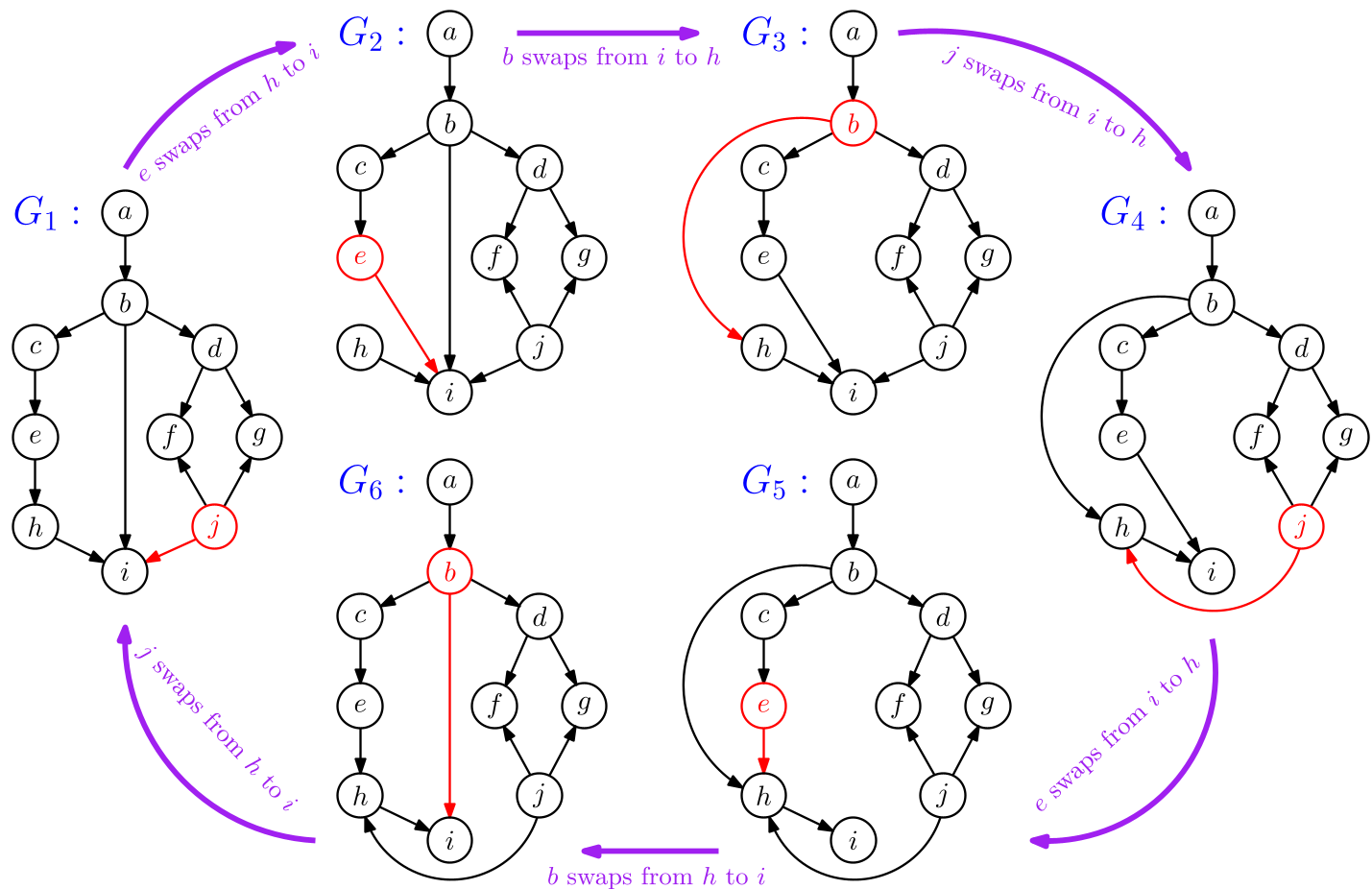 Figure 2: An unconventional cyclic sequence of moves showing that agents e, b, and j can endlessly swap edges without reaching a stable state.
Conclusion and Future Outlook
The degNCG model provides a major breakthrough in the analysis of selfish network formation. By aligning individual costs with local structural properties (degree), the model bridge the gap between local selfishness and global efficiency.
Key Takeaways:
- Constant PoA: Finally achieved by making edge costs linear functions of node degrees.
- Local vs. Global: In the 2-local version (where agents only see their immediate neighbors), the PoA degrades to , emphasizing that global visibility is crucial for network efficiency.
- Future Path: The authors suggest exploring bilateral versions (where both nodes must agree to a link), which could further refine our understanding of economic partnerships and social link formation.
This paper is a must-read for researchers in Algorithmic Game Theory and Network Science, as it provides both a new theoretical toolset and an intuitive explanation for the structural efficiency of complex networks.