
The Selfish Vaccine: Engineering Cooperation in a World of Free-Riders
THE SELFISH VACCINE RECIPE: A SIMPLE MECHANISM FOR AVOIDING FREE-RIDING
The paper presents a computational simulation study of collective problem-solving to address social loafing and free-riding in crowdsourcing. It introduces two reward distribution mechanisms, "Recipe A" (open access to benefits) and "Recipe B" (exclusive access for contributors), demonstrating that restrictive sharing policies significantly enhance cooperation and collective knowledge.
TL;DR
Human collective intelligence is a double-edged sword: while "many hands make light work," they also provide a perfect hiding spot for free-riders. This paper proposes a "Selfish Vaccine"—a simple mechanism (Recipe B) that limits the benefits of collective knowledge only to those who contribute. Through numerical simulations, the authors prove that by "selfishly" protecting the fruits of cooperation, we can actually rescue large-scale collaboration from the decay of social loafing.
Background: The Price of Cooperation
From the evolutionary expansion of the human brain to modern platforms like Wikipedia, our species thrives on Collective Intelligence. However, as groups grow, two psychological demons emerge:
- Social Loafing: The tendency for individual effort to decrease as the group size increases.
- Free-Riding: The rational but parasitical choice to enjoy public goods (like open-source software) without contributing back.
The authors argue that current "open" models (Recipe A)—used by Linux, Wikipedia, and Google—are inherently vulnerable to these effects. To solve this, they look for the minimum conditions necessary to keep cooperation viable in large groups.
Methodology: A Tale of Two Recipes
The researchers simulated a population of 128 players, varying group sizes () and task simplicity (). Players have a fixed propensity to cooperate () and face tasks where collective knowledge () significantly lowers the barrier to success.
The core of the experiment lies in the two "Norm Systems":
- Recipe A (The Open Commons): If a cooperator solves a task, the resulting "fitness" (gain) is distributed to everyone in the group. Free-riders get a "free lunch."
- Recipe B (The Selfish Vaccine): If a cooperator solves a task, the gain is shared only with players who also chose to cooperate in the previous turn.
The Evolutionary Engine
The simulation isn't static; it's evolutionary. Every 1000 iterations, the bottom 20% of performers are "killed off" and replaced with new agents, allowing the system to find an equilibrium where the most successful strategies survive.
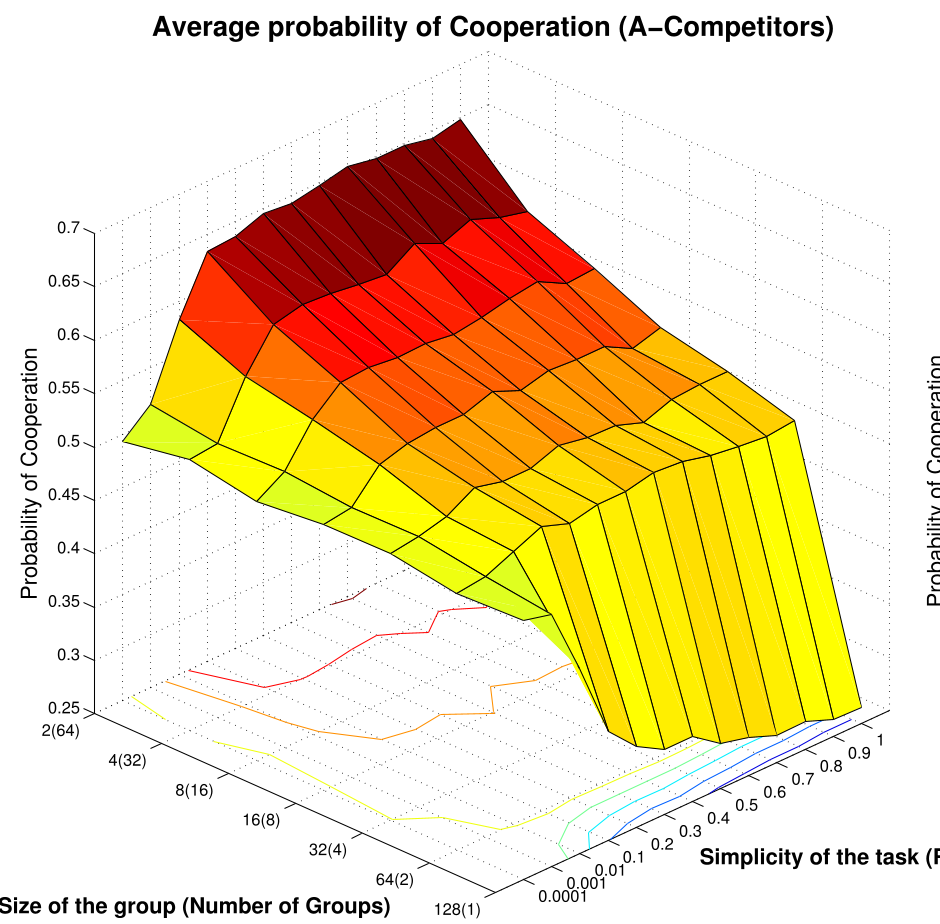 Figure: The stark contrast in cooperation density between Recipe A (left) and Recipe B (right).
Experimental Insight: Reversing the Ringelmann Effect
The results from the simulation provide a profound insight into social engineering:
1. Group Size vs. Cooperation
In Recipe A, the simulation replicates the classic "Social Loafing" effect: as groups get larger, cooperation collapses. However, in Recipe B, the trend is completely reversed. Larger groups actually encourage cooperation because the cost of being excluded from a large pool of collective knowledge is too high to ignore.
2. Efficiency and Knowledge Growth
Recipe B doesn't just promote "niceness"—it promotes efficiency. The "Collective Knowledge" (the group's ability to solve problems) grows exponentially faster when benefits are gated.
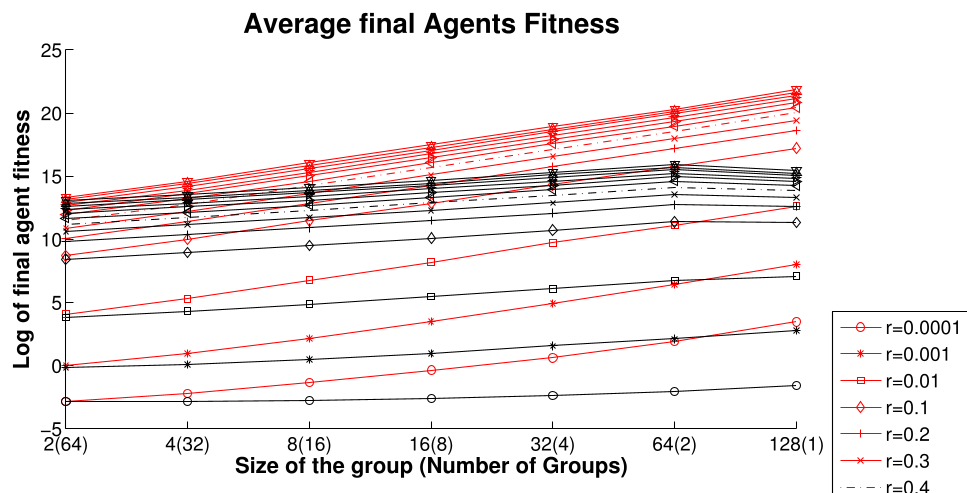 Figure: Log-scale results showing that Recipe B (red) consistently outperforms Recipe A (black) in both Agent Fitness and Collective Knowledge accumulation.
Critical Analysis: Is "Selfishness" the Solution?
The irony of the "Selfish Vaccine" is that by introducing a layer of exclusion (which feels "selfish"), the system creates a more robust foundation for "altruistic" cooperation.
Key Takeaways for Crowdsourcing:
- Access Constraints are Necessary: Purely open systems are biologically and psychologically predisposed to social loafing.
- Reputation Systems as Gated Walls: To implement Recipe B in the real world, platforms should use reputation scores to grant access to premium resources. For instance, a research platform might allow full-paper access only to those who provide quality peer reviews.
Limitations: The authors acknowledge that this model is an exploratory simulation and lacks the heavy mathematics of formal Game Theory (e.g., Nash Equilibria). Real-world implementation is also "non-trivial"—the cost of tracking everyone's contribution (the "monitoring cost") could potentially outweigh the gains of Recipe B if not designed efficiently.
Conclusion
This paper serves as a wake-up call for the "open everything" movement. If we want to solve truly complex, "high-R" simplicity problems using global crowds, we must design systems that protect cooperators from the parasitic nature of free-riders. The future of collective intelligence may not be an open door, but a carefully guarded gate.