
Social Network Search: Bridging the Semantic Gap with Deep Learning and Spatio-Temporal Fusion
Social network search based on semantic analysis and learning
This review article presents a comprehensive framework for social network search (SNS) integrating semantic analysis and deep learning. It categorizes the SNS landscape into four core dimensions: spatio-temporal data acquisition, cross-modal semantic modeling, deep mapping learning between heterogeneous media, and optimized indexing/ranking mechanisms.
TL;DR
The explosion of multi-modal social media data (Twitter, Weibo, Instagram) has rendered traditional keyword-based search obsolete. This article reviews a sophisticated framework that leverages Deep Semantic Learning and Multi-modal Modeling to synthesize text, images, and spatio-temporal metadata into a unified search experience. By bridging the "Semantic Gap," researchers are moving toward a future where search engines understand not just what was typed, but the context, emotion, and visual narrative behind every post.
The "Big & Fast" Data Dilemma
Social network search (SNS) faces a unique "triple threat":
- Content Sparsity: Tweets and micro-blogs are too short for traditional NLPs to extract robust features.
- Heterogeneity: A single "event" is distributed across text, images, and videos, often with no explicit link between them.
- Spatio-Temporal Volatility: Information in social networks is highly localized and time-sensitive; a search result relevant five minutes ago might be obsolete now.
Existing SOTA methods before the deep learning revolution struggled to reconcile these dimensions, leading to noisy and irrelevant search results.
Methodology: The Core Framework
The researchers propose a four-tier architecture to solve these problems.
1. Multi-modal Representation
To represent short text, the framework moves beyond Bag-of-Words to Word Embryology/Word2Vec and Biterm Topic Models (BTM), which handle document-level sparsity by analyzing global word co-occurrences. For images, the shift from manual SIFT features to Deep Convolutional Neural Networks (CNNs) like VGG-Net and AlexNet has become the industry standard.
2. The Shared Semantic Space
The "holy grail" of SNS is the Mapping Relationship. How do you compare an image of a protest to a tweet mentioning "justice"? The framework utilizes:
- Corr-LDA: Mapping images and text into a shared topic distribution.
- Deep Fragment Embeddings: Aligning specific image segments with specific text fragments to learn local and global similarities.
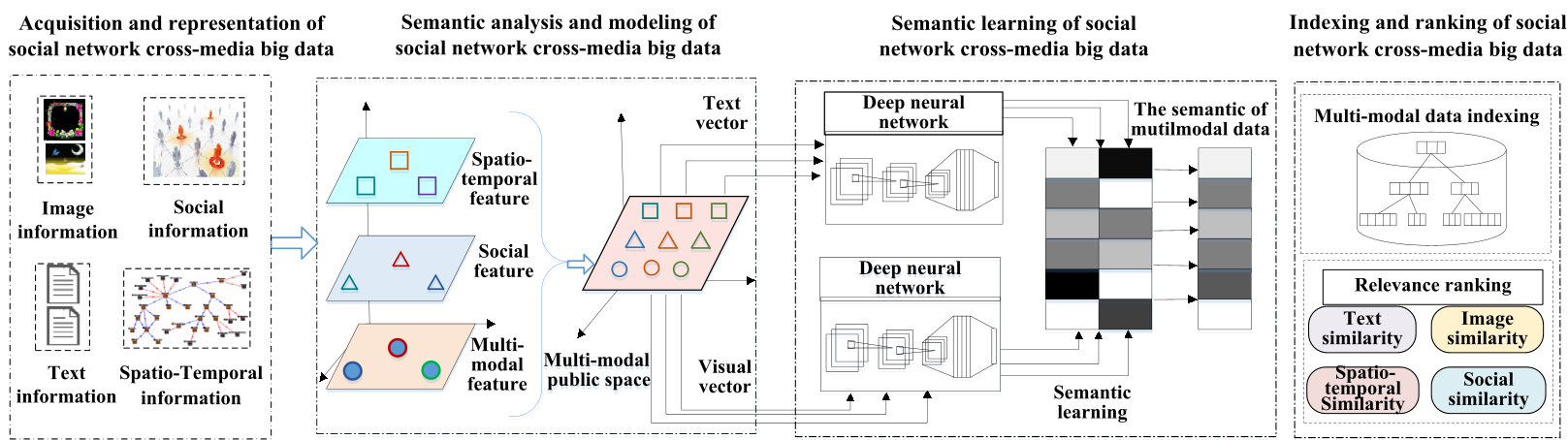 Note: The overall framework integrates data acquisition, semantic modeling, deep mapping, and indexing.
3. Spatio-Temporal and Social Context
What sets social search apart is the Contextual Metadata.
- Time & Location: Modeled as Beta distributions or discrete slices, these features allow the engine to prioritize "Now and Here."
- Social Graphs: Using algorithms like DeepWalk, the framework treats users and posts as nodes in a graph, learning latent representations of social influence.
Experiments & Engineering Realities
A search engine is only as good as its speed. The paper discusses the transition from disk-based Hadoop systems to Main-memory flushing strategies (kFlushing). By keeping high-relevance data in RAM and flushing "cold" data to disk, real-time performance is maintained even under heavy loads.
Furthermore, Cross-modal Huffman Coding (Hashing) is identified as a critical technique for reducing the dimensionality of deep features, allowing for lightning-fast similarity comparisons across billions of images.
Critical Insight & The Path Forward
While the paper outlines a robust foundation, several challenges remain:
- Sentiment Granularity: Most systems still categorize emotions into a simple "Positive/Negative/Neutral" triad. Real-world search requires a more "meticulous" understanding of irony, sarcasm, and nuanced public sentiment.
- Multi-scale Scene Recognition: Images of the same event taken from different angles or distances (multi-scale) still pose a significant challenge for objective scene recognition.
Takeaway
The evolution of SNS is moving toward Unsupervised Multi-source Fusion. The future of search is not a query box—it is a semantic engine that can take an image of a current event and instantly retrieve its history, its social impact, and its geographical trajectory by navigating a multi-dimensional latent space.
References:
- Kou, F., Du, J., et al. (2016). Social network search based on semantic analysis and learning. Chongqing University of Technology.