
Semantic Analytics: Unmasking Hidden Conflicts of Interest via Social Networks
Semantic Analytics on Social Networks: Experiences in Addressing the Problem of Conflict of Interest Detection
The paper presents a Semantic Web application for automated Conflict of Interest (COI) detection in scientific peer review. By integrating FOAF (social) and DBLP (collaboration) networks into a populated ontology, the system discovers "semantic associations" to quantify relationship strengths between reviewers and authors.
TL;DR
This seminal paper introduces a Semantic Web framework to solve a perennial problem in academia: Conflict of Interest (COI). By fusing structured DBLP co-authorship data with semi-structured FOAF social networks, the researchers developed a system that goes beyond simple "same-company" checks to uncover deep, multi-hop relationships that could bias the peer-review process.
Contextual Positioning
Published in 2006, this work sits at the intersection of early Semantic Web engineering and Social Network Analysis (SNA). While contemporary systems were static, this paper pioneered the use of ontologies to provide a "reasoning" layer over raw data, shifting the focus from simple data retrieval to complex relationship analytics.
The Problem: The Invisibility of "Friend-of-a-Friend"
Manual COI detection is inherently flawed. A Program Committee (PC) Chair cannot possibly know if a reviewer and an author shared a PhD advisor ten years ago or if they are connected through a tight-knit "hidden" social circle.
Existing tools at the time (like Confious or CMT) were limited to:
- Direct Co-authorship: Only checking if A and B wrote a paper together.
- Email Suffixes: Checking if A and B are both at
@stanford.edu.
The authors identified that the real challenge lies in Entity Disambiguation—knowing that "R. Guha" and "Ramanathan V. Guha" are the same person—and Indirect Associations (the "common intermediary" problem).
Methodology: The Semantic Pipeline
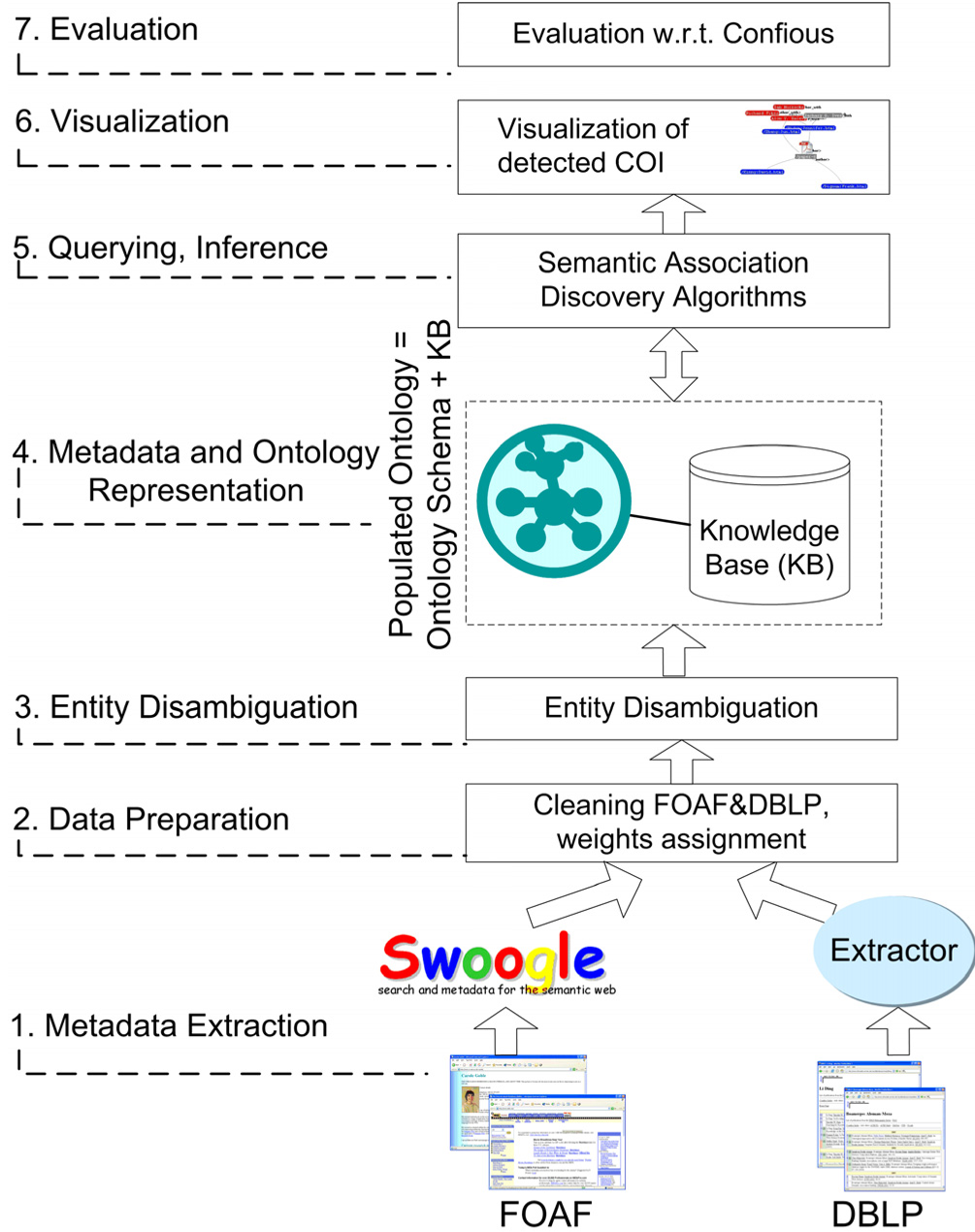
The authors proposed a multi-step engineering process that serves as a blueprint for Semantic Web applications:
1. Data Fusion & Entity Disambiguation
The system merges FOAF (personal profiles) and DBLP (scientific records). To solve the "name mess," they adapted a name-reconciliation algorithm that uses context (co-authors, affiliations) rather than just string matching.
2. Relationship Weighting
Not all relationships are equal. The authors introduced an asymmetric weighting formula for co-authorship: If author has written 50% of their papers with , the "bias" weight is high (0.5). If has written 100 papers and only 1 with , the reciprocal weight is low (0.01).
3. Discovery of Semantic Associations
The system searches for paths (up to length 3) between entities. For example:
- High Level: Direct co-authorship ().
- Medium Level: Common intermediary (), such as sharing a student or advisor.
- Low Level: Distant ties ().
Experiments: Validating Bias
Testing on the WWW 2004 Semantic Web Track, the system revealed complex conflict webs.
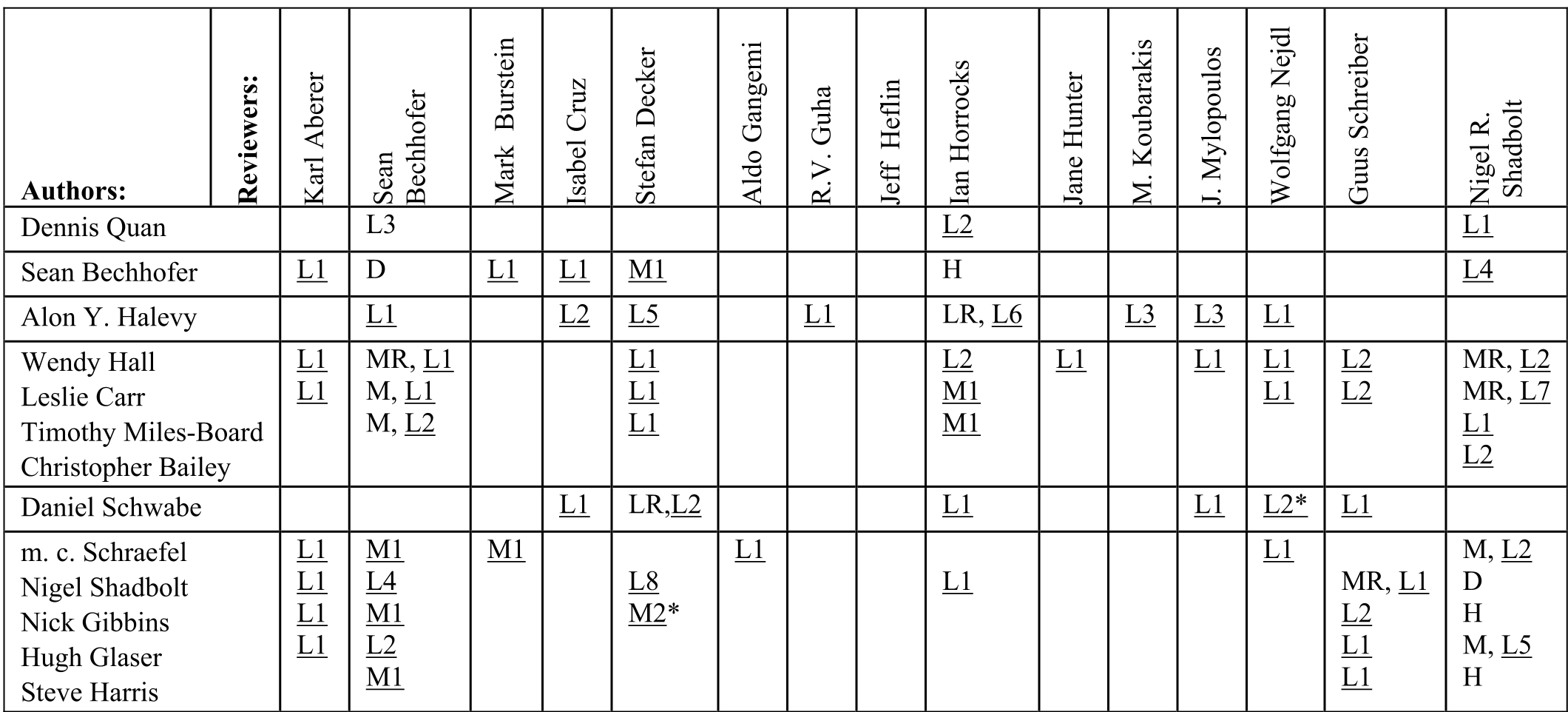
The results (annotated with , , ) showed that the system could catch nuances like "occasional co-authorship" or "common collaborators" that would otherwise be ignored. Crucially, the system provides justification—it doesn't just say "Conflict," it shows the graph path of why it thinks so.
Critical Insight: Why This Matters
The brilliance of this paper isn't just in the COI detection; it's in the acknowledgement of Data Quality. The authors admit that "altering weights and thresholds alone did not improve results" as much as cleaning the data and resolving entities did.
Limitations
- Data Recency: The system is only as good as its last "crawl."
- Subjectivity: A "Medium" conflict for one PC Chair might be "Low" for another.
- Privacy: Relying on FOAF files (which have since largely disappeared from the web) is a vulnerability.
Conclusion
This paper proved that "Connecting the Dots" is a semantic problem. While the specific technologies (RDF/FOAF) have evolved into modern Knowledge Graphs and Vector Databases, the core logic—that relationship context defines reality—remains the gold standard for fraud detection, regulatory compliance, and academic integrity today.