
SAP: Decoding the Soul of Places via User Behavior Patterns
On the semantic annotation of places in location-based social networks
The paper introduces SAP (Semantic Annotation of Places), a multi-label classification framework designed to automatically assign category tags to Points of Interest (POIs) in Location-Based Social Networks (LBSNs). By leveraging user check-in behaviors, it combines Explicit Patterns (EP) of individual places with Implicit Relatedness (IR) derived from a novel Network of Related Places (NRP) to achieve SOTA-level annotation accuracy.
TL;DR
How do you know if a coordinate on a map is a trendy bar or a quiet library if no one wrote a description? This paper proposes SAP (Semantic Annotation of Places), a system that "reads" the category of a place by analyzing who visits it and when. By combining individual check-in statistics with a "Network of Related Places," SAP accurately predicts multiple tags for unlabeled locations.
Context: The Invisible Map
In Location-Based Social Networks (LBSNs) like Foursquare or Yelp, semantic tags (e.g., "Nightlife," "Food") are the lifeblood of recommendation engines. However, millions of POIs remain unannotated. Traditional NLP-based tagging fails when text is missing. The authors' insight is profound: Human behavior is a signature. People don't visit hospitals at 2 AM on a Saturday, but they do visit bars.
Methodology: The Dual-Engine Approach
1. Explicit Patterns (EP) - The "Digital Pulse"
The system first analyzes the place in isolation. It extracts five core features:
- Population Features: Total check-ins, unique visitors, and loyalty (max visits by one person).
- Temporal Features: The "Pulse" of the place across 24 hours and 7 days.
For instance, a "College Campus" shows high weekday activity, while a "Bar" spikes on weekends.
2. Implicit Relatedness (IR) - The "Social Network of Places"
This is the paper's most innovative contribution. The authors argue that if User A often visits Place X and Place Y, those places likely share semantic traits.
They build a Network of Related Places (NRP) using:
- Random Walk and Restart (RWR): To measure similarity between places based on shared users and shared check-in times.
- Relaxation Labeling: A recursive probability update that lets a place "inherit" the likely tags of its neighbors in the network.
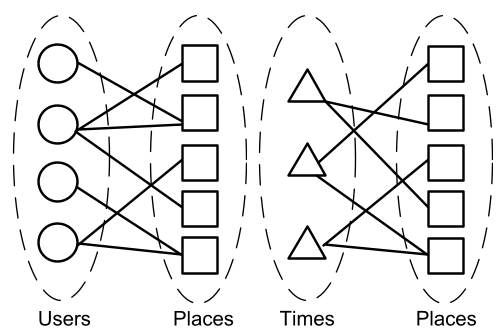 Above: The User-Place (UP) and Temporal-Place (TP) bipartite graphs used to construct the NRP.
Experiments and Results
Testing on the Whrrl dataset, the researchers analyzed 53,432 places. They used binary SVMs for each tag to handle the multi-label nature of places (e.g., a venue can be both a "Restaurant" and a "Bar").
Key Findings:
- EP vs. IR: EP features are dominant for "Restaurants" and "Nightlife" because social norms (lunchtime, party nights) are universal.
- The Shopping Exception: "Shopping" behavior is highly individual. Here, IR (behavioral similarity) outperformed EP, as the network effectively linked users with specific shopping routines.
- Smoothing Time: By treating time as continuous (allowing check-ins at 13:55 to influence the 14:00 slot), the model's accuracy improved further.
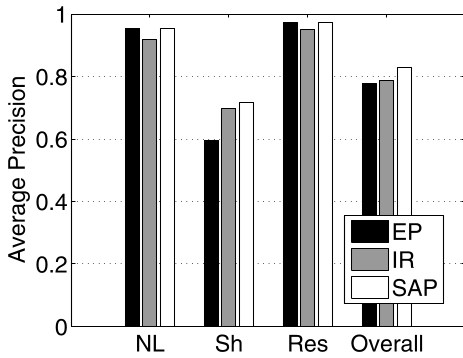 Above: Comparison of Hamming Loss across different categories, showing the superior performance of the combined SAP approach.
Critical Insight & Future Outlook
The beauty of SAP lies in its ability to bridge the gap between individual statistics and relational structures. While modern methods might replace the SVM with a Graph Convolutional Network (GCN), the fundamental feature engineering described here—capturing the rhythm of urban life—remains a cornerstone of spatial data science.
Limitations: The model assumes users have a certain level of activity (entropy < 0.5 was used for evaluation). It might struggle with highly unique venues or very sparse data regions.
Conclusion: This work proves that the "semantics" of a place are defined not just by its physical walls, but by the collective heartbeat of the people who inhabit it.