
SAMOnto: Harnessing Collective Intelligence via Semantic Argumentation
A semantic argumentation approach to collaborative ontology engineering
This paper introduces SAMOnto, a collaborative ontology engineering framework based on the Semantic Argumentation Model (SAM). It enables a community of experts and users to systematically deliberate on ontology design through structured "Issues," "Positions," and "Arguments," ultimately driving consensus using quantitative acceptance measures.
TL;DR
Building a shared "worldview" (ontology) for AI systems is notoriously difficult when experts disagree. SAMOnto solves this by turning ontology engineering into a structured debate. By quantifying the quality of arguments, the reliability of sources, and the "soft consensus" of a group, the system mathematically arrives at the best possible version of an ontology.
Academic Positioning: This work bridges the gap between Argumentation Theory (IBIS) and Semantic Web engineering, moving beyond simple Wiki-style editing toward a rigorous, measurement-driven deliberation process.
Problem: The "Edit War" of Knowledge Engineering
When multiple domain experts try to define a field (e.g., "What constitutes student performance?"), they often clash.
- Centralized Bottlenecks: Small teams missed perspectives.
- Decentralized Chaos: Tools like Wikipedia lead to "edit wars" where the most persistent, not the most correct, win.
- Lack of Metrics: There is rarely a formal way to calculate if a proposed concept is actually "good" or just "popular."
Methodology: The SAM Framework
The authors propose the Semantic Argumentation Model (SAM), which breaks down deliberation into a logical flow: Issue → Position → Argument → Consensus.
1. The Quality Equation
Unlike systems that treat all "likes" or "votes" equally, SAM calculates a Content Quality () score.
- Textual Quality: Misspellings, grammar, and Flesch readability.
- Ontology Quality (OntoQA): Evaluates relationship diversity and schema deepness.
- Backing Reliability: Uses PageRank to score external links and weights for pre-defined user requirements.
2. Systematic Rebuttals
An argument's strength () is not static. If a rebuttal is launched against it, the argument’s weight is deducted. This creates a "survival of the fittest" environment for ideas.
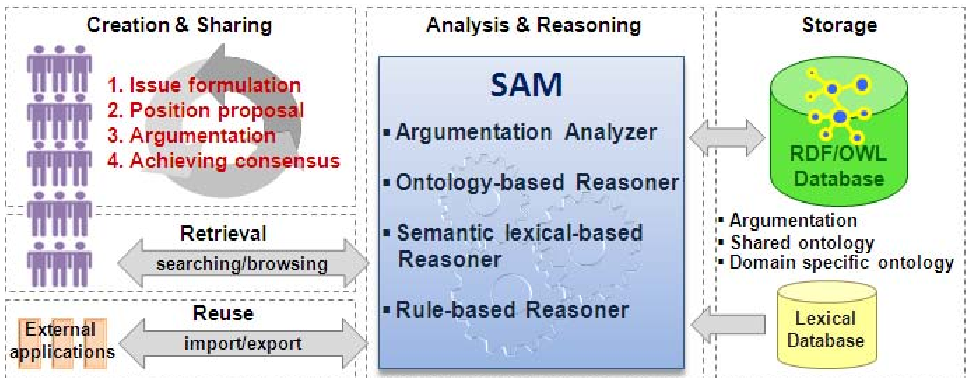 Figure 1: The architecture of SAM, demonstrating the loop from creation to reasoning and reuse.
Experiments: Modeling E-Learning
The team tested SAMOnto by tasking nine participants (engineers, experts, and users) with creating an E-learning ontology.
The "Learner Performance" Conflict
Three competing positions were proposed for recording learner data.
- Position p2 had the highest structural quality (1.0).
- Position p3 had slightly lower structural quality (0.96) but much higher community support.
Using the Ordered Weight Averaging (OWA) operator, the system calculated the Degree of Position (). Even though p2 was technically "cleaner," p3 was integrated into the final collective ontology because it better satisfied the community's functional requirements and survived the most rigorous argumentation.
 Figure 2: Preference matrix showing how individual preferences (i1-i9) aggregate into a Group Preference ().
Critical Insight: Expertise is Earned
One of the most profound features of SAM is the Expertise Analysis. A user’s "Expertise Degree" is not fixed; it rises based on:
- Accuracy: Do they propose positions that eventually reach consensus?
- Contribution: How active are they in the deliberation?
This creates a meritocratic loop where the opinions of "proven" experts carry more weight in future debates.
Conclusion & Future Outlook
SAMOnto successfully demonstrates that Consensus is a Calculation, not just a meeting. While the 2009 tech stack (Sesame, RDF/OWL) has evolved, the core logic of using "Soft Consensus" (threshold-based agreement) remains vital for modern Decentralized Autonomous Organizations (DAOs) and collaborative AI training.
Limitations: The system still necessitates manual entry of arguments. A future extension involving LLMs to automatically generate rebuttals or summarize deliberation maps would significantly lower the barrier to entry for non-technical users.